2D perovskite thin films boost sensitivity 100-fold compared to conventional detectors, require no outside power source, and enable low-dose dental and medical images
Credit: Los Alamos National Laboratory
A new X-ray detector prototype is on the brink of revolutionizing medical imaging, with dramatic reduction in radiation exposure and the associated health risks, while also boosting resolution in security scanners and research applications, thanks to a collaboration between Los Alamos National Laboratory and Argonne National Laboratory researchers.
“The perovskite material at the heart of our detector prototype can be produced with low-cost fabrication techniques,” said Hsinhan (Dave) Tsai, an Oppenheimer Postdoctoral fellow at Los Alamos National Laboratory. “The result is a cost-effective, highly sensitive, and self-powered detector that could radically improve existing X-ray detectors, and potentially lead to a host of unforeseen applications.”
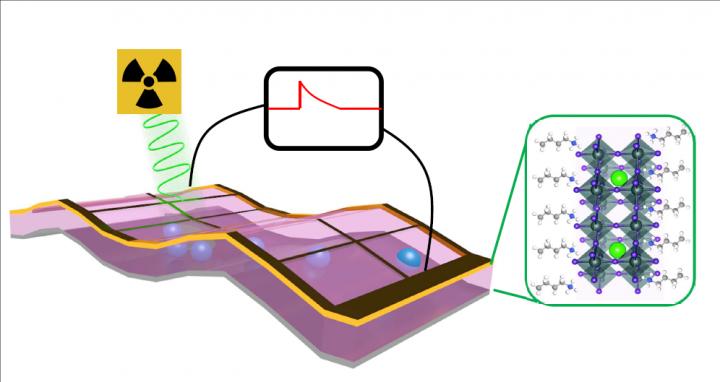
The detector replaces silicon-based technology with a structure built around a thin film of the mineral perovskite, resulting in a hundred times more sensitivity than conventional silicon-based detectors. In addition, the new perovskite detector does not require an outside power source to produce electrical signals in response to X-rays.
High sensitivity perovskite detectors could enable dental and medical images that require a tiny fraction of the exposure that accompanies conventional X-ray imaging. Reduced exposure decreases risks for patients and medical staff alike. The fact that perovskite detectors can be made very thin allows them to offer increased resolution for highly detailed images, which will lead to improved medical evaluations and diagnoses. Lower-energy and increased-resolution detectors could also revolutionize security scanners and imaging in X-ray research applications.
Because perovskite is rich in heavy elements, such as lead and iodine, X-rays that easily pass through silicon undetected are more readily absorbed, and detected, in perovskite. As a result, perovskite significantly outperforms silicon, particularly at detecting high-energy X-rays. This is a crucial advantage when it comes to monitoring X-rays at high-energy research facilities, such as synchrotron light sources.
Perovskite films can be deposited on surfaces by spraying solutions that cure and leave thin layers of the material behind As a result, the thin-layer detectors will be much easier and cheaper to produce than silicon-based detectors, which require high-temperature metal deposition under vacuum conditions.
“Potentially, we could use ink-jet types of systems to print large scale detectors,” said Tsai. “This would allow us to replace half-million-dollar silicon detector arrays with inexpensive, higher-resolution perovskite alternatives.”
In addition to the promise of thin-layer perovskites in X-ray detectors, thicker layers work well provided they include a small voltage source. This suggests that their useful energy range could be extended beyond X-rays to low-energy gamma-rays.
###
The new prototype was fabricated and tested successfully thanks to a collaborative effort among Los Alamos National Laboratory material scientists led by Wanyi Nie and Hsinhan Tsai, and the Los Alamos Theory team led by Sergei Tretiak, in conjunction with Joseph Strzalka at Argonne National Laboratory’s X-ray Science Division.
About Los Alamos National Laboratory
Los Alamos National Laboratory, a multidisciplinary research institution engaged in strategic science on behalf of national security, is operated by Triad, a public service oriented, national security science organization equally owned by its three founding members: Battelle Memorial Institute (Battelle), the Texas A&M University System (TAMUS), and the Regents of the University of California (UC) for the Department of Energy’s National Nuclear Security Administration.
Los Alamos enhances national security by ensuring the safety and reliability of the U.S. nuclear stockpile, developing technologies to reduce threats from weapons of mass destruction, and solving problems related to energy, environment, infrastructure, health, and global security concerns.
Media Contact
James Riordon
[email protected]