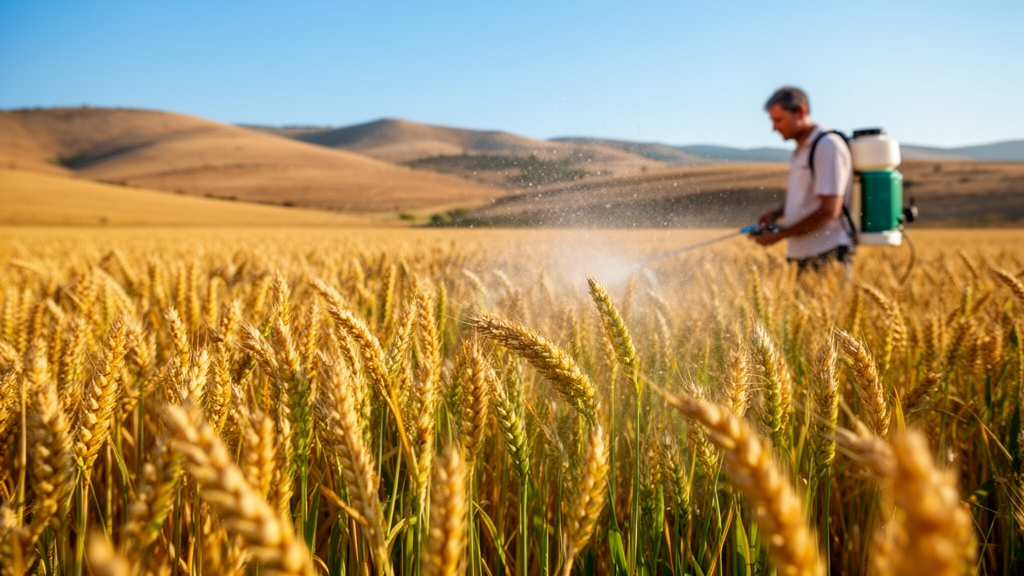
Durum wheat, the grain behind pasta, couscous and bulgur, faces a double squeeze in the Mediterranean: climate-driven abiotic stress is eroding grain quality even as consumers demand more nutritious and safer food. A two-year field experiment in southern Italy now reports that two low-input agronomic tools, organic foliar fertilization and selenium biofortification, can act on both fronts at once.
The study, published in Agriculture & Food Security, drew on field trials conducted in 2018 and 2019 at Foggia, in southern Italy, under rainfed conditions. The researchers grew two modern Italian durum wheat cultivars, Marco Aurelio and Nadif, alongside two old ones, Cappelli and old Saragolla. Four organic foliar fertilization treatments were compared against a control fertilized with dry blood meal at seeding: sulfur alone applied at the flag leaf sheath opening stage, nitrogen alone applied at the beginning of heading, and a combined nitrogen plus sulfur regime. Selenium biofortification was layered on top as a separate factor, with one application of sodium selenate at the booting stage. The design was a split-split-plot randomized complete block layout with three replicates, giving 96 experimental units per year.
Weather separated the two seasons sharply. Total seasonal rainfall fell from 401 millimeters in 2018 to 299 millimeters in 2019, and during grain filling the drop was starker still: 203 millimeters in 2018 against only 99 millimeters in 2019, a 51 percent reduction. Mean daily maximum temperatures during grain filling were 28.8 degrees Celsius in 2018 and 24.5 degrees Celsius in 2019, yet 2019 recorded more days above 35 degrees. Given the soil’s estimated plant-available water capacity of about 118 millimeters in the top 50 centimeters, the researchers judged that the 2019 precipitation deficit likely induced moderate water stress during grain filling, consistent with observed shortening of the grain-filling period.
Gluten proteins determine whether semolina can be worked into good pasta, and the team dissected them with size-exclusion chromatography. Glutenin polymers are held together mainly by intermolecular disulfide bonds; smaller polymers stay soluble in sodium dodecyl sulfate, while the largest, most cross-linked aggregates resist solubilization and are measured as unextractable polymeric protein, or UPP. Water stress left a clear genetic fingerprint. Marco Aurelio, a modern cultivar with a shorter cycle that completed grain filling more rapidly, maintained high UPP and gluten index values in both years and showed the largest increase in soluble large polymers in the dry season, about 28 percent more than in 2018.
The multivariate analysis reinforced this picture. Principal component analysis identified a first component explaining 45.2 percent of variance, interpreted as polymerization capacity and associated with soluble large polymers, the total polymeric protein fraction, and grain sulfur and zinc concentrations. A second component explaining 26.9 percent was read as aggregation potential, tied to insoluble large polymers, UPP, gluten index and grain iron. Year correlated strongly with the first component and cultivar with the second. Clustering placed the wetter year’s samples in a group with the lowest polymeric protein, soluble large polymers and grain sulfur and zinc, while a third cluster dominated by Marco Aurelio combined high polymerization with high aggregation, suggesting this genotype can support both processes simultaneously under stress.
Sulfur emerged as a key lever on protein structure, but with a caveat. In the wetter 2018 season, the organic sulfur spray significantly increased soluble large polymers relative to the control, yet reduced insoluble large polymers and UPP, indicating that sulfur-driven disulfide bonds promoted glutenin polymerization without assembling the largest aggregates, which also require non-covalent stabilization among glutamine-rich domains. The combined nitrogen plus sulfur treatment produced the highest UPP values that year. In the drier 2019 season, the combined treatment significantly lowered soluble large polymers relative to the control, possibly because drought redirected sulfur toward stress-protective compounds such as glutathione. The abstract reports that in the wetter year organic sulfur fertilization raised protein polymerization by 11 percent and the gluten index by 14 percent over the control.
The mineral results carried direct nutritional weight. Selenium sprays predictably raised grain selenium in both years, but in the drier year they also significantly increased grain iron by 2.8 milligrams per kilogram and zinc by 1.2 milligrams per kilogram, with no effect detected in 2018. The authors attribute this to bypassing soil competition for uptake, an advantage that appears especially valuable under water stress. Notably, foliar sulfur treatments reduced grain selenium concentrations, consistent with competitive inhibition between the chemically similar elements, whereas selenium application did not depress grain sulfur. Grain nitrogen was higher in the wetter year across all cultivars, while grain sulfur and zinc were significantly higher in the drier one.
Food safety findings may prove the most consequential. The sulfur spray also lowered all detected mycotoxins, with reductions between 11 percent for deoxynivalenol and 33 percent for total enniatins. The authors link selenium’s action to antioxidant metabolism, noting that inorganic selenium forms have inhibited Fusarium graminearum growth and deoxynivalenol production in vitro, and that selenium is a core constituent of glutathione peroxidase, which scavenges the free radicals that accompany fungal infection.
Correlation analysis added a cautionary thread: deoxynivalenol contamination correlated negatively with insoluble large polymers, UPP and the gluten index, and positively with the monomeric fraction and grain nitrogen and sulfur. In 2018, Fusarium species developing during ripening may have contributed to the weaker formation of large aggregates, since Fusarium graminearum secretes proteases that degrade glutenin polymers. Even so, deoxynivalenol levels stayed below the European Union maximum of 1500 micrograms per kilogram for durum wheat kernels at harvest, and average contamination with the unregulated emerging toxins moniliformin, about 25 micrograms per kilogram, and total enniatins, about 112 micrograms per kilogram, remained low compared with other cereal-growing areas.
The authors conclude that combining foliar organic sulfur, selenium biofortification applied at the appropriate growth stages, and a resilient modern cultivar offers a practical strategy to co-improve the nutritional, technological and safety profile of durum wheat under rainfed Mediterranean conditions. They frame the findings cautiously: the mycotoxin results are limited to two cultivars, two seasons and specific agronomic combinations, and the approach requires validation across more environments and genotypes, particularly for emerging mycotoxins, before it can support broader climate-resilient wheat production.
Subject of Research: Effects of organic foliar fertilization and selenium biofortification on durum wheat grain quality, nutrient concentrations and mycotoxin contamination in Mediterranean farming systems
Article Title: Enhancing durum wheat (Triticum turgidum ssp. durum L.) grain quality and safety: the role of organic foliar fertilization and selenium biofortification in mediterranean farming systems
Article References: Carucci, F., Gatta, G., Blandino, M., Scarpino, V., Moreno-Martín, G., Madrid-Albarrán, Y., & Michela Giuliani, M. (2026). Enhancing durum wheat (Triticum turgidum ssp. durum L.) grain quality and safety: the role of organic foliar fertilization and selenium biofortification in mediterranean farming systems. Agriculture & Food Security, 15(1), Article 40. https://doi.org/10.1186/s40066-026-00629-5
Image Credits: AI Generated
DOI: 10.1186/s40066-026-00629-5
Keywords: durum wheat, selenium biofortification, organic foliar fertilization, gluten protein polymerization, mycotoxins, deoxynivalenol, grain quality, Mediterranean agriculture, water stress, cultivar resilience, food safety, agronomy
News Source: Alan Morgan. (October 30, 2026). Selenium spray boosts durum wheat grain quality and cuts mycotoxins in Mediterranean trials. Scienmag.