Repeated exposure to a widely used anesthetic can quietly erode memory in mice, and a drug already sitting on pharmacy shelves may stop it. In a new study published in Frontiers in Cellular Neuroscience, researchers report that selegiline, an FDA-approved inhibitor of the enzyme monoamine oxidase-B, prevented cognitive deficits and preserved hippocampal function in mice subjected to repeated isoflurane anesthesia.
Postoperative cognitive dysfunction is a familiar concern in medicine, affecting up to 40 percent of elderly patients shortly after surgery, and roughly 10 percent of those patients may experience impairments that persist for months or years. Yet the condition arises from a tangle of factors: anesthetic exposure, surgical trauma, systemic inflammation, perioperative pain, and postoperative stress all contribute. Disentangling the role of anesthesia itself has proven difficult. The Korean research team, led by investigators at Kyung Hee University and Incheon National University, tackled this by designing a mouse model of what they call anesthesia-induced cognitive impairment, in which animals received repeated isoflurane exposure with no surgical intervention at all.
The protocol was straightforward but demanding. Six-week-old male C57BL/6 mice were placed in an induction chamber and given 1.5 percent isoflurane in a carrier gas mixture of oxygen and nitrous oxide for three hours per session. The exposures occurred every other day for a total of five sessions across days zero through eight. Four groups were compared: untreated controls, mice receiving isoflurane alone, mice receiving selegiline alone, and mice given selegiline at 10 milligrams per kilogram by intraperitoneal injection one hour before each anesthetic session. No mortality or gross physical abnormalities appeared in any group during the exposure schedule.
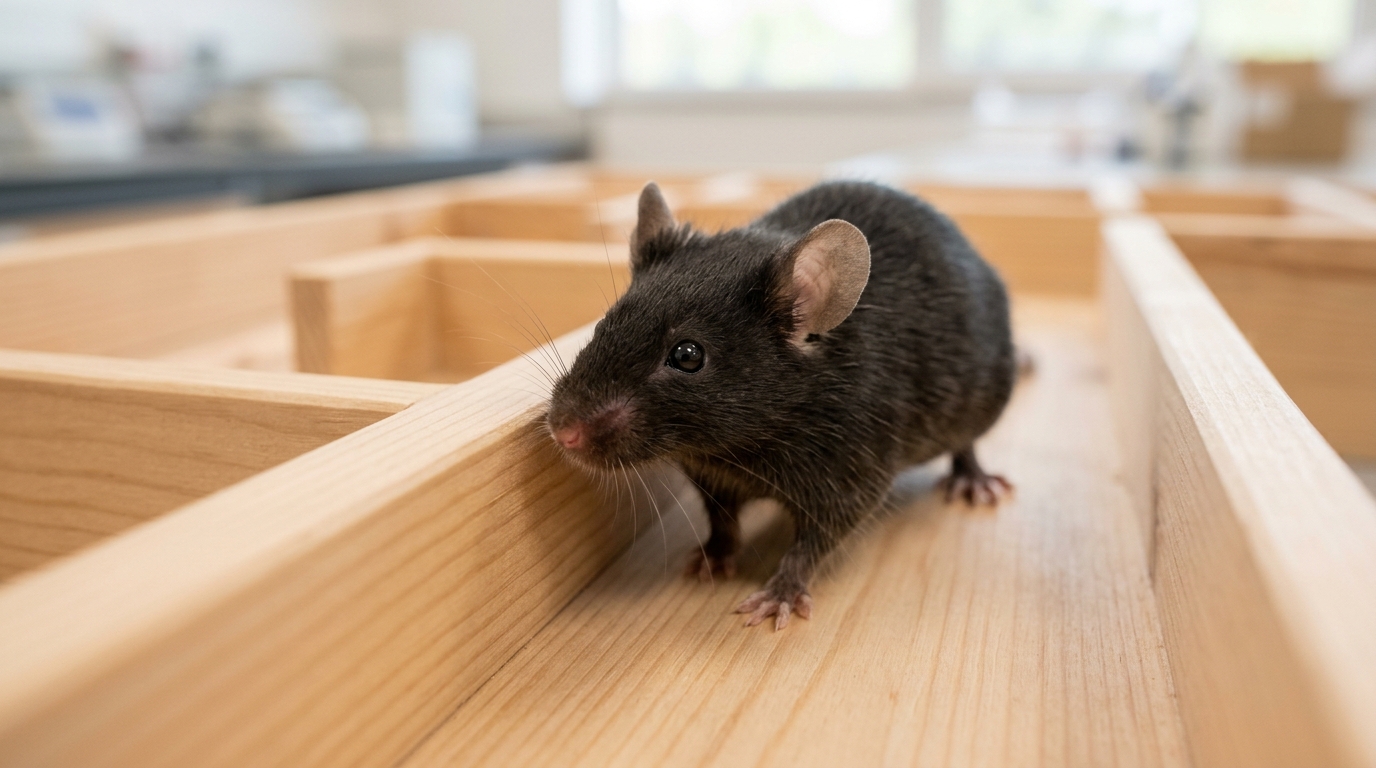
Behavioral testing revealed a consistent pattern of memory damage. In the spontaneous Y-maze alternation test, which measures spatial working memory, the isoflurane-exposed mice showed a significant reduction in spontaneous alternation compared with controls. In the novel object recognition test, which probes recognition memory, the same mice displayed a significantly lower preference for a novel object over a familiar one. Importantly, total arm entries in the maze, total distance moved, and total object exploration time did not differ significantly across groups, suggesting the deficits reflected genuine cognitive impairment rather than changes in locomotion or general exploratory drive. The researchers acknowledge they cannot completely rule out subtle effects of anxiety, arousal, or motivation on performance.
Selegiline pretreatment changed the picture dramatically. Mice that received the drug before each anesthetic exposure performed comparably to untreated controls on both memory tests, maintaining normal spatial alternation and novel object preference. Mice given selegiline without isoflurane also behaved like controls, indicating the drug itself did not disrupt cognition at this dose.
To trace the cellular roots of these behavioral changes, the team turned to electrophysiology. On day 16, well past the acute recovery period, they prepared hippocampal brain slices and recorded field excitatory postsynaptic potentials in the CA1 region while stimulating Schaffer collateral inputs. Long-term potentiation, the strengthening of synaptic connections widely considered a cellular foundation of learning and memory, was induced with high-frequency stimulation at 100 hertz. In slices from isoflurane-exposed mice, LTP induction was significantly impaired, showing reduced fEPSP amplitude during the final five minutes of recording. In slices from mice that had received selegiline pretreatment, LTP magnitude was preserved at levels comparable to controls.
Whole-cell patch-clamp recordings from individual CA1 pyramidal neurons uncovered the intrinsic cellular damage. Neurons from isoflurane-exposed mice fired fewer action potentials in response to depolarizing current injections, a hallmark of hypoexcitability. Single spike waveforms revealed the mechanism in finer detail: the maximum rise rate of the action potential was unchanged, indicating preserved depolarizing kinetics, but the maximum decay rate was significantly reduced, meaning repolarization slowed. These neurons also showed prolonged action potential half-width and markedly reduced afterhyperpolarization amplitude. The authors hypothesize that impaired repolarization and a smaller afterhyperpolarization may reflect reduced function of potassium channels, and that slower recovery could delay the reactivation of voltage-gated sodium channels, predisposing neurons to depolarization block during sustained stimulation. Because specific channel currents were not directly measured, this proposed sequence remains speculative.
Selegiline pretreatment largely reversed these cellular abnormalities. Firing frequency across depolarizing current steps returned close to control levels, and action potential half-width, decay rate, and afterhyperpolarization amplitude were maintained near normal values. Neurons from isoflurane-exposed mice also displayed a hyperpolarized action potential threshold and increased spike amplitude, parameters that moved closer to control values with pretreatment. The drug’s influence extended to synaptic transmission as well. Spontaneous excitatory postsynaptic currents, which reflect the background chatter of excitatory glutamatergic signaling onto these neurons, showed both reduced frequency and reduced amplitude after repeated isoflurane. Selegiline preserved sEPSC frequency near control levels, though the reduction in amplitude was not significantly prevented, indicating the protection was partial at the synaptic level.
The study also delivered a cautionary note about dosing. When selegiline was applied directly to hippocampal slices from control animals, the effects depended sharply on concentration. At 5 micromolar, a concentration chosen because it does not affect basal synaptic transmission, the drug produced only a modest reduction in LTP magnitude. At 100 micromolar, a high concentration previously shown to suppress hippocampal potentiation, selegiline markedly suppressed LTP induction. This concentration-dependent interference with normal synaptic plasticity underscores that more is not necessarily better, and the authors note that the correspondence between the 10 milligram per kilogram in vivo dose and the concentrations tested in slices was not examined.
Mechanistically, the authors propose that selegiline’s primary action as an MAO-B inhibitor may underlie its protective effects. Recent work has shown that MAO-B activity in astrocytes generates both gamma-aminobutyric acid and hydrogen peroxide through the putrescine degradation pathway. Limiting MAO-B activity could reduce GABA output and ease tonic inhibitory pressure on the CA1 network, potentially explaining the preserved sEPSC frequency. Reduced hydrogen peroxide production might also protect redox-sensitive cysteine residues on potassium channels involved in repolarization, offering a candidate explanation for the preserved spike kinetics. However, MAO-B activity, GABA levels, hydrogen peroxide, and channel currents were not directly measured in this study, so these remain hypotheses requiring validation. The limitations are considerable: the paradigm excluded surgical trauma and therefore does not reproduce the full clinical syndrome of perioperative neurocognitive disorders; no single-exposure control group was included; the selegiline-only group was evaluated behaviorally but not electrophysiologically; MAO-A inhibition or other monoaminergic effects at the chosen dose were not confirmed; and the findings involved a single anesthetic agent, isoflurane, and should not be generalized to other inhaled anesthetics or clinical settings. Still, because selegiline is already approved and clinically used as an adjunct therapy for Parkinson’s disease, the results position it as a repositioning candidate warranting further mechanistic and translational study against anesthesia-related cognitive decline.
Subject of Research: Selegiline pretreatment preventing cognitive and hippocampal electrophysiological deficits caused by repeated isoflurane anesthesia in mice
Article Title: Selegiline prevents cognitive impairment and hippocampal CA1 excitability deficits induced by repeated isoflurane exposure
Article References: Choe, J., Jeong, H., Shin, H., You, M., Kim, Y. T., Park, S., Choi, J., Jang, D., Baeg, E., Maeng, S., & Yang, S. (2026). Selegiline prevents cognitive impairment and hippocampal CA1 excitability deficits induced by repeated isoflurane exposure. Frontiers in Cellular Neuroscience, 20, Article 1936103. https://doi.org/10.3389/fncel.2026.1936103
Image Credits: AI Generated
DOI: 10.3389/fncel.2026.1936103
Keywords: selegiline, isoflurane, anesthesia-induced cognitive impairment, postoperative cognitive dysfunction, hippocampus, CA1 pyramidal neurons, long-term potentiation, action potential kinetics, sEPSC, monoamine oxidase-B, neuroprotection, C57BL/6 mice
News Source: Drew Townsend. (November 7, 2026). Selegiline shields mouse memory from repeated anesthesia damage. Scienmag.