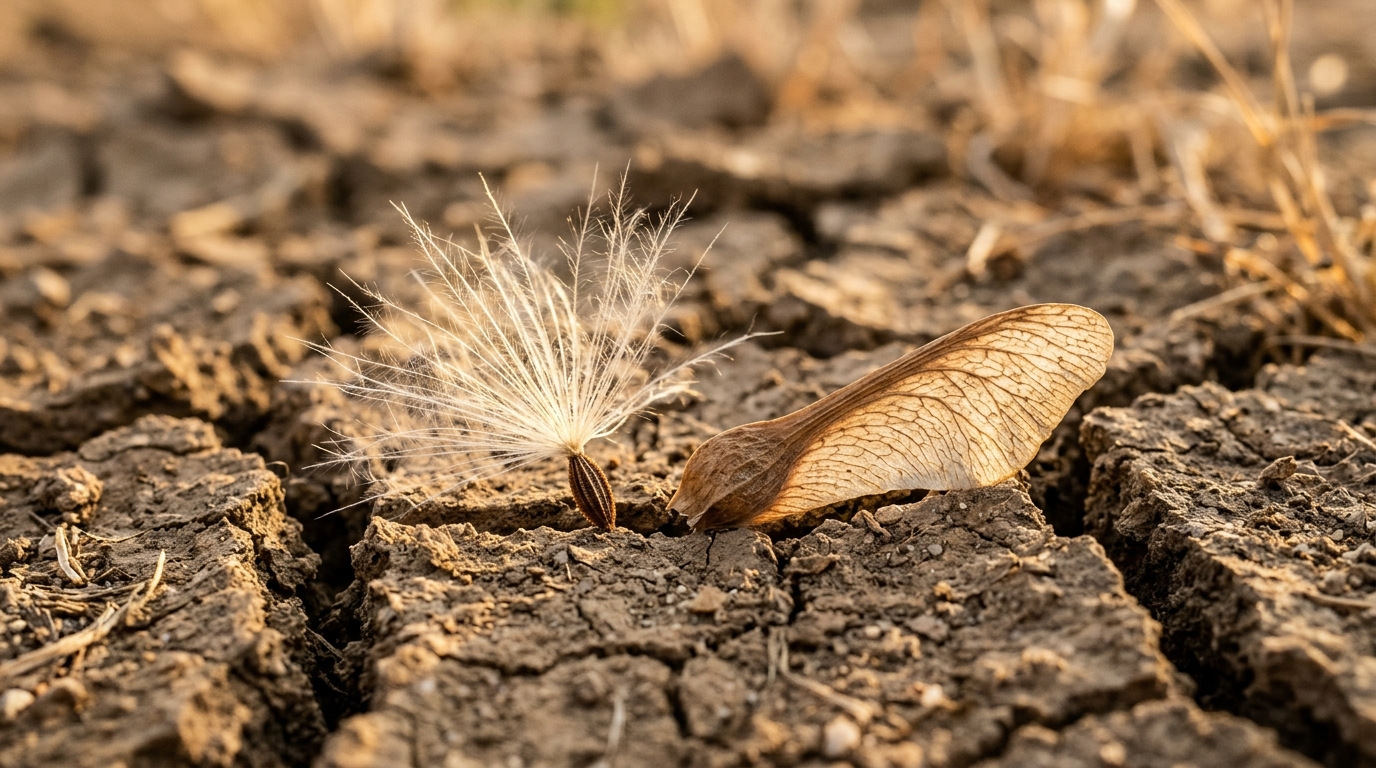
Seed dispersal has long been treated as a fixed life-history trait, but a new narrative review argues that it is instead a moving target under global environmental change. Writing in Frontiers in Systems Biology, a team led by Ioan G Oroian of the University of Agricultural Sciences and Veterinary Medicine of Cluj-Napoca synthesizes evidence on how climate change, habitat fragmentation, biological invasions and defaunation reshape the movement of seeds, and how those movements feed back into the evolution of the plants themselves. The work, received in September 2026 and accepted in October, builds an integrative causal framework connecting environmental drivers to trait variation, selection, propagule movement, establishment and eventual population redistribution.
The review spans all major dispersal modes: anemochory by wind, hydrochory by water, zoochory by animals, autochory by the plant’s own mechanical mechanisms, and anthropochory, the human-mediated transport that the authors flag as a major and underappreciated pathway across disturbed landscapes and geographical barriers.
A central finding is sobering: dispersal can facilitate colonization and local persistence, but it rarely guarantees climate tracking. Realized redistribution depends on landscape permeability, the functional integrity of disperser communities, the directionality of climatic shifts and the availability of suitable recruitment conditions. In other words, a seed that can travel is not the same as a seed that arrives, establishes and thrives.
The review also distinguishes herbaceous from woody plants, noting that generation time, reproductive turnover, seed traits and dependence on animal vectors can dramatically alter the pace and direction of both ecological and evolutionary responses.
Changes in plant–disperser networks, the authors argue, can further modify dispersal effectiveness and selection on plant traits, potentially generating eco-evolutionary feedbacks. As dispersers decline or shift their own ranges, the selective landscape for seed traits changes, which in turn alters dispersal outcomes and the distribution of plant populations. Those redistributed populations then encounter new ecological and selective environments, closing the feedback loop.
Despite the elegance of this framework, the review is candid about the limits of current evidence. Empirical data linking multiple global change drivers to evolutionary changes in dispersal, and to reciprocal plant–disperser responses, remain limited. The authors call for research that connects environmental drivers, plant life history, dispersal vectors, trait evolution, landscape structure and establishment processes in a single predictive framework.
For now, the review stands as a synthesis rather than a definitive empirical demonstration. It maps the terrain where dispersal ecology, evolutionary biology and global change science intersect, and it identifies the feedbacks that could either accelerate or stall plant persistence in a rapidly changing world. The authors conclude that predicting plant persistence and redistribution requires exactly that integrated view, one that treats dispersal not as a background assumption but as a dynamic, evolving and human-influenced process.
Subject of Research: Evolutionary and ecological dynamics of seed dispersal under climate change, fragmentation, invasion and defaunation
Article Title: Evolutionary dynamics of seed dispersal under global change: trait shifts, climate tracking, and plant-disperser reconfiguration
Article References: Oroian, I. G., Muntean, L., Carpa, R., Brejea, R. P., Pandey, P., Maxim, A., Moldovan, B., Bordea, D., Oroian, F. C., & Petrescu-Mag, I. V. (2026). Evolutionary dynamics of seed dispersal under global change: trait shifts, climate tracking, and plant-disperser reconfiguration. Frontiers in Systems Biology, 6, Article 2008605. https://doi.org/10.3389/fsysb.2026.2008605
Image Credits: AI Generated
DOI: 10.3389/fsysb.2026.2008605
Keywords: seed dispersal, climate change, habitat fragmentation, defaunation, biological invasions, anthropochory, zoochory, migration lag, mutualistic networks, phenotypic plasticity, eco-evolutionary feedback, plant range shifts
News Source: Alan Morgan. (November 5, 2026). Seed Dispersal Faces an Evolutionary Reckoning as Global Change Accelerates. Scienmag.