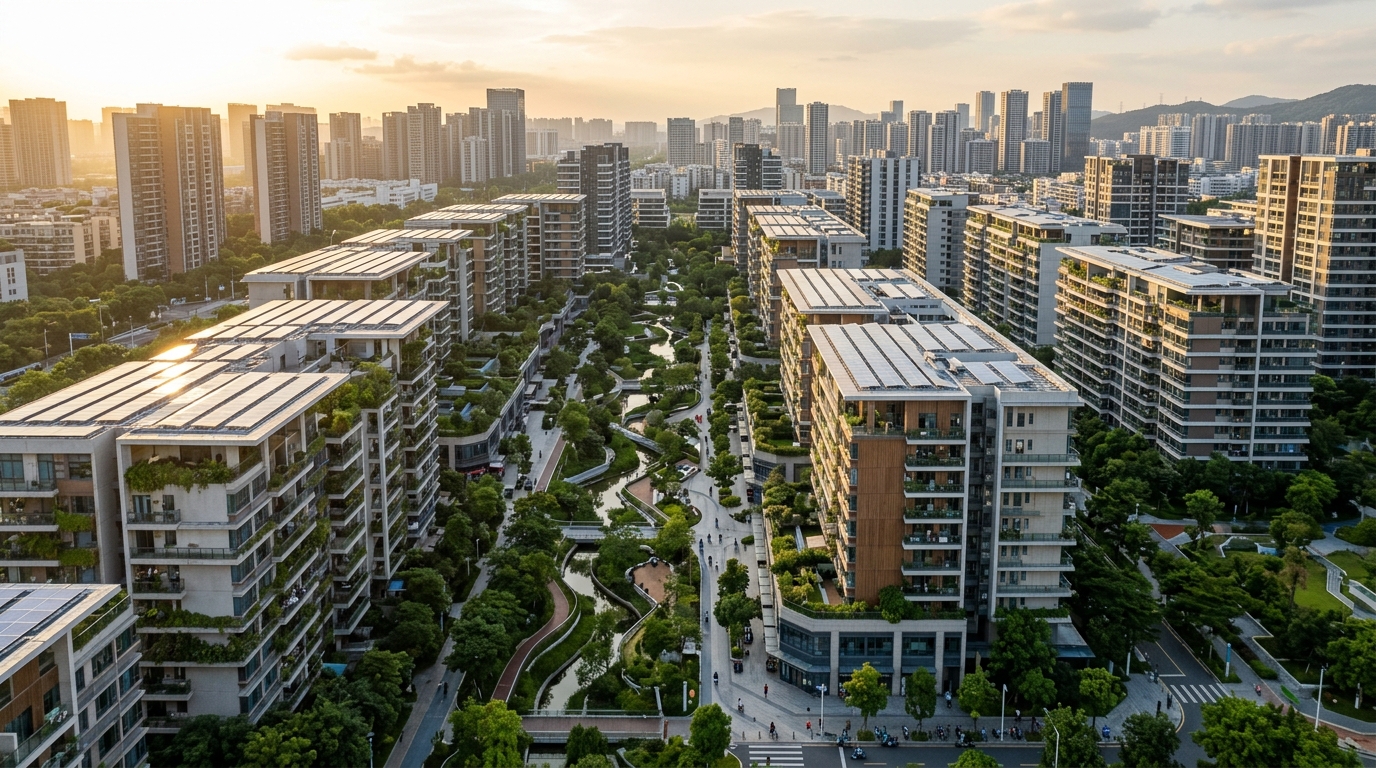
Published in the journal Carbon Neutrality, the study integrates static and dynamic modeling to evaluate emission pathways and carbon budgets at the provincial level. The framework is designed to provide a practical tool for generating robust carbon budget estimates even when data is limited, thereby enhancing its applicability for policy-oriented planning. By focusing on the residential sector, which accounts for over 60% of energy use and nearly half of emissions in the building sector, the study addresses a critical gap in subnational climate planning.
The study employs the Kaya identity to model operational carbon emissions for both urban and rural residential buildings. This identity decomposes emissions into five key factors: population size, urbanization rate, per capita floor area, energy intensity, and comprehensive carbon emission factors. The researchers developed two distinct scenarios to analyze future trends: a business-as-usual scenario and a decarbonization scenario. The business-as-usual scenario assumes that energy intensity follows the baseline trajectory, while the decarbonization scenario assumes a 30% reduction in urban residential energy intensity by 2060 relative to 2020 levels, along with significantly higher electrification rates and larger shares of self-generated energy.
To account for uncertainties in future parameter distributions, the researchers utilized Monte Carlo simulation to transform the static model into a dynamic one. This approach involved assigning standard deviation values to normal distributions for each variable in the emission model. By conducting 100,000 simulations, the study captured the stochastic characteristics of emissions, allowing for a probabilistic assessment of when and at what levels carbon peaks would occur. This dynamic analysis provides a more realistic representation of potential emission pathways compared to deterministic models, which often overlook spatial heterogeneity and dynamic uncertainties.
Under the business-as-usual scenario, the study projects that national urban residential building emissions will peak at 990 mega-tons of carbon dioxide (MtCO2) in 2031, with an uncertainty range of ± 0.7 MtCO2 and ± 4.7 years. Rural residential building emissions are projected to peak earlier, at 450 MtCO2 in 2026, with an uncertainty range of ± 0.2 MtCO2 and ± 2.6 years. These findings indicate that rural residential buildings are expected to reach their carbon peak before 2030, whereas the challenge for urban buildings to do so by the same deadline appears more manageable. The significant difference in peak timing and magnitude highlights the distinct emission characteristics of urban and rural residential sectors.
In the decarbonization scenario, the projected peak emissions decrease substantially. Urban residential building emissions are estimated to peak at 900 MtCO2, representing a reduction of 90 MtCO2 compared to the business-as-usual scenario. The probability of urban residential buildings reaching this peak in 2023 was calculated at 3.386%, with a 0.021% chance of achieving the specific peaking value interval. For rural residential buildings, the peak emissions are estimated at 420 MtCO2, a reduction of 30 MtCO2 from the business-as-usual projection. The probability of rural buildings reaching their peak in 2021 was found to be 0.954%, with a 0.003% chance of achieving the peaking value interval. These results suggest that achieving the 2060 carbon neutrality target requires aggressive decarbonization measures in both urban and rural sectors.
The study also examines the variation in emission peaks across China’s 30 provinces, excluding Taiwan, Hong Kong, Tibet, and Macau due to data unavailability. Under the business-as-usual scenario, there is significant regional disparity in the timing and magnitude of carbon peaks. For urban residential buildings, Shandong is expected to have the highest peak at 110 MtCO2, while Hainan is projected to have the lowest at 2.84 MtCO2. For rural residential buildings, Hebei is projected to have the highest peak at 57.16 MtCO2, while Shanghai has the lowest at 1.15 MtCO2. The peaking years for rural buildings range from 2021 to 2035, with Shanghai and Jiangsu peaking earliest in 2021, and Xinjiang peaking last in 2035.
The analysis of provincial carbon budgets reveals that certain provinces face significantly higher emission reduction requirements than others. The provinces with the highest emission reduction needs are Henan (16.74 MtCO2), Xinjiang (12.59 MtCO2), Gansu (9.87 MtCO2), Hebei (8.46 MtCO2), and Guangdong (3.37 MtCO2). Regionally, Northwest China shoulders the greatest reduction responsibility, totaling 38.14 MtCO2 across its provinces. This finding underscores the need for differentiated policy approaches that account for regional disparities in economic development, climatic conditions, and energy structures. The study emphasizes that a one-size-fits-all approach to carbon budgeting is insufficient for achieving equitable and effective decarbonization.
Further analysis of the decarbonization scenario indicates that achieving national targets requires provinces to advance their carbon peaking times significantly. For urban residential buildings, Xinjiang requires the most substantial acceleration, needing to advance its peaking time by 14 years compared to the business-as-usual scenario. In contrast, Shanghai requires the least advancement, with just a 1-year shift. For rural residential buildings, Xinjiang also requires the earliest advancement, by 9 years, followed by Hainan (8 years) and Jiangxi (7 years). Jiangsu, Beijing, and Heilongjiang require the least advancement, with just 2-year shifts. These findings highlight the varying degrees of difficulty different provinces face in aligning their emission trajectories with national decarbonization goals.
The study proposes an optimized provincial carbon budget assessment scheme based on the principle of maximizing emission reduction potential. This scheme dynamically optimizes the peaking values and peaking years for each province, providing a scientific basis for setting actionable emission targets at the provincial level. The allocation framework involves projecting provincial emissions under a business-as-usual scenario, backcasting a carbon-neutrality-oriented decarbonization scenario from the 2060 net-zero target, and identifying the maximum gap between the two scenarios to capture each province’s reduction potential. This approach ensures consistency with national commitments while incorporating urban–rural heterogeneity and provincial-specific conditions.
The researchers offer several policy recommendations to facilitate the implementation of these carbon budgets. They suggest addressing regional disparities by providing targeted central transfers, concessional green lending, and inter-provincial technology cooperation, particularly for less-developed regions like Northwest China. Tailored provincial strategies are recommended, such as large-scale retrofits in Henan, cold-arid urban pathways in Xinjiang, and dual-track strategies in Hebei. The study also emphasizes the importance of phased implementation, with short-term priorities including pilots in high-potential provinces and deployment of quick-win retrofits, medium-term goals involving scaling up comprehensive retrofits and accelerating electrification, and long-term objectives focusing on the transition to net-zero-ready residential buildings.
Additionally, the study highlights the role of intelligent control technologies and improved energy efficiency in building equipment. It recommends optimizing the operation of major energy-intensive systems, such as air conditioning and lighting, and advocating for the large-scale adoption of high-efficiency HVAC systems, LED lighting, and heat pumps. Strengthening mandatory efficiency labeling standards and restricting low-efficiency appliances from entering the market are also suggested to incentivize manufacturers to transition toward low-carbon product design. Improving subsidy mechanisms, refining energy market pricing, and strengthening green finance are identified as essential measures to enhance the economic viability of low-carbon technologies and promote emission reductions in residential buildings.
The study acknowledges several limitations that warrant further investigation. It focuses solely on estimating operational-phase energy use and associated emissions of residential buildings, excluding full life-cycle emissions. Considering the full life cycle would provide a more comprehensive assessment of the building sector’s carbon footprint. Additionally, the study does not assess decarbonization trends for other building types, such as commercial buildings, which are also crucial for achieving net-zero goals. As buildings progressively decarbonize, incorporating a cost–benefit analysis when implementing decarbonization measures becomes essential to ensure economic feasibility. Future research should address these gaps to provide a more holistic view of the building sector’s contribution to climate change mitigation.
By providing a dynamically optimized carbon budget assessment tool, this study offers valuable insights for government policy-making. It plays a key role in facilitating the low-carbon transition of China’s building sector during the pre-2030 planning period, ultimately contributing to the goal of achieving net-zero emissions in the building sector by mid-century. The integration of static and dynamic modeling, along with the explicit consideration of urban–rural distinctions and provincial heterogeneity, sets a new standard for subnational climate planning. The findings underscore the importance of robust, data-driven approaches in addressing the complex challenges of decarbonizing the residential building sector.
Subject of Research: Provincial carbon budget assessment for residential buildings in China
Article Title: Assessing provincial carbon budgets for residential buildings to advance net-zero ambitions
Article References: Yuan, H., Ma, M., Zhou, N., Ma, Z., & Zhang, C. (2026). Assessing provincial carbon budgets for residential buildings to advance net-zero ambitions. Carbon Neutrality, 5(1), Article 5. https://doi.org/10.1007/s43979-025-00159-2
Image Credits: AI Generated
DOI: 10.1007/s43979-025-00159-2
Keywords: carbon budgets, residential buildings, net-zero emissions, China, emission peaks, Monte Carlo simulation, Kaya identity, decarbonization, provincial planning, energy intensity, Assessing, provincial
News Source: Sloane Callahan. (November 7, 2026). China’s Residential Carbon Budgets Mapped for Net-Zero. Scienmag.