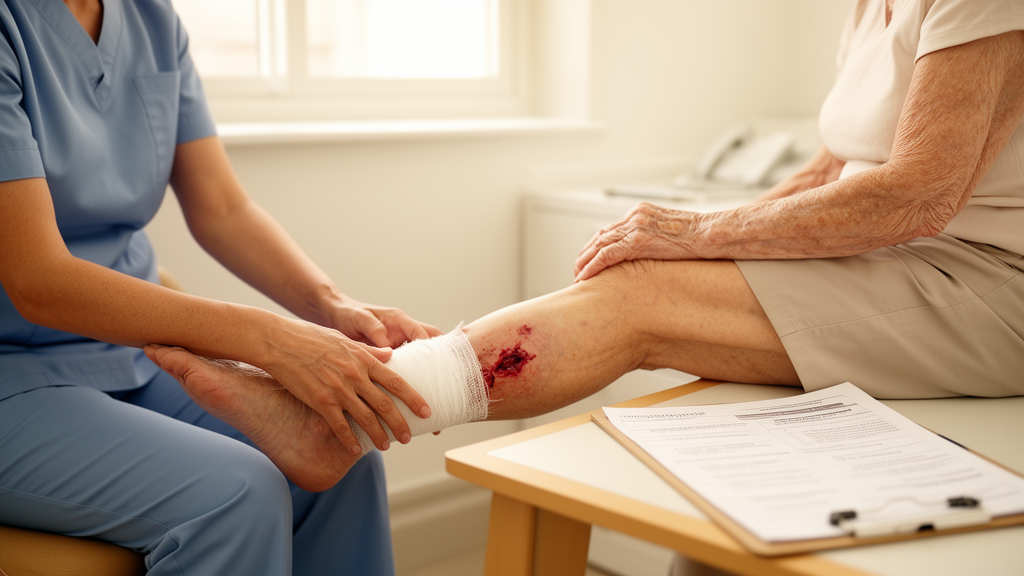
Chronic wounds are among the most stubborn and burdensome conditions in modern healthcare, yet the tools used to measure how patients actually experience them have long remained scattered, inconsistent, and unevenly tested. A new scoping review published in BMC Health Services Research has now mapped the landscape of patient-reported outcome measures, or PROMs, designed for people living with chronic wounds, offering clinicians and researchers a rigorous guide to which instruments can genuinely be trusted. Led by Yujie Wu and colleagues at Tongji Hospital, Tongji Medical College, Huazhong University of Science and Technology, the review systematically identified and evaluated the psychometric properties and content characteristics of self-report instruments intended for chronic wound populations, with the explicit aim of informing day-to-day clinical practice.
The team followed the well-established Arksey and O’Malley framework for scoping reviews and reported their work in accordance with the PRISMA-ScR guidelines, the international standard for transparent reporting of scoping reviews. They conducted a systematic search across five major bibliographic databases: MEDLINE, Web of Science, Embase, CINAHL, and PubMed. This multi-database strategy ensured that studies published across the breadth of medical, nursing, and health services literature were captured, from wound-specific journals to broader quality-of-life research. Original studies that evaluated PROMs used with patients suffering from chronic wounds were eligible for inclusion, and the reviewers extracted detailed data on instrument characteristics, psychometric properties, and the content domains each tool covered.
The scale of the review’s findings is striking precisely because of how few instruments survived systematic scrutiny. In total, eight original patient self-report instruments were included in the final synthesis, a remarkably small number given the global prevalence of chronic wounds such as diabetic foot ulcers, venous leg ulcers, and pressure injuries. These eight instruments divided into two camps: four PROMs developed specifically for chronic wound populations and four that were not wound-specific but had been applied to these patients. This scarcity matters clinically, because outcome measurement is the backbone of evidence-based wound care. Without reliable, valid, and responsive instruments, clinicians cannot track whether a treatment genuinely improves a patient’s quality of life, and trialists cannot compare interventions across studies with confidence.
Psychometrics, the science of measuring the reliability and validity of questionnaires, sits at the heart of the review. Internal consistency, typically assessed using Cronbach’s alpha, reflects how well the items within an instrument’s subscales hang together as measures of a single underlying construct. Encouragingly, all eight instruments included in the review demonstrated good internal consistency, meaning that patients respond to the items in a coherent, predictable pattern rather than randomly. That is a necessary foundation, but it is far from sufficient. A questionnaire can be internally consistent yet still fail to measure what it claims to measure, which is why validity evidence carries so much weight in instrument selection.
Here the review uncovered a significant gap. Most of the instruments had reported evidence for content validity, which examines whether the items comprehensively and relevantly represent the concept being measured, often through patient interviews and expert panels, and for construct validity, which tests whether scores behave in ways predicted by theory, such as correlating with related measures in expected directions. However, few instruments, notably the Wound-QoL and the Chronic Wound Impact Scale, known as CWIS, provided evidence for criterion validity. Criterion validity is arguably the most demanding form of validation: it requires demonstrating that scores on the instrument correlate with a gold-standard or external benchmark of the same construct. The scarcity of criterion validity evidence means that, for most wound PROMs, researchers and clinicians must rely on indirect evidence when interpreting scores, leaving room for uncertainty about what the numbers truly represent.
The content analysis revealed that most of the identified instruments were multidimensional, capturing the physical, psychological, and social domains of living with a chronic wound. This tripartite structure mirrors the World Health Organization’s classic conceptualization of health and reflects a growing recognition in wound care that these conditions affect far more than tissue integrity. Chronic wounds produce persistent pain, odor, and exudate that can erode physical functioning and sleep; they generate anxiety, depression, and shame that burden mental health; and they constrain mobility, work, and social participation that define a patient’s place in the world. An instrument that measures only wound size or healing time would miss the dimensions patients themselves often care about most, which is precisely why PROMs have become central to patient-centered outcome assessment.
Among the eight instruments, two emerged as clear front-runners. The review concluded that the Wound-QoL and the CWIS collectively represent the optimal combination of clinical relevance and psychometric rigor for assessing chronic wounds. The Wound-QoL carries an additional distinction: beyond covering the physical, psychological, and social domains, it uniquely incorporates an economic burden dimension, acknowledging that chronic wound care imposes substantial financial strain through dressing costs, clinic visits, and lost productivity. Its cross-cultural reach is also exceptional, with translations into thirty languages, making it one of the few wound PROMs capable of supporting multinational trials and international comparisons of care quality. For a condition that affects hundreds of millions of people worldwide, that adaptability is no small technical achievement.
The implications for clinical practice are direct and actionable. For clinicians selecting an instrument to embed in wound assessment pathways, the review suggests prioritizing the Wound-QoL or CWIS, depending on whether the broad content coverage and multilingual availability of the former or the psychometric profile of the latter better fits the clinical context. For researchers designing trials of advanced wound therapies, dressings, or digital monitoring systems, the findings provide a defensible basis for instrument choice, which in turn strengthens the comparability and credibility of outcomes across studies. And for instrument developers, the review identifies exactly where the field’s evidence base is thin, most notably in criterion validity, providing a roadmap for future validation work rather than redundant reinvention.
The authors also point toward the digital frontier of wound care. They argue that future research should prioritize validating the criterion validity of existing PROMs and promoting their integration into electronic health and telemedicine applications. This recommendation reflects a broader transformation in chronic disease management: as remote monitoring, smartphone-based assessments, and virtual consultations expand, patient-reported measures are increasingly collected outside the clinic, often at the point of care in the patient’s own home. PROMs validated for paper-based clinical use may not behave identically when administered digitally, so ensuring their measurement properties hold in e-health environments is an urgent methodological priority. Embedding validated PROMs into telemedicine platforms could give clinicians a continuous, patient-centered picture of wound burden between appointments, enabling earlier intervention when a patient’s physical or emotional state deteriorates.
The study, funded by the Tongji Hospital Research Fund of Nursing Project (No. 2024D45), arrives at a moment when health systems worldwide are grappling with the mounting economic and human costs of chronic wounds, particularly as populations age and diabetes prevalence climbs. By distilling a sprawling literature into a concise evaluation of just eight instruments, the review performs a valuable service of clarity: it tells the field which measurement tools have earned their place, which have gaps, and where the next wave of validation research should be aimed. For patients, the ultimate payoff is subtler but no less important, because a well-validated questionnaire is the instrument through which their pain, distress, and daily struggles can finally be counted, compared, and acted upon by the clinicians and scientists who treat them.
Subject of Research: Psychometric evaluation of patient-reported outcome measures for chronic wound populations
Article Title: Patient-reported outcome measures for chronic wound populations: a scoping review of psychometric properties and content characteristics to inform clinical practice
Article References: Wu, Y., Zheng, D., Wu, L., Jiang, M., Xiao, Y., Zhang, P., Xie, L., & Liu, X. (2026). Patient-reported outcome measures for chronic wound populations: a scoping review of psychometric properties and content characteristics to inform clinical practice. BMC Health Services Research. https://doi.org/10.1186/s12913-026-15481-3
Image Credits: AI Generated
DOI: 10.1186/s12913-026-15481-3
Keywords: chronic wounds, patient-reported outcome measures, psychometrics, scoping review, Wound-QoL, CWIS, quality of life, internal consistency, criterion validity, telemedicine, wound care, health services research
News Source: Ophelia Keating. (October 16, 2026). Scoping Review Reveals Which Questionnaires Best Measure Life With Chronic Wounds. Scienmag.