Valproic acid is one of the most widely prescribed antiseizure medications in the world, trusted for decades to control epilepsy and also approved for bipolar disorder and migraine prevention. Yet the drug carries a shadow: in a minority of patients it injures the liver and triggers acute pancreatitis, sometimes with fatal consequences. A new study from researchers at Vellore Institute of Technology in India, published in Frontiers in Pharmacology, reports that an extract of burdock root — Arctium lappa, a plant long used in traditional medicine — can substantially blunt this damage in rats, restoring biochemical balance and tissue architecture that valproic acid otherwise destroys.
The research team, led by Mukul Shyam and Sabina Evan Prince, set out to test whether the hydroalcoholic root extract of A. lappa, abbreviated ALRE, could protect both the liver and the pancreas from valproic acid toxicity. Their motivation was rooted in chemistry: valproic acid is metabolized extensively in the liver through glucuronidation, mitochondrial beta-oxidation, and cytochrome P450-mediated oxidation, generating toxic metabolites such as 4-ene-VPA and 2,4-diene-VPA. These metabolites disrupt mitochondrial fatty acid metabolism, deplete coenzyme A, inhibit carnitine palmitoyl transferase I, and ultimately damage hepatocytes. In the pancreas, the drug depletes antioxidant defenses, driving lipid peroxidation and tissue injury.
To prepare the extract, the researchers used Soxhlet hot continuous extraction, testing methanol, ethanol, acetone, water, and a 50:50 methanol-water mixture. The hydroalcoholic solvent yielded the most material — 12.80 percent by weight — and also extracted the highest levels of phenolics and flavonoids, at 21.36 milligrams of gallic acid equivalents and 19.93 milligrams of quercetin equivalents per gram of dry root, respectively. Gas chromatography–mass spectrometry tentatively identified several volatile constituents, while high-performance liquid chromatography revealed 17 peaks, with the dominant peak at 5.013 minutes accounting for nearly 70 percent of the chromatogram and provisionally identified as arctiin, the signature lignan of burdock.
Antioxidant assays confirmed the extract’s radical-scavenging capacity. In the DPPH assay, the hydroalcoholic extract showed the lowest IC50 value among the tested solvents at 370.70 micrograms per milliliter, close to the benchmark antioxidant butylated hydroxytoluene at 310.11 micrograms per milliliter. In the ABTS assay, the methanolic extract performed best at 370.43 micrograms per milliliter, with the hydroalcoholic extract close behind. These results established the hydroalcoholic preparation as the lead candidate for biological testing.
Safety screening came next. Using the MTT assay, the team measured the extract’s effect on four human cell lines: Hep3B liver cancer cells, PANC-1 pancreatic cancer cells, THLE-2 normal liver epithelial cells, and H6C7 normal pancreatic duct epithelial cells. The extract showed minimal cytotoxicity toward the normal cells, with IC50 values of 1,084.92 and 1,174.62 micrograms per milliliter for THLE-2 and H6C7 respectively — concentrations far above anything used therapeutically. Cancer cell lines were similarly resistant, with IC50 values of 1,184.46 and 1,234.11 micrograms per milliliter, suggesting the extract is not a potent cytotoxic agent but rather a gentle, cytoprotective one.
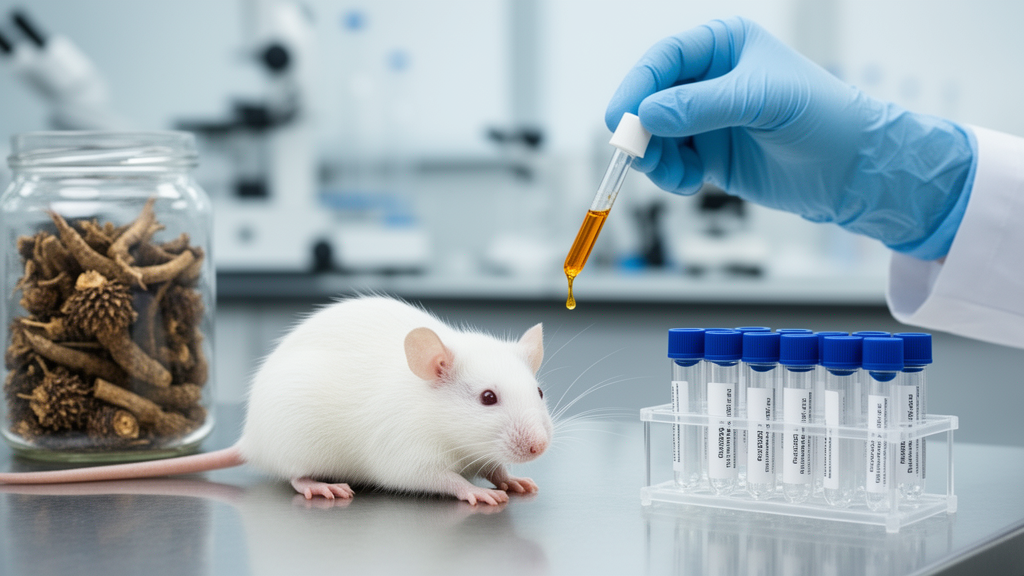
For the in vivo experiment, thirty-six male Wistar albino rats were divided into six groups. One group received normal saline as a control. A second received valproic acid at 300 milligrams per kilogram of body weight daily by oral gavage for twenty-eight days — a dose established in prior rodent studies to reliably induce hepatotoxicity and pancreatitis. Two further groups received valproic acid plus ALRE at 300 or 500 milligrams per kilogram. A fifth group received valproic acid plus L-carnitine at 300 milligrams per kilogram, a clinically used protective agent included as a positive control. The final group received ALRE alone at 500 milligrams per kilogram to assess safety at the highest dose.
The results were striking. Valproic acid drove serum alanine aminotransferase to 127.67 units per liter, aspartate aminotransferase to 153.67, alkaline phosphatase to 178.67, and gamma-glutamyl transferase to 7.67 — all dramatically above control values. Pancreatic enzymes rose in parallel, with amylase climbing to 47.33 and lipase to 49.00 units per liter. Co-administration of ALRE reversed these elevations in a dose-dependent manner, with the 500-milligram dose bringing ALT down to 48.67 and AST to 42.33 units per liter, approaching the levels seen with L-carnitine. The extract alone produced no adverse changes in any measured parameter.
Beyond serum chemistry, the researchers examined oxidative stress markers in liver and pancreatic tissue. Valproic acid depleted superoxide dismutase, catalase, and reduced glutathione while elevating malondialdehyde, the end product of lipid peroxidation. ALRE treatment restored all three antioxidant enzymes and lowered malondialdehyde in both organs, with the higher dose again showing the stronger effect. Histopathological examination under blinded scoring confirmed the biochemical findings: livers from valproic acid-treated rats showed lobular disorganization, cellular swelling, and inflammatory infiltration, while pancreases showed acinar derangement and early connective tissue proliferation. Both organs appeared markedly better preserved in the ALRE-treated groups, with the 500-milligram dose yielding near-normal architecture.
Immunohistochemistry added a molecular dimension. Staining for tumor necrosis factor-alpha and interleukin-1 beta — two pro-inflammatory cytokines central to the inflammatory cascade — was intense in the livers and pancreases of valproic acid-treated rats, localized around central veins, portal areas, and pancreatic ducts. In the ALRE-treated groups, this staining diminished markedly and dose-dependently, and the extract-alone group showed virtually no immunoreactivity, comparable to healthy controls. The researchers quantified these differences using ImageJ software with color deconvolution, providing objective measurement rather than subjective scoring.
The authors are careful to frame their findings within limits. This is the first study to demonstrate protection against valproic acid-induced hepatopancreatic toxicity with A. lappa, but the molecular pathways — including NF-kappa B, Nrf2, and GSK-3 beta signaling implicated in prior burdock research — were not directly probed here. Pharmacokinetic interactions between the extract and valproic acid metabolism remain unexamined, as do long-term effects and chronic toxicity. The cytotoxicity assessment used a single 24-hour time point, and food and water intake were not quantitatively recorded. Sample size was constrained to six animals per group by ethical considerations under the 3Rs framework, though the observed differences reached statistical significance.
Future work, the researchers write, should use western blotting and quantitative PCR to dissect the signaling pathways involved, and liquid chromatography–tandem mass spectrometry to measure whether ALRE alters the accumulation of toxic valproic acid metabolites such as 4-ene-VPA and 2,4-diene-VPA. Such studies would clarify whether the protection is purely antioxidant and anti-inflammatory or also involves modulation of drug metabolism itself. For now, the study adds burdock root to a growing list of plant-derived agents — including curcumin, resveratrol, silymarin, and ellagic acid — showing experimental protection against valproic acid organ injury, and offers a promising, low-toxicity lead for a clinical problem that has long needed better solutions.
Subject of Research: Hepatoprotective and pancreatoprotective effects of Arctium lappa root extract against valproic acid-induced toxicity in rats
Article Title: Hepatoprotective and pancreatoprotective effects of Arctium lappa root extract in valproic acid–induced toxicity: biochemical, histopathological, and immunohistochemical analysis
Article References: Hepatoprotective and pancreatoprotective effects of Arctium lappa root extract in valproic acid–induced toxicity: biochemical, histopathological, and immunohistochemical analysis. (n.d.). https://doi.org/10.3389/fphar.2026.1883451
Image Credits: AI Generated
DOI: 10.3389/fphar.2026.1883451
Keywords: Arctium lappa, burdock root, valproic acid, hepatotoxicity, pancreatitis, oxidative stress, antioxidant, phytochemistry, liver injury, pancreatic enzymes, L-carnitine, Wistar rats
News Source: Ophelia Keating. (October 16, 2026). Burdock Root Extract Shields Liver and Pancreas From Valproic Acid Damage in Rats. Scienmag.