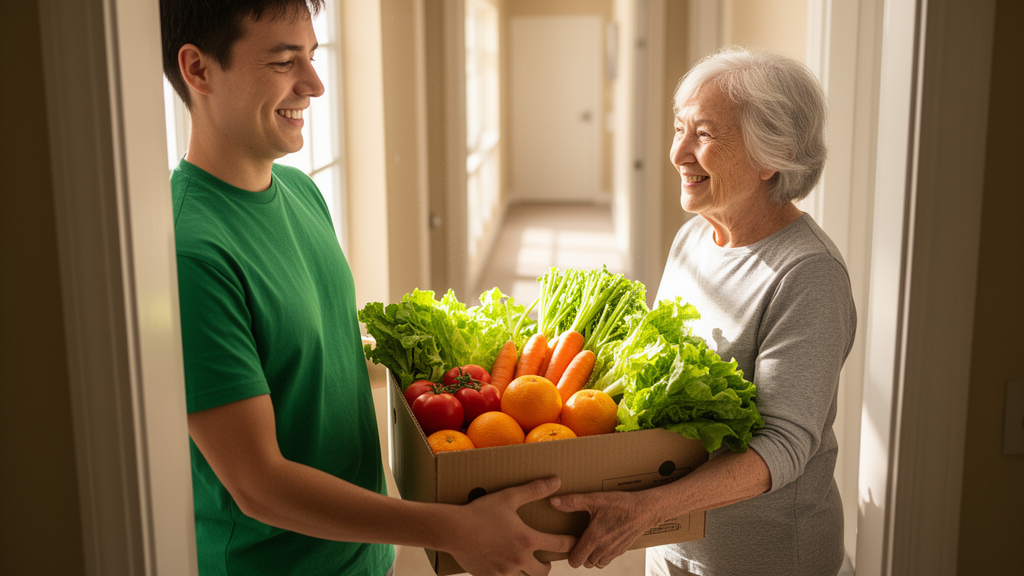
Food prescription programs have long promised a simple solution to one of the most stubborn problems in public health: getting fresh, nutritious food into the hands of people who cannot reliably afford it. The premise is straightforward. People who eat more fruits and vegetables tend to be healthier, so prescribing produce the way clinicians prescribe medication should, in theory, improve diets and reduce diet-related disease. Yet for years, these programs have stumbled over a deceptively small obstacle. Research shows that only 9 to 18 percent of people who receive vouchers for fresh produce actually redeem them, leaving the vast majority of the intended nutritional benefit stranded on paper.
A new randomized controlled study from the University at Buffalo suggests that the missing ingredient may not be motivation, education, or even money, but logistics. When fresh produce was delivered directly to participants’ homes, redemption rates jumped to nearly 90 percent, a figure that dwarfs the results of the traditional voucher model. The findings, published in Frontiers in Public Health, offer some of the clearest evidence yet that the design of food prescription programs, not just their existence, determines whether they succeed.
The study recruited 67 adults, most of them African American, all over the age of 65, and all of whom had reported experiencing food insecurity at times. Participants were drawn from primary care clinics at Erie County Medical Center in Buffalo and were randomly assigned to one of three groups for 12 weeks. One third received weekly boxes of fresh produce delivered to their doorsteps by FreshFix, a local food delivery company, with the option to customize their orders. Another third received home deliveries of healthy meal kits, which contained produce along with the additional ingredients needed to prepare three meals each week, chosen from five to six rotating options. The final third, serving as the standard-of-care comparison, received vouchers redeemable at the ECMC mobile market or at several FeedMore Western New York markets across Buffalo.
The results were striking. In both home-delivery arms, redemption, defined as the preparation and consumption of the delivered produce, reached 89.2 percent. In the control arm, where participants had to travel to a mobile market to redeem their vouchers, redemption was just 28.3 percent. That gap, more than 60 percentage points, represents the difference between a program that transforms diets and one that largely does not.
Lucia A. Leone, PhD, corresponding author and associate professor of community health and health behavior in the School of Public Health and Health Professions at UB, has spent years studying why food prescription programs underperform. The problem historically, she explains, is that people get the vouchers but do not redeem them. Her team’s goal was to test different versions of home delivery to boost redemption and compare them against the standard approach of handing out vouchers for redemption at a mobile market.
The barriers that suppress redemption in traditional programs are well documented but rarely addressed in program design. Many older adults lack reliable transportation to the markets where vouchers can be redeemed. Others avoid those settings altogether because the markets often operate out of food pantries, and recipients may feel stigmatized by being seen seeking assistance. By making home delivery the default, the Buffalo study removed both obstacles at once. Participants did not have to arrange a ride, stand in line, or explain themselves to anyone. The food simply arrived.
Two design choices appear to have been particularly important. First, delivery was automatic. Participants were not required to take any action to redeem their prescription, which eliminated the behavioral friction that causes so many voucher programs to fail. Second, the program allowed customization. Participants could tailor their produce orders to their preferences rather than receiving identical boxes. Leone notes that in many delivery programs, everybody gets the same food, and that partnering with FreshFix allowed the research team to combine delivery with personalization. A one-size-fits-all approach, she suggests, is less effective than one tailored to specific populations.
Interestingly, adding meal kits to the delivery model did not further increase produce consumption. Leone attributes this to the study population: adults over 65 generally already know how to cook with fresh produce, so providing recipes and supplementary ingredients did not change their behavior in the kitchen. The meal kits did, however, increase the overall quantity of food in the household, which helped improve food security. Redemption fell short of 100 percent mainly for mundane reasons, such as participants being out of town or feeling they already had sufficient food on hand.
Participants rated both delivery-based programs higher than 9 out of 10 and said they would recommend them to others. They also singled out the FreshFix delivery driver, Charles Humphrey, a community outreach coordinator with prior experience at mobile markets including the UB Veggie Van, for praise. Leone describes him as a wonderful, personable person who made every delivery throughout the study. That human connection, she says, is something the research team sees across their work: when a program has a good ambassador, it can substantially improve the program’s success. The finding adds a social dimension to what might otherwise seem like a purely logistical intervention.
The implications extend well beyond Buffalo. Large food prescription programs, including those offered through Medicaid, could potentially adopt home delivery as a default, though Leone cautions that large programs may find it harder to customize offerings for specific populations. The research team has already secured funding from the National Institutes of Health to test the model in a more challenging population: families on Medicaid experiencing food insecurity with children ages 2 to 6, in partnership with local pediatric practices. If the dramatic redemption gains seen among older adults hold for younger families, home delivery could reshape how food prescriptions are written and filled across the country. The study was funded by the American Heart Association, with preliminary work supported by UB’s Civic Engagement Research Fund, and partners included FreshFix, FeedMore WNY, and the UB Veggie Van. Co-authors include Anne Lally Mathiebe, Jennifer A. Stoll, the late Jill Tirabassi, and Rocco A. Paluch.
Subject of Research: Home delivery of fresh produce in food prescription programs for food-insecure older adults
Article Title: Study: Food prescription programs for food-insecure, older adults work best when fresh food is delivered to their door
Article References: Study: Food prescription programs for food-insecure, older adults work best when fresh food is delivered to their door. (n.d.). Original publication
Image Credits: AI Generated
DOI: Not provided
Keywords: food prescription, food insecurity, fresh produce, home delivery, older adults, randomized controlled trial, University at Buffalo, Frontiers in Public Health, meal kits, mobile market, Medicaid, public health
News Source: Daisy Hatcher. (October 16, 2026). Home-Delivered Fresh Produce Boosts Food Prescription Redemption to Nearly 90 Percent. Scienmag.