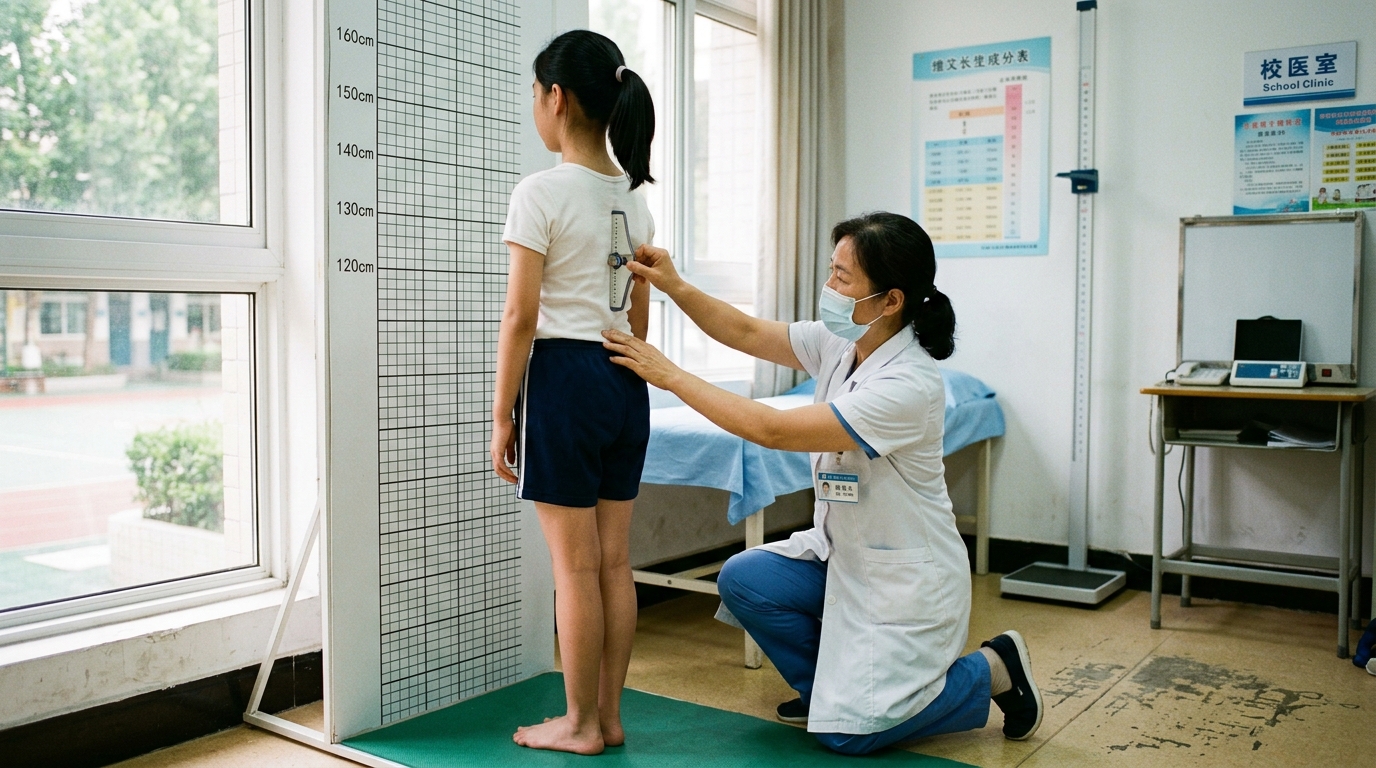
A large systematic review of school-based scoliosis surveys in China has pooled two very different numbers that are often confused in public reporting: a screening-positive rate of 3.43% and a radiographically confirmed prevalence of 1.83% among children and adolescents surveyed between 2020 and 2025. The analysis, published in Frontiers in Pediatrics, drew on 103 independent cross-sectional studies and was registered in PROSPERO under identifier CRD420261443909. Its central message is that neither figure can be treated as a fixed national prevalence value, because both outcomes showed extreme statistical heterogeneity across studies and wide prediction intervals that dwarf the precision implied by the confidence intervals alone.
The review team, led by Shiyi Lu and Wenxin Xu of Fujian Normal University, searched six databases for Chinese- or English-language studies published from January 2020 to May 2026, restricting eligibility to school- or population-based cross-sectional surveys of Chinese children aged 6 to 18 years or primary and secondary school students, with actual survey periods between January 2020 and December 2025. Hospital-treated populations, children selected for known congenital, neuromuscular, syndromic or other secondary causes of scoliosis, and non-cross-sectional designs were excluded. After screening 1,603 records and assessing 150 full-text articles, the team retained 103 studies. Of these, 80 reported screening-positive outcomes only, 19 reported Cobb angle–confirmed outcomes only, and four reported both, so the two analyses drew on overlapping but distinct subsets of the evidence base.
The distinction between the two outcomes is the conceptual core of the paper. Screening positivity counts students flagged as suspected cases by postural examination, the Adams forward-bend test, angle of trunk rotation (ATR) measurement, or China’s national screening standard GB/T 16133-2014, divided by everyone screened. Radiographically confirmed prevalence counts only students who met the Cobb angle criteria on standing spinal X-ray, again divided by the total screened population. Because these measures sit at different stages of the diagnostic pathway and use different diagnostic thresholds, the authors argue that calling both “prevalence” weakens comparability between regions and countries. They therefore pooled them separately and declined to combine them into a single overall estimate.
For the screening-positive analysis, 84 studies contributed 95 effect sizes from 6,045,953 participants, of whom 226,212 screened positive. Individual sample sizes ranged from 640 to 1,793,787, and observed screening-positive rates ranged from 0.47% to 12.61%. The pooled estimate was 3.43% (95% CI 2.98–3.93%), with I² of 99.84%, τ² of 0.500, and a 95% prediction interval of 0.86% to 12.70%. For the radiographic analysis, 23 studies covering 1,162,720 participants yielded 11,147 confirmed cases and a pooled prevalence of 1.83% (95% CI 1.17–2.86%), with I² of 99.85%, τ² of 1.225, and a prediction interval spanning 0.18% to 16.41%. Sixteen of the 23 radiographic studies used a Cobb angle threshold of 10 degrees or more, and seven used a threshold above 10 degrees.
The prediction intervals are the numbers that matter most for interpretation. A confidence interval quantifies uncertainty around the pooled average; a prediction interval estimates the range within which the true prevalence of a future comparable study may fall after accounting for between-study heterogeneity. Here, the prediction intervals were several times wider than the confidence intervals, meaning the pooled 3.43% and 1.83% describe only the average level across the included populations. The authors attribute the spread to differences in age and school-stage composition, screening criteria and thresholds, regional sampling, examination procedures, and completeness of radiographic follow-up, and they caution that the intervals should not be read as individual-level risk ranges or diagnostic thresholds.
Subgroup analyses showed consistent sex differences. Among 56 studies reporting sex-specific screening results, pooled rates were 2.85% in boys and 4.60% in girls, with a within-study female-to-male prevalence ratio of 1.58 (95% CI 1.41–1.77). Among 21 studies with sex-specific radiographic data, the corresponding figures were 1.33% in boys and 2.04% in girls, with a ratio of 1.49 (95% CI 1.26–1.76). The authors note that these are observational associations, possibly related to puberty, bone maturation and curve-progression risk, and cannot establish causation. School-stage point estimates rose from primary (1.57% screening-positive; 2.08% confirmed) through junior secondary (4.24%; 3.32%) to senior secondary (6.16%; 6.98%), but because the groups came mainly from different studies, the pattern does not demonstrate an age-related increase within individuals.
Geography told a more nuanced story. Screening-positive rates were broadly similar across eastern (3.57%), central (3.64%) and western China (3.07%), and meta-regression detected no regional difference for that outcome. Radiographically confirmed prevalence, however, was 0.81% in eastern China, 2.66% in central China and 3.03% in western China, and region was associated with study-level prevalence (P = 0.011), explaining 24.5% of between-study variance. In the multivariable model adjusting for sample size, the coefficient for central versus eastern China remained significant, while the western estimate was less precise. The authors stress these are ecological, study-level associations that may capture differences in population composition, medical resources, screening coverage, access to radiography and referral procedures rather than true differences in individual scoliosis risk, and they label the regional findings exploratory.
The referral pathway emerges as a key source of that variation. In one cited five-year program in eastern China involving 90,635 adolescents, 11.1% screened positive but only 14.4% of screen-positive students underwent radiography, and 559 confirmed cases amounted to just 0.62% of the total screened. An earlier Shanghai study found only 57.9% of screen-positive students completed hospital radiographic referral. Within the review itself, five of the 23 radiographic studies explicitly documented incomplete radiographic follow-up; excluding them raised the pooled prevalence from 1.83% to 2.06% (95% CI 1.28–3.32%), while heterogeneity remained near-total. In 15 of the 23 studies, radiographic completion could not be determined from the published report at all, so unreported follow-up gaps may still contribute to underestimation.
Methodological robustness checks were extensive. Leave-one-study-out estimates for screening positivity ranged from 3.37% to 3.55%, and for confirmed prevalence from 1.73% to 2.05%. Alternative estimators, including DerSimonian–Laird, Freeman–Tukey double-arcsine transformation, a binomial-logit generalized linear mixed model, and the Hartung–Knapp adjustment, produced closely concordant results, though a fixed-effect model yielded 2.12% for confirmed prevalence and was used only for methodological comparison. A three-level meta-analysis nesting 95 effect sizes within 84 studies gave 3.56%, with between-study heterogeneity dominating (75.71% versus 24.17% within-study). Meta-regression found log sample size negatively associated with both outcomes, but an additional analysis comparing 44 routine public-health screening programs with 36 investigator-initiated academic studies found no between-setting difference (P = 0.392), indicating the sample-size association is not explained by program type alone.
The review’s practical conclusion is directed at how scoliosis data are reported and used. The authors argue that monitoring reports should specify the diagnostic stage, denominator, screening tools and thresholds, referral coverage, actual numbers of X-ray examinations and re-examination completion rates, because only confirmed cases divided by the total screened population constitute a population-level prevalence estimate; ratios based on screen-positive or radiographed subsets reflect referral processes instead. Girls and students in higher grades can be regarded as priority groups for attention, they write, but stratified management should still be combined with age, growth rate, bone maturity, prior screening results, family history and clinical signs. The public health value of school screening, they conclude, depends less on the initial positive rate than on whether re-examination, radiographic confirmation, referral and follow-up form a continuous pathway — and on reports making that pathway visible enough for the numbers to be compared honestly across regions and over time.
Subject of Research: Pooled screening-positive rates and radiographically confirmed prevalence of scoliosis among Chinese children and adolescents
Article Title: Screening positive rate and radiographically confirmed prevalence of scoliosis in Chinese children and adolescents from 2020 to 2025: a systematic review and meta-analysis
Article References: Lu, S., Huang, Z., Zhang, Y., Qin, Z., Yang, W., Wu, Y., Fan, S., & Xu, W. (2026). Screening positive rate and radiographically confirmed prevalence of scoliosis in Chinese children and adolescents from 2020 to 2025: a systematic review and meta-analysis. Frontiers in Pediatrics, 14, Article 1954010. https://doi.org/10.3389/fped.2026.1954010
Image Credits: AI Generated
DOI: 10.3389/fped.2026.1954010
Keywords: scoliosis, children and adolescents, China, school screening, systematic review, meta-analysis, Cobb angle, radiographic confirmation, heterogeneity, prediction intervals, public health, Frontiers in Pediatrics
News Source: Harold Sullivan. (November 6, 2026). Scoliosis screening in Chinese children: pooled rates mask wide regional variation. Scienmag.