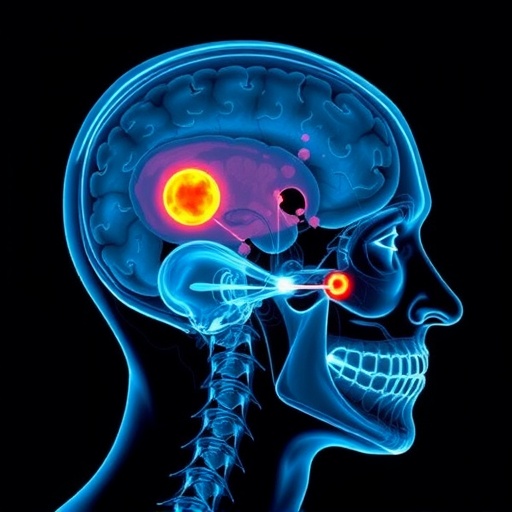
Research team of Alexey Amunts in collaboration with AstraZeneca unravel the extracellular region of the receptor tyrosine kinase RET involved in degenerative diseases.
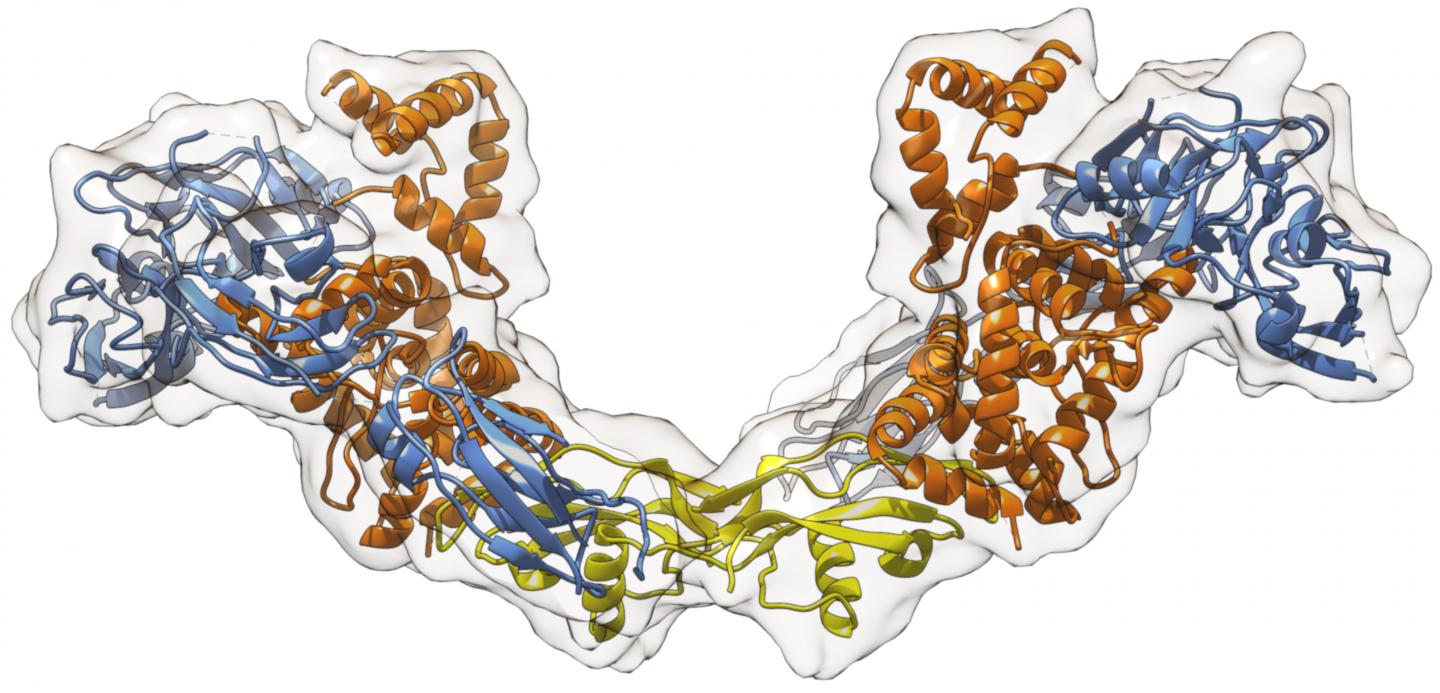
Credit: A. Amunts
The study published in Science Advances reveals the mechanism by which the receptor tyrosine kinase RET can increase neuronal survival in degenerative diseases. To understand the mechanism of this signalling complex, the researchers solved the cryo-EM structure of its extracellular region, employing a new approach for data collection. The resulting structural information shows how two large RET monomers dimerise on the membrane at the last few residues before the transmembrane region. This explains why the assembly of six proteins is required for proper placement of the transmembrane helices, which is the prerequisite for intracellular autophosphorylation of signalling. The cryo-EM data allowed scientists to propose how the selectivity between RET ligands is achieved, and why it has a potential to trigger different signalling pathways for cellular response. The identified components can be used for drug targeting to improve the survival of neurons, which is important to prevent progression of neurodegenerative diseases such as Alzheimer’s and Parkinson’s.
Tove Sjogren, head of the Protein Structure section at AstraZeneca R&D, believes that the established cryo-EM collaboration is set to become increasingly important for AstraZeneca: “Thanks to cryo-EM, the structural biology field has seen an incredible development over the past few years. By establishing a collaboration with the Amunts group from SciLifeLab, we have expanded our ability to access know-how and infrastructure in Sweden, which has provided a valuable advantage for us in the endeavours to advance drug discovery.”
“Cryo-EM is expected to accelerate the successful enterprise of drug design and structural biology. The collaboration with AstraZeneca is an early step in this direction, and we are fortunate to be involved in such a promising growth”, says Alexey Amunts.
The collaborative research might also have wider national implications. Ratan Bhat, head of strategy and external innovation within Cardiovascular, Renal and Metabolism at AstraZeneca adds: “Working with SciLifeLab enables us to access novel technology and science. And it is the interaction with their scientists that we particularly value, because it often provides an innovative thought pathway to address our scientific queries. The cryo-EM collaboration is a benchmark in this regard.”
Olli Kallioniemi, the director of SciLifeLab, emphasises that the successful collaborative effort, which allowed overcoming technical difficulties, also illustrates how the SciLifeLab fellows’ program contributes to technology development and new service capabilities, “The SciLifeLab fellows’ program is key for our infrastructure and the national research community to be at the cutting-edge globally. It further increases the critical mass and international standing of cryo-EM at SciLifeLab and in Sweden as a whole.”
###
About SciLifeLab
SciLifeLab is a joint enterprise of Swedish universities, that aims to provide frontline technologies for the Swedish academic community and develop cutting-edge research programs. Situated on the expanding Stockholm biomedical campus, SciLifeLab offers the opportunity to work in an internationally competitive and synergistic environment. The center combines technical expertise with advanced knowledge of translational medicine and molecular bioscience.
About AstraZeneca
AstraZeneca is a global, science-led biopharmaceutical company. Its R&D is concentrated mostly in Gothenburg (Sweden) and Cambridge (UK). AstraZeneca has a portfolio of products for major disease areas including cancer, cardiovascular, gastrointestinal, infection, neuroscience, respiratory and inflammation.
Media Contact
Vasileios Kyriakidis
[email protected]
Original Source
https:/
Related Journal Article
http://dx.