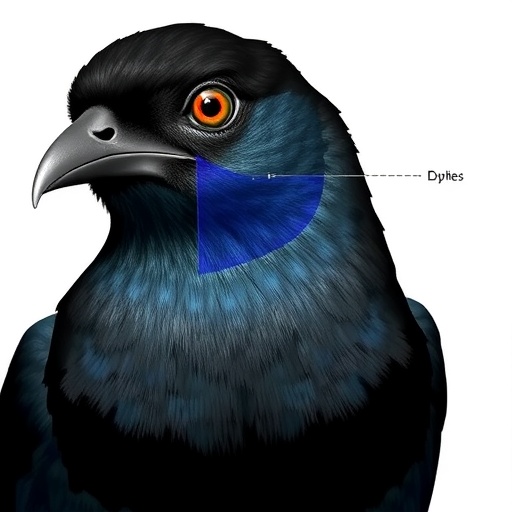
In a significant breakthrough for neuroscience and animal navigation studies, researchers have unveiled the first comprehensive digital three-dimensional brain atlas of the Eurasian blackcap (Sylvia atricapilla), a migratory bird renowned for its incredible navigational abilities. Utilizing advanced light microscopy techniques, this pioneering brain atlas offers an unprecedented look into the neural architecture of a species whose migratory precision continues to fascinate scientists. The resulting open-source resource, developed collaboratively by teams at the Sainsbury Wellcome Centre (SWC) at University College London (UCL) and the University of Oldenburg in Germany, promises to revolutionize neuroscientific studies across species by providing a detailed and publicly accessible framework for brain mapping.
Brain atlases have long been critical tools in neuroscience, offering digital, high-resolution, and volumetric representations of brain anatomy. These atlases facilitate a universal language among researchers, allowing for precise cross-referencing of experimental data within a standardized coordinate space. The Eurasian blackcap atlas embodies these ideals by providing researchers worldwide with a platform to integrate and compare multimodal datasets with accuracy and consistency, addressing a historic challenge in the field. This advancement is expected to significantly enhance our understanding of neural circuits related to cognition, sensory processing, and behavior in migratory species.
The team employed serial two-photon (STP) tomography, an advanced imaging methodology renowned for its ability to capture entire brain volumes at near cellular resolution. In this study, eight male blackcap brains were systematically imaged, generating volumetric datasets with voxel dimensions of 2 by 2 by 5 micrometers. This high spatial resolution enables detailed visualization of the brain’s microarchitecture, ensuring that subtle anatomical boundaries and functional subdivisions can be discerned and mapped with precision. The iterative alignment and averaging of these images produced a canonical brain template representative of the species.
Following image acquisition, expert neuroanatomists meticulously annotated the atlas, identifying 44 distinct brain regions. These segmented compartments encompass major brain areas, well-conserved anatomical subdivisions across avian species, key components of the song-control system, and critical sensory regions implicated in magnetoreception—the bird’s ability to sense Earth’s magnetic field. This detailed annotation not only enriches the atlas’s utility but also lays the groundwork for interrogating the neural pathways governing navigation and decision-making.
Among the atlas’s novel contributions is the revealed neural connectivity between magnetosensitive brain areas and the nidopallium caudolaterale—a brain region considered functionally analogous to the mammalian prefrontal cortex. This pathway’s elucidation suggests a direct link between environmental magnetic field perception and higher-order decision-making processes. Such findings open new avenues for exploring the neural basis of magnetoreception and its integration with complex behaviors like migration, highlighting the atlas’s role in facilitating discoveries that were previously unattainable due to technological constraints.
Dr. Simon Weiler, lead author and Senior Research Fellow at SWC, emphasized the importance of open accessibility: “Providing an open-source digital atlas ensures that researchers globally can align their experimental data within a shared spatial framework. This standardization is crucial for reproducibility and comparative studies, ultimately accelerating neuroscientific progress.” The project is set within the BrainGlobe ecosystem, a growing suite of interoperable tools designed to democratize computational neuroanatomy and enable seamless creation, registration, and analysis of brain-wide data across species.
Encouraged by their success with the blackcap brain, the team has embarked on generating a similar atlas for the zebra finch (Taeniopygia guttata), a species extensively studied for its vocal learning abilities. The vision is to expand this open-source atlas repository, encompassing diverse avian species and providing a common framework to interrogate evolutionary, developmental, and functional questions across taxa. This cross-species approach will enhance comparative neuroanatomy and facilitate integrated understanding of brain function.
The utility of the blackcap atlas extends beyond fresh brain samples. The software tools and methodologies developed are compatible with historic histological samples preserved for decades, enabling the mapping and alignment of archived data. This capability significantly broadens the potential datasets that can be integrated, fostering longitudinal studies and meta-analyses that span temporal and geographical ranges.
Birds exhibit extraordinary navigation skills, often traversing continents with pinpoint accuracy using Earth’s magnetic field cues. Despite decades of behavioral research, the underlying neural circuits mediating magnetoreception and spatial orientation have remained elusive. This brain atlas offers the neuroscientific community a vital resource to chart these circuits with anatomical precision and integrate multimodal recordings, such as electrophysiology or genetic markers, into a coherent spatial framework.
The development pipeline, incorporating serial two-photon tomography imaging, expert manual annotation, and integration into BrainGlobe, sets a new standard for brain atlas construction. While STP tomography was central to this project, the framework remains versatile, supporting data derived from various microscopy techniques including light-sheet imaging. This flexibility ensures that as imaging technologies evolve, the atlas can be augmented with multimodal datasets, refining anatomical and functional subdivisions based on molecular markers and gene expression profiles.
Looking forward, the researchers anticipate iterative upgrades to the atlas, incorporating novel data types and refining segmentation schemes informed by advances in whole-brain labeling strategies. Such enhancements will deepen the understanding of functional neuroanatomy and the molecular identities of brain regions. The project’s open-source nature invites contributions from the international community, fostering collaborative refinement and expansion.
Professor Henrik Mouritsen from the University of Oldenburg highlighted the atlas’s transformative potential: “For the first time, the magnetoreception and migration research communities have access to a unified brain framework. This resource addresses a critical gap, enabling consistent methodology across studies and species, thus expediting breakthroughs in deciphering the neuronal mechanisms underlying migration.” The atlas’s deployment exemplifies how technological innovation can catalyze scientific discovery and promote interdisciplinary collaboration.
Funded by prominent organizations such as the Gatsby Charitable Foundation, the Wellcome Trust, the Alexander von Humboldt Foundation, the Chan Zuckerberg Initiative, the European Research Council, and the Deutsche Forschungsgemeinschaft, this project underscores the importance of collaborative and well-supported research infrastructures. Together, these efforts illuminate the neural underpinnings of migration, cognition, and sensory processing in avian species and pave the way for similar endeavors across the animal kingdom.
In sum, this groundbreaking three-dimensional, open-source brain atlas not only charts new territory in avian neuroscience but also establishes critical tools and frameworks that will resonate across neurobiology, behavioral science, and evolutionary biology. As the atlas becomes widely adopted and refined, it will undoubtedly accelerate the unraveling of the enigmatic neural codes enabling migration and spatial navigation, advancing our understanding of brain function across species.
Subject of Research: Animals
Article Title: An open-source three-dimensional digital brain atlas of a migratory bird, the Eurasian blackcap
News Publication Date: 20-Apr-2026
Web References:
https://brainglobe.info/blackcap
References:
DOI: 10.1016/j.cub.2026.03.034
Image Credits:
Sainsbury Wellcome Centre, UCL
Keywords:
Brain, Neuroscience, Anatomy, Animal Physiology, Brain Structure
Tags: 3D digital brain atlas of blackcap birdadvanced light microscopy in brain mappingcross-species brain mapping toolsEurasian blackcap neuroscience researchhigh-resolution volumetric brain imagingmigratory bird neural architecturemultimodal neuroscience data integrationneural circuits in migratory birdsopen-source brain atlas resourcesSainsbury Wellcome Centre neuroscience projectsstandardized brain coordinate systemsUniversity College London brain studies