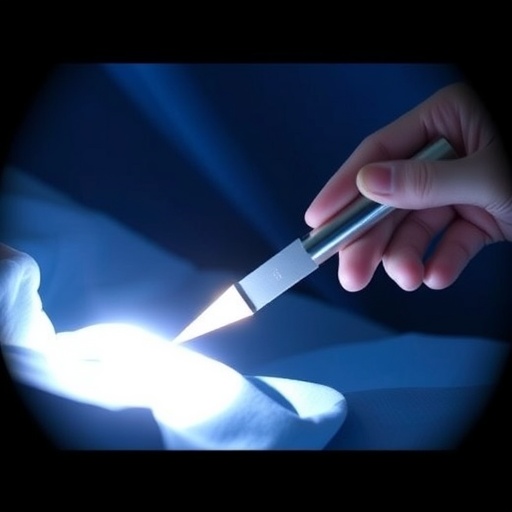
In a groundbreaking advancement poised to transform minimally invasive surgical procedures, a team of researchers has unveiled a novel flexible high-pressure injection knife designed specifically for endoscopic submucosal dissection (ESD). This innovative instrument represents a significant leap forward in the precision, safety, and efficacy of ESD, a complex technique widely used to remove early-stage gastrointestinal tumors. The study detailing the preclinical and clinical evaluation of this new device has been published recently, marking an exciting chapter in therapeutic endoscopy.
Endoscopic submucosal dissection, a technique that allows for en bloc resection of superficial neoplasms within the gastrointestinal tract, demands exceptional dexterity and technological support to navigate the intricate layers of the mucosa. Traditional ESD methods often grapple with challenges such as suboptimal maneuverability and the risk of inadvertent damage to surrounding tissues. The emergence of this flexible high-pressure injection knife addresses these limitations by integrating a high-pressure fluid injection system directly into a highly maneuverable cutting tool, radically enhancing surgical precision.
At the core of this innovation lies the synergy between flexibility and controlled high-pressure injection, which allows for more accurate submucosal lifting of lesions. This lifting is crucial for creating an optimal dissection plane, minimizing the risk of perforations and ensuring a clean resection margin. The device’s ability to deliver pressurized fluid precisely beneath the lesion facilitates better visualization and safer separation of the submucosal layer from the muscularis propria, consequently reducing procedural complications.
The preclinical testing phase of the device involved extensive evaluation in animal models, where the researchers meticulously assessed its mechanical performance, fluid dynamics, and tissue interaction properties. These assessments confirmed that the instrument could sustain consistent high-pressure fluid delivery without sacrificing flexibility or control, verifying its readiness for human clinical trials. Importantly, the preclinical data highlighted a remarkable reduction in procedure time and the incidence of adverse events compared to conventional ESD instruments.
Transitioning to the clinical evaluation, the research team conducted a series of trials involving patients with early-stage gastrointestinal neoplasms eligible for ESD. Throughout these trials, the new flexible high-pressure injection knife demonstrated superior handling and operational precision. Endoscopists reported enhanced tactile feedback and ease of use, which contributed to a more efficient dissection process. The high-pressure injection mechanism delivered continuous and adjustable fluid streams, which allowed optimistic adaptation to varying lesion morphologies and tissue resistance.
Safety outcomes from the clinical phase were particularly encouraging. There was a marked decline in occurrences of submucosal bleeding and perforations, notorious complications of traditional ESD techniques. This safety profile is attributed to the device’s improved control over fluid injection and cutting movements, enabling the surgeon to maintain an optimal dissection plane under direct visual guidance. Moreover, patients experienced reduced procedural discomfort and faster postoperative recovery times, which are critical parameters in enhancing the overall success of ESD.
The technical backbone of the device entails a sophisticated micro-engineered channel integrated into the knife’s blade, which channels the high-pressure fluid. This integration is carefully balanced to maintain the knife’s slim profile, ensuring it can navigate the narrow and tortuous confines of the gastrointestinal tract. Additionally, the design emphasizes ergonomic considerations, presenting a handle that allows intuitive manipulation and a fluid pressure control system that offers precise adjustments during the procedure.
This device also capitalizes on advances in fluid mechanics and materials science. The fluid delivery system is capable of generating pressures sufficiently high to achieve efficient submucosal lifting without causing tissue rupture. The materials selected for the construction of the knife optimize flexibility, durability, and biocompatibility, ensuring repeated sterilization cycles do not degrade performance or safety. Such engineering precision reflects a deep understanding of both the surgical environment’s demands and the biomechanical properties of gastrointestinal tissues.
Clinicians involved in the trials emphasized that the device’s introduction could significantly democratize ESD procedures. Currently, ESD requires a high level of skill and experience, limiting its availability to specialized centers. By enhancing procedural safety and ease, the flexible high-pressure injection knife has the potential to shorten learning curves, empowering more endoscopists to adopt ESD in diverse clinical settings.
From a surgical workflow perspective, the device introduction streamlines several procedural steps. Previously, submucosal injection and dissection were often conducted as separate maneuvers, necessitating instrument exchanges that increased operation time and risk of contamination. The integrated injection and cutting functionality reduces instrument swaps, simplifying the procedure and improving sterilization logistics.
Moreover, the adaptability of the injection pressure is a game-changer in managing lesions with diverse vascularity and fibrosis levels. Surgeons can modulate the fluid force in real time, optimizing the lifting effect according to the specific tissue characteristics encountered. This customization enhances both safety and the completeness of tumor removal, which is pivotal in preventing recurrence.
The implications of this innovation extend beyond gastrointestinal oncology. The principles underlying the flexible high-pressure injection knife may inspire similar technological advancements in other fields requiring precise soft tissue dissection and fluid-based plane creation, such as gynecology, urology, and pulmonology. The ripple effect could lead to a new generation of multifunctional surgical instruments.
As the device begins to gain broader clinical adoption, further longitudinal studies will be critical to fully understand its long-term outcomes and cost-effectiveness. However, the preliminary evidence positions this instrument as a transformative development in endoscopic surgery, combining mechanical ingenuity with clinical insight to improve patient outcomes and procedural feasibility.
In conclusion, the introduction of this flexible high-pressure injection knife for endoscopic submucosal dissection exemplifies the convergence of engineering innovation and clinical necessity. By enhancing surgical precision, reducing complications, and simplifying complex procedures, it holds the promise of elevating standard care in gastrointestinal oncology and potentially beyond. As endoscopists incorporate this tool into their repertoire, patients worldwide stand to benefit from safer, more effective minimally invasive cancer treatments.
Subject of Research: Endoscopic submucosal dissection (ESD) and the development of a flexible high-pressure injection knife device.
Article Title: Preclinical and clinical evaluation of a new flexible high pressure injection knife for endoscopic submucosal dissection.
Article References:
Olivier, R., Albouys, J., Juglard, C. et al. Preclinical and clinical evaluation of a new flexible high pressure injection knife for endoscopic submucosal dissection. Sci Rep (2026). https://doi.org/10.1038/s41598-026-37018-8
Image Credits: AI Generated
Tags: advanced therapeutic endoscopy devicesclinical evaluation of endoscopic toolsearly-stage gastrointestinal tumor removal techniquesendoscopic submucosal dissection innovationflexible high-pressure injection knifehigh-pressure fluid injection in surgeryimproved maneuverability in ESDminimally invasive gastrointestinal surgery toolsnovel surgical instrument developmentprecision endoscopic cutting instrumentsreducing perforation risk in ESDsubmucosal lifting technology