• HOME
  • NEWS
  • EXPLORE
    • CAREER
      • Companies
      • Jobs
    • EVENTS
    • iGEM
      • News
      • Team
    • PHOTOS
    • VIDEO
    • WIKI
  • BLOG
  • COMMUNITY
    • FACEBOOK
    • INSTAGRAM
    • TWITTER
Friday, May 15, 2026
BIOENGINEER.ORG
No Result
View All Result
  • Login
  • HOME
  • NEWS
  • EXPLORE
    • CAREER
      • Companies
      • Jobs
        • Lecturer
        • PhD Studentship
        • Postdoc
        • Research Assistant
    • EVENTS
    • iGEM
      • News
      • Team
    • PHOTOS
    • VIDEO
    • WIKI
  • BLOG
  • COMMUNITY
    • FACEBOOK
    • INSTAGRAM
    • TWITTER
  • HOME
  • NEWS
  • EXPLORE
    • CAREER
      • Companies
      • Jobs
        • Lecturer
        • PhD Studentship
        • Postdoc
        • Research Assistant
    • EVENTS
    • iGEM
      • News
      • Team
    • PHOTOS
    • VIDEO
    • WIKI
  • BLOG
  • COMMUNITY
    • FACEBOOK
    • INSTAGRAM
    • TWITTER
No Result
View All Result
Bioengineer.org
No Result
View All Result
Home NEWS Science News

Scientists uncover drivers of phenotypic innovation and diversification in gymnosperms

Bioengineer by Bioengineer
July 19, 2021
in Science News
Reading Time: 2 mins read
0
IMAGE
Share on FacebookShare on TwitterShare on LinkedinShare on RedditShare on Telegram

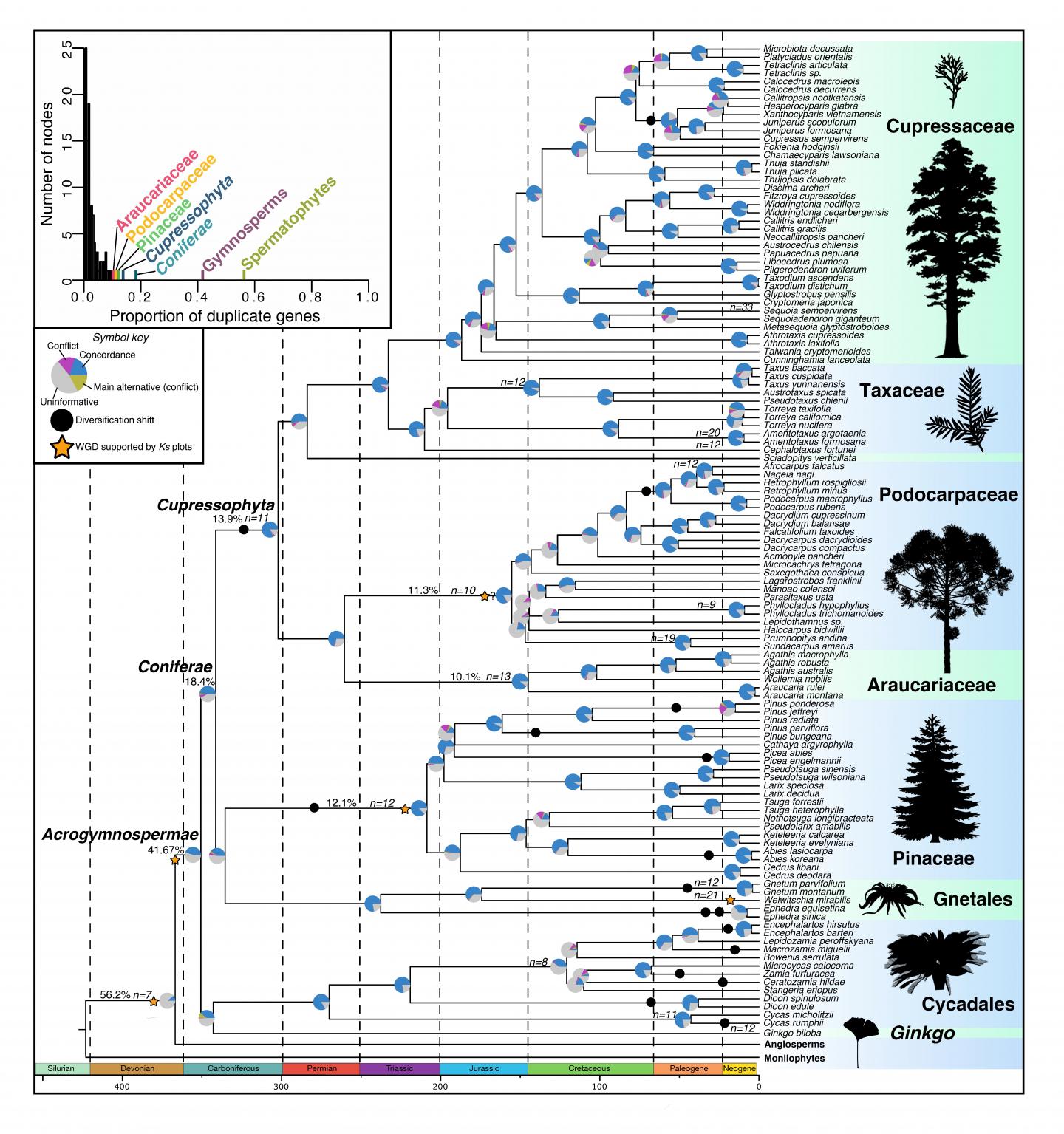
IMAGE

Credit: KIB

Determining the major drivers of species diversification and phenotypic innovation across the Tree of Life is one of the grand challeges in evolutionary biology.

Facilitated by the Germplasm Bank of Wild Species of the Kunming Institute of Botany (KIB) of the Chinese Academy of Sciences (CAS), Prof. YI Tingshuang and Prof. LI Dezhu of KIB led a novel study on gymnosperm diversification with a team of international researchers.

This study provides critical insight on the processes underlying diversification and phenotypic evolution in gymnosperms, with important broader implications for the major drivers of both micro- and macroevolution in plants.

The results were published today online in Nature Plants in an article entitled “Gene duplications and phylogenomic conflict underlie major pulses of phenotypic evolution in gymnosperms.”

In green plants, it is well understood that whole-genome duplication (WGD, or polyploidization) is an important evolutionary force. However, scientists have not clearly understood the role of WGD in shaping broad-scale evolutionary patterns in plants, especially when WGD is combined with adaptive radiation and other processes arising from climate change or new ecological opportunities.

Likewise, extant gymnosperm lineages clearly exhibit a complex history of ancient radiations, major extinctions, extraordinary stasis, and recent diversification. However, the correlates and causes of major phases of gymnosperm evolution have also not been well understood.

Using a novel transcriptome dataset as well as a diversity of comparative datasets, the researchers examined the relationship between various facets of genomic evolution, including gene and genome duplication, genome size, and chromosome number, and macroevolutionary patterns of phenotypic innovation, species diversification, and climatic occupancy in gymnosperms.

The scientists showed that spikes of gene duplication typically coincide with major spikes of phenotypic innovation, representing one of the first demonstrations of a direct relationship between gene duplication and phenotypic innovation on a macroevolutionary scale.

They also found that most shifts in gymnosperm diversification, since the rise of angiosperms, were decoupled from WGD events and instead are associated with increased rates of climatic occupancy evolution in cooler and/or more arid climatic conditions.

This suggests that ecological opportunity, especially in the late Cenozoic, along with environmental heterogeneity have driven a resurgence of gymnosperm diversification.

###

This work was funded by the Strategic Priority Research Program of CAS and the large-scale scientific facilities of CAS.

Media Contact
YANG Mei
[email protected]

Related Journal Article

http://dx.doi.org/10.1038/s41477-021-00964-4

Tags: BiologyGenesGeneticsPlant Sciences
Share12Tweet8Share2ShareShareShare2

Related Posts

Exploring Ethical and Practical Issues of Social Robot Pepper

May 15, 2026
Root-Knot Nematodes Hijack Plant Signaling Peptides — Biology

Root-Knot Nematodes Hijack Plant Signaling Peptides

May 15, 2026

Autism Subtypes Revealed Through Cross-Species Brain Mapping

May 15, 2026

Synthetic Cell Microreactor with Dual Dynamic DNA Pores

May 15, 2026
Please login to join discussion

POPULAR NEWS

  • Research Indicates Potential Connection Between Prenatal Medication Exposure and Elevated Autism Risk

    843 shares
    Share 337 Tweet 211
  • New Study Reveals Plants Can Detect the Sound of Rain

    729 shares
    Share 291 Tweet 182
  • Salmonella Haem Blocks Macrophages, Boosts Infection

    62 shares
    Share 25 Tweet 16
  • Breastmilk Balances E. coli and Beneficial Bacteria in Infant Gut Microbiomes

    58 shares
    Share 23 Tweet 15

About

We bring you the latest biotechnology news from best research centers and universities around the world. Check our website.

Follow us

Recent News

Exploring Ethical and Practical Issues of Social Robot Pepper

Root-Knot Nematodes Hijack Plant Signaling Peptides

Autism Subtypes Revealed Through Cross-Species Brain Mapping

Subscribe to Blog via Email

Enter your email address to subscribe to this blog and receive notifications of new posts by email.

Join 82 other subscribers
  • Contact Us

Bioengineer.org © Copyright 2023 All Rights Reserved.

Welcome Back!

Login to your account below

Forgotten Password?

Retrieve your password

Please enter your username or email address to reset your password.

Log In
No Result
View All Result
  • Homepages
    • Home Page 1
    • Home Page 2
  • News
  • National
  • Business
  • Health
  • Lifestyle
  • Science

Bioengineer.org © Copyright 2023 All Rights Reserved.