• HOME
  • NEWS
  • EXPLORE
    • CAREER
      • Companies
      • Jobs
    • EVENTS
    • iGEM
      • News
      • Team
    • PHOTOS
    • VIDEO
    • WIKI
  • BLOG
  • COMMUNITY
    • FACEBOOK
    • INSTAGRAM
    • TWITTER
Friday, August 21, 2026
BIOENGINEER.ORG
No Result
View All Result
  • Login
  • HOME
  • NEWS
  • EXPLORE
    • CAREER
      • Companies
      • Jobs
        • Lecturer
        • PhD Studentship
        • Postdoc
        • Research Assistant
    • EVENTS
    • iGEM
      • News
      • Team
    • PHOTOS
    • VIDEO
    • WIKI
  • BLOG
  • COMMUNITY
    • FACEBOOK
    • INSTAGRAM
    • TWITTER
  • HOME
  • NEWS
  • EXPLORE
    • CAREER
      • Companies
      • Jobs
        • Lecturer
        • PhD Studentship
        • Postdoc
        • Research Assistant
    • EVENTS
    • iGEM
      • News
      • Team
    • PHOTOS
    • VIDEO
    • WIKI
  • BLOG
  • COMMUNITY
    • FACEBOOK
    • INSTAGRAM
    • TWITTER
No Result
View All Result
Bioengineer.org
No Result
View All Result
Home NEWS Science News Biology

Scientists produce 'designer triacylglycerols' in industrial microalgae

Bioengineer by Bioengineer
December 31, 2018
in Biology
Reading Time: 2 mins read
0
IMAGE
Share on FacebookShare on TwitterShare on LinkedinShare on RedditShare on Telegram

IMAGE

Credit: QIBEBT


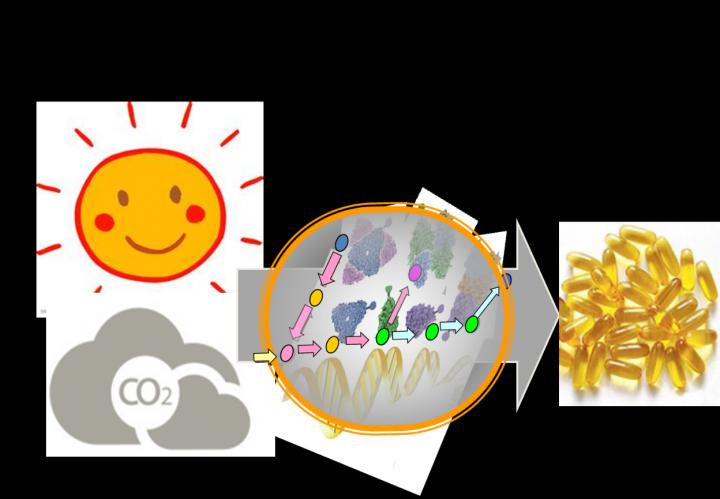
Molecules of triacylglycerol (TAG), formed by attaching three molecules of fatty acid (FA) to a glycerol backbone, are the main constituents of vegetable oil in plants and fats in animals and humans. TAG plays an important role in cellular metabolism as a universal storage form and currency of energy, since its energy density is much greater than carbohydrates or proteins.

The health benefit of TAG molecules (TAGs) is dependent on which FA comprise the molecule. For example, linoleic acid (LA) can lower blood cholesterols and prevent atherosclerosis, while eicosapentaenoic acid (EPA) can treat hypertension and inflammation. Can the FA composition of TAGs be customized to create “designer” TAGs that carry tailored health benefits?

The answer is yes. A research team led by Prof. XU Jian from the Qingdao Institute of Bioenergy and Bioprocess Technology (QIBEBT), Chinese Academy of Sciences (CAS), has discovered two novel diacylglyceryl transferases (DGAT2s) that preferentially attach LA and EPA, respectively, to the glycerol backbone to form TAGs.

By modulating the ratio of these specialist enzymes in the cell, a strain bank of the industrial oleaginous microalga Nannochloropsis oceanica was created where the proportions of LA and EPA in TAGs varied by 18.7- and 34.7-fold, respectively.

LA and EPA are both “essential fatty acids” for humans. They are essential for human metabolism, but human genomes do not encode the enzymes that directly synthesize these fatty acids. Therefore, humans have to intake LA and EPA via plant or animal TAGs.

The discovery of novel DGATs that selectively assemble LA and EPA into microalgal TAGs thus lays the foundation for producing on a large scale “designer TAGs,” whether present in nature or not, for tailored or even personalized health benefits.

###

The study, published in Molecular Plant, was supported by the National Natural Science Foundation of China (NSFC).

Media Contact
CHENG Jing
[email protected]

Original Source

http://english.cas.cn/

Related Journal Article

http://dx.doi.org/10.1016/j.molp.2018.12.007

Tags: BioinformaticsBiologyBiomedical/Environmental/Chemical EngineeringBiotechnologyMolecular Biology
Share12Tweet8Share2ShareShareShare2

Related Posts

Tropical Mountain Forest Canopies and Understories Reveal Contrasting Biodiversity Patterns Along Elevation

Tropical Mountain Forest Canopies and Understories Reveal Contrasting Biodiversity Patterns Along Elevation

August 21, 2026
Heart backup blood vessels grow from capillaries—not arteries

Heart backup blood vessels grow from capillaries—not arteries

August 21, 2026

Newly discovered jungle snake named after Guns N’ Roses guitarist Slash

August 21, 2026

Younger lung cancer patients more likely to harbor targetable mutations, study finds

August 20, 2026
Please login to join discussion

POPULAR NEWS

  • Clonal Follicular CD4+ T Cells Adapt Across Lymph Nodes and Lung Tumors

    29 shares
    Share 12 Tweet 7
  • Tobacco Firms Overwhelmed Federal Comments, Delaying Proposed Menthol Cigarette Ban

    29 shares
    Share 12 Tweet 7
  • Durable hydrogen catalyst operates continuously for 3,000 hours

    29 shares
    Share 12 Tweet 7
  • Scientists warn free-to-play games hide high costs, urging stronger player protections

    29 shares
    Share 12 Tweet 7

About

We bring you the latest biotechnology news from best research centers and universities around the world. Check our website.

Follow us

Recent News

Clonal Follicular CD4+ T Cells Adapt Across Lymph Nodes and Lung Tumors

Tobacco Firms Overwhelmed Federal Comments, Delaying Proposed Menthol Cigarette Ban

Durable hydrogen catalyst operates continuously for 3,000 hours

Subscribe to Blog via Email

Enter your email address to subscribe to this blog and receive notifications of new posts by email.

Join 85 other subscribers
  • Contact Us

Bioengineer.org © Copyright 2023 All Rights Reserved.

Welcome Back!

Login to your account below

Forgotten Password?

Retrieve your password

Please enter your username or email address to reset your password.

Log In
No Result
View All Result
  • Homepages
    • Home Page 1
    • Home Page 2
  • News
  • National
  • Business
  • Health
  • Lifestyle
  • Science

Bioengineer.org © Copyright 2023 All Rights Reserved.