Special Issue ‘Status of the SPARC Physics Basis’, from the ‘Journal of Plasma Physics’
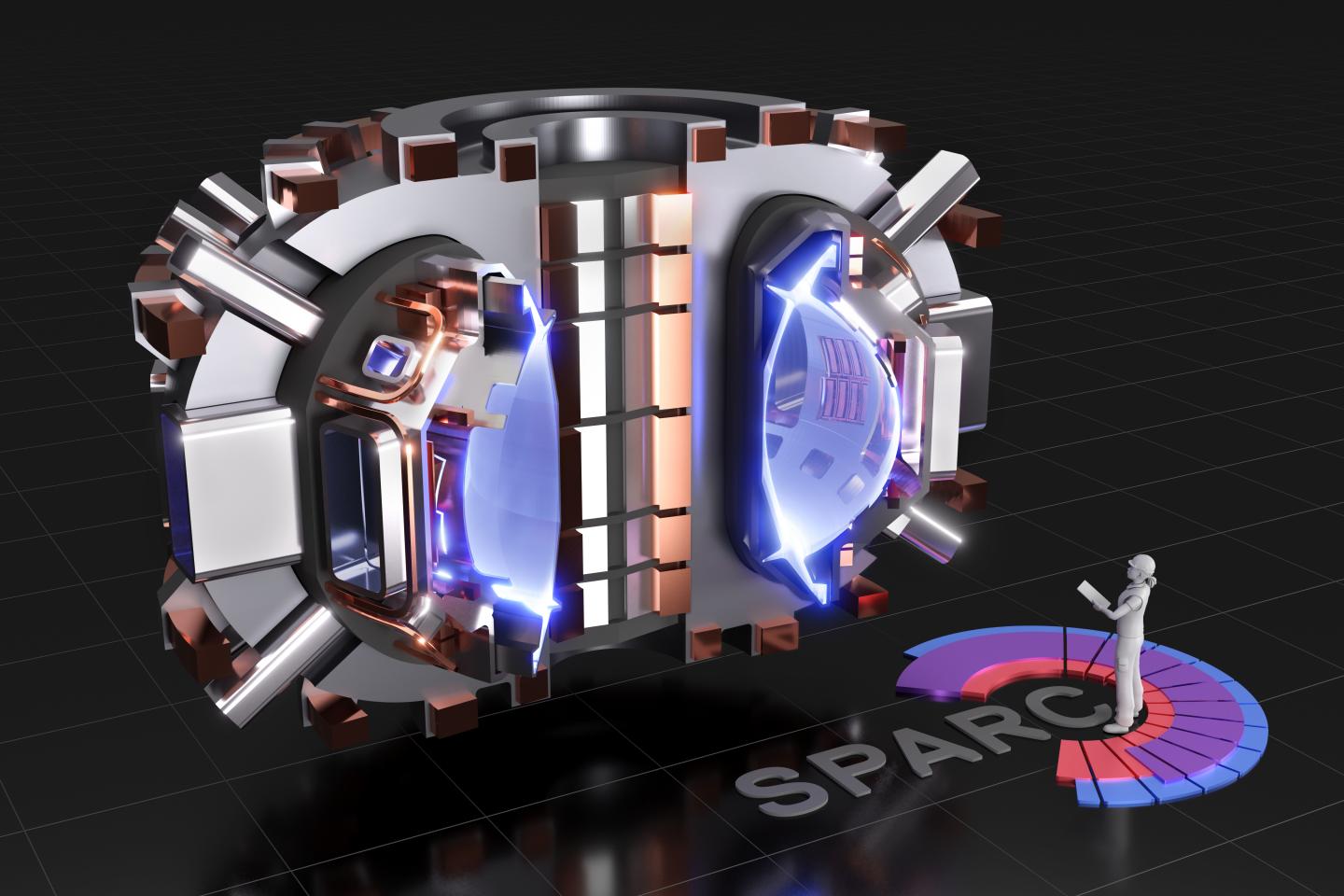
Credit: CFS/MIT-PSFC – CAD Rendering by T. Henderson
As part of the Journal of Plasma Physics‘ continuing focus on the scientific progress in fusion physics, the journal editors and Cambridge University Press are proud to present an important Special Issue of JPP, the Status of the SPARC Physics Basis.
This special issue’s seven peer-reviewed articles provide a comprehensive summary of the physics basis for SPARC: a compact, high-field, DT burning tokamak, currently under design by a team from the Massachusetts Institute of Technology and Commonwealth Fusion Systems.
SPARC is a new nuclear reactor concept based on fusing hydrogen nuclei rather than splitting uranium atoms. The intense design work happening at MIT builds on two big ideas. They are leveraging decades of scientific progress in magnetic confinement fusion, and marrying that with recent breakthroughs in high-temperature superconductor technology. How they will handle the challenges of delivering on the promise of fusion energy with these foundations is laid out in these seven peer-reviewed articles that make up the special issue of JPP.
William Dorland, JPP Editor, University of Maryland, USA, said: “This is one of a growing number of fusion projects with significant non-governmental funding, and it is the first and only project with substantial private funding to publish a detailed, peer-reviewed study of the physics basis of the proposed experiment. I expect this collection of papers to raise the bar that private investors use to estimate the risks and rewards associated with fusion investments.”
This progress puts researchers in a position to take advantage of a technological break-through developed outside of the field, namely the emergence of high-temperature superconductors (HTS) as a practical engineering material.
Guest Editorial Author Martin Greenwald, Plasma Science & Fusion Center, Massachusetts Institute of Technology: “These studies put SPARC on a firm scientific basis. When we build and operate the machine as described in these papers, we fully expect to meet our target for fusion gain and produce a wealth of new and important information on burning plasmas”
Leveraging the broad progress in tokamak physics, the SPARC design has been fundamentally informed by existing experimental observations, as was ITER’s, but also by first principles, theory-based modelling. Both approaches result in essentially the same prediction of overall plasma performance and fusion gain, thereby increasing confidence in the projections. Ongoing work features the use of state-of-the-art codes for calculation of RF heating, turbulent transport, pedestal structure, edge profiles, MHD stability, and ripple losses of fast alphas.
The seven papers review the basic parameters of the machine, predictions of core and pedestal performance, RF heating, divertor physics, MHD, disruptions and the confinement of fast particles.
“JPP is proud to host this set of important papers, which lay out how to use state-of-the-art plasma physics science to design and engineer a fusion reactor experiment. Plasma physicists are part of a vibrant scientific community that is driven by technological advances. We are excited to be the platform chosen by the SPARC team for this set of important scientific publications. This reinforces a standard for the way in which new experiments can be proposed: in an open-access, peer-reviewed format.” – William Dorland
With the basic machine parameters set, the SPARC physics team has already begun a deeper level of physics analysis, aimed at informing and confirming design choices, developing a range of operational scenarios and control strategies, defining diagnostic needs and outlining the scientific research program.
Read the Introduction to the SPARC special issue: Status of the SPARC Physics Basis by Martin Greenwald at https:/
All seven articles in the Journal of Plasma Physics Special Issue, Status of the SPARC Physics Basis, are open access and can be found at http://www.
###
Media Contact
Martin Greenwald
[email protected]
Original Source
https:/
Related Journal Article
http://dx.