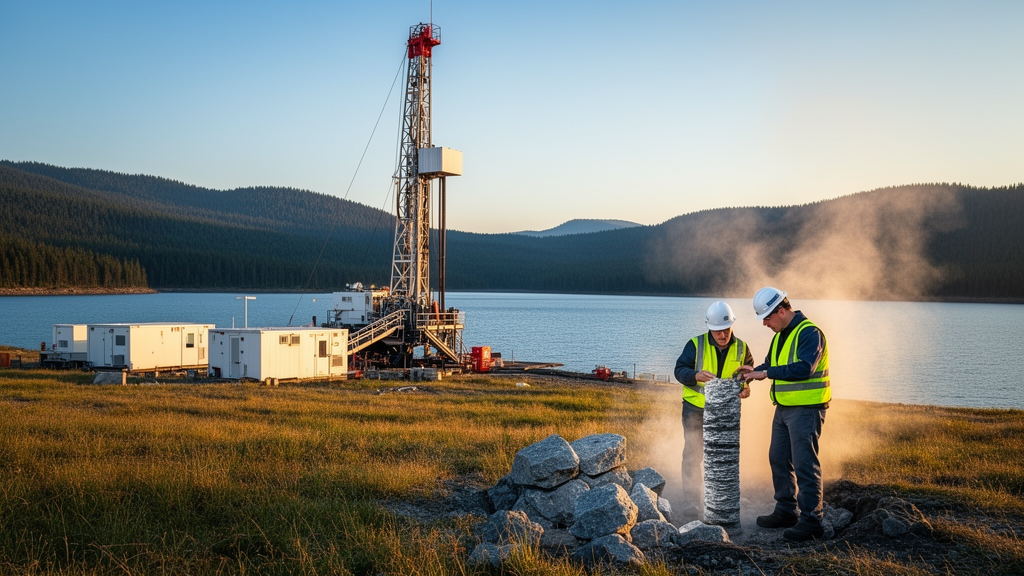
Beneath the rolling hills and vineyards of western Germany lies one of Europe’s most quietly unsettling geological secrets. The Eifel region, better known to tourists for its crater lakes and medieval towns, hosts hundreds of volcanoes of Quaternary age, including the Laacher See volcano, which unleashed a colossal eruption of volcanic explosivity index 6 roughly 13,000 years ago, ejecting 6.3 cubic kilometers of dense rock equivalent. Today the volcano is dormant but far from dead: it is actively deforming, degassing carbon dioxide, and trembling with deep earthquakes. Now, following three international workshops, a consortium of leading geoscientists has laid out a detailed plan to do something unprecedented, namely to drill directly into the plumbing system of an actively degassing intraplate volcano that sits above one of the youngest silicate-carbonatite intrusive complexes known anywhere on Earth.
The scientific case rests on a paradox that has puzzled researchers for years. The Laacher See region shows exceptionally high uplift rates on spatial scales of hundreds of kilometers, persistent seismic activity, and vigorous carbon dioxide degassing from springs and mofettes, gas vents that bubble mantle-derived CO2 straight out of the ground. The helium isotopic composition of these gases, with elevated 3He/4He ratios, demonstrates a significant contribution from the Earth’s mantle. Yet the shallow hydrothermal system above the residual magma reservoir appears to be surprisingly cold, despite the fact that the system beneath is clearly dynamic. Only drilling, the workshop participants concluded, can resolve this contradiction by sampling the fluids and host rocks at depth and by providing the first reliable heat flow measurements for the region.
The evidence for what lies beneath is extraordinary in itself. Plutonic ejecta clasts, fragments of rock torn from the walls of the magma system and hurled out during the eruption, are found in the pyroclastic deposits of the Laacher See volcano. These clasts include cogenetic carbonatite, a rare igneous rock rich in carbonate minerals, whose study transformed early hypotheses about the crustal origins of carbonatites by demonstrating their mantle-like carbon and oxygen isotopic composition. The carbonatite ejecta reach critical mineral levels of roughly 0.25 weight percent rare earth element and yttrium oxide, well above the global median for carbonatites of about 0.08 weight percent. This provides tangible evidence for magmatic pre-enrichment and hydrothermal redistribution of critical elements within the Laacher See magma plumbing system, and it hints at processes that, in older fossil systems, have produced world-class ore deposits.
Recent geophysical observations have sharpened the picture considerably. Deep low-frequency earthquakes, first detected in 2013, occur in persistent depth clusters and trace a subvertical channel structure between 10 and 45 kilometers depth through which CO2-rich fluids and possibly melt migrate upward. This transcrustal channel coincides with the location of the highest CO2 fluxes and the most elevated helium isotope ratios in the region, close to the village of Glees. Local earthquake tomography, drawing on a large-N passive seismological experiment with more than 500 stations deployed between 2022 and 2023, has resolved a cylindrical velocity anomaly beneath Laacher See with a diameter of about 3 kilometers, dipping roughly 53 degrees toward the south-southeast and reaching a depth of about 10 kilometers. Three-dimensional gravity inversion confirms a density deficit down to at least 9 kilometers depth, and receiver function analysis reveals strong upwellings of the crust-mantle boundary and the lithosphere-asthenosphere boundary beneath the region.
The eruption history adds urgency to the hazard questions. Volcanism in the East Eifel Volcanic Field began at the Rieden center around 460,000 to 430,000 years ago, migrated southeastward, and culminated in the VEI 6 eruption of Laacher See at 13,000 years ago, an event precisely dated by tree-ring-correlated radiocarbon and speleothem uranium-series methods. More than 350 eruptions occurred within roughly 700,000 years across the Eifel fields. Petrological studies show that the pre-eruptive reservoir was thermally and compositionally stratified, remained hot above 560 degrees Celsius for tens of thousands of years, and received a basanitic recharge with magma-mingling timescales of less than 400 days before the climactic eruption. That spontaneous response between recharge and eruption poses a serious challenge for hazard assessment in systems with long and irregular recurrence intervals.
Even more intriguing are the possible precursors. Mapping along the western slope of the Veitskopf scoria cone has identified diatreme breccias, structures interpreted as potentially CO2-driven explosive events that may represent precursor activity related to the ancestral Laacher See system. Remarkably large aligned tree trunks, one meter long and about 30 centimeters in diameter, are preserved near the base of these breccia deposits, along with charred plant remnants. Radiocarbon dating indicates the terminal diatreme breccia deposition occurred before 13,000 years ago, with a tree trunk minimum age of about 51,000 years. Evidence for cold, CO2-driven diatreme formation, combined with current deformation transients and occasional limnic gas bursts in the lake itself, including an eyewitness report from August 2022, suggests that long-lasting gas recharge into and release from subsurface CO2 reservoirs poses hazards that are currently widely disregarded, both in the Eifel and elsewhere.
The workshop process, funded in part by the International Continental Scientific Drilling Programme, brought together more than 80 participants from 10 countries and produced a clear two-phase strategy. Phase 1 comprises four shallow boreholes of 300 to 2000 meters depth. The first, planned near Glees as part of the ERC Synergy Project Archean Park, targets a CO2 mofette location about 1.6 kilometers northwest of the lake with a target depth of 300 meters, drilling planned for winter 2025 to spring 2026. A second site near Krufter Waldsee, about 3 kilometers southeast of the lake center, would core a maar structure whose lake sediments may preserve an unprecedented record of precursor events before the cataclysmic eruption. A third site would test links between surface fluid transients and deep low-frequency earthquakes, while a fourth would constrain volcano-tectonic subsidence associated with the 13,000-year-old eruption.
Phase 2, the aspirational deep hole of 3000 to 4000 meters, would penetrate and core the syenitic-carbonatitic intrusive carapace and its hydrothermal aureole at an anticipated depth of 4 to 6 kilometers at its top. This would be globally unique: direct sampling of fluids and rocks within an active silicate-carbonatite system, unmodified by the weathering, erosion, and metamorphic overprinting that complicate the study of older carbonatites. Such samples are the tangible evidence required to properly balance CO2 fluxes from degassing magma against CO2 sequestration in carbonatites and fluid-precipitated carbonates, a question with direct relevance to understanding both the global volcanic carbon budget and the feasibility of anthropogenic carbon storage in continental settings.
The stakes extend beyond pure science. Carbonatites are the primary resource for the rare earth elements needed for permanent magnets in the transition to a zero-emission economy, and silicate-carbonatite intrusions are globally recognized as major hosts for critical metal deposits. The Laacher See project would complement the ICDP REEDRILL project targeting the fossil Songwe Hill complex in Malawi by capturing mineralizing processes in the act of formation. Instrumented wells would also transform monitoring, using borehole thermometry, tiltmeters, geophones, optical fibers, and pressure sensors to detect weak precursor signals of magma ascent. With the region’s dense population, excellent infrastructure, and 200 years of prior research, the workshop participants concluded that Laacher See is an ideal test bed, one whose lessons will apply to distributed volcanic fields worldwide, from Auckland to Medina, where similar hazards lurk beneath deceptively calm landscapes.
Subject of Research: Scientific drilling of the actively degassing Laacher See volcano and its underlying silicate-carbonatite intrusion in the Eifel volcanic field, Germany
Article Title: Follow the CO2 – drilling into an actively degassing intraplate volcano underlain by a silicate–carbonatite intrusion
Article References: Dahm, T., Schmitt, A. K., de Silva, S., Fischer, T., Holzheid, A., Kukowski, N., Lavallee, Y., Sturm, A., & Troch, J. (2026). Follow the CO 2 – drilling into an actively degassing intraplate volcano underlain by a silicate–carbonatite intrusion. Scientific Drilling, 35(1), 1-20. https://doi.org/10.5194/sd-35-1-2026
Image Credits: AI Generated
DOI: 10.5194/sd-35-1-2026
Keywords: Laacher See, Eifel volcanism, scientific drilling, carbonatite, carbon dioxide degassing, intraplate volcanism, maar volcanoes, deep low-frequency earthquakes, rare earth elements, ICDP, magma reservoir, volcanic hazards
News Source: Violet Maxwell. (October 9, 2026). Scientists Plan to Drill Into Germany’s Restless Laacher See Volcano to Follow Its Carbon Dioxide Trail. Scienmag.