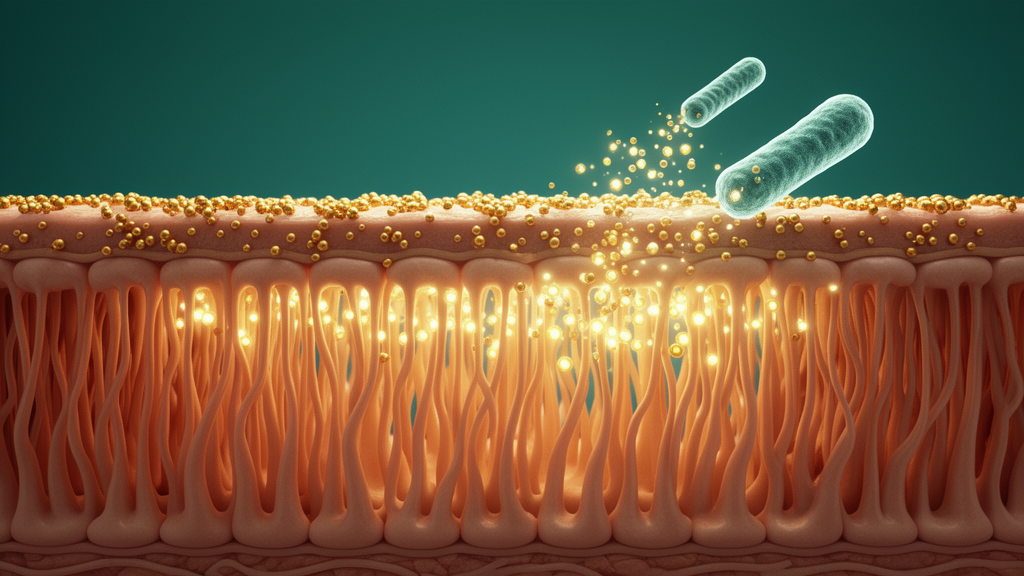
A polysaccharide extracted from the bracket fungus Ganoderma applanatum, long prized in traditional medicine, has been shown to heal a damaged intestinal barrier by a route that runs entirely through the gut microbiota. Researchers report in Advanced Science that a purified fraction of these polysaccharides, dubbed GAP2, selectively feeds a common human commensal bacterium, Phocaeicola vulgatus, prompting it to churn out an obscure fatty acid called tridecylic acid. That microbe-made molecule then switches on a signaling circuit inside intestinal epithelial cells that rebuilds the tight junctions holding the gut lining together. The work, published on 7 October 2026, offers one of the most complete chains of evidence yet for how a dietary fiber-like compound can act as a prebiotic, its bacterial partners as the engine, and a bacterial metabolite as the postbiotic drug.
The intestinal barrier is a single layer of epithelial cells sealed by protein complexes known as tight junctions, which include zonula occludens-1 (ZO-1), occludin, and claudins. When these seals fail, bacteria and antigens slip into the underlying tissue, igniting the mucosal inflammation that drives inflammatory bowel disease, including ulcerative colitis and Crohn’s disease. Strategies that restore tight junction integrity are therefore a major goal of colitis research. Gut microbes contribute to barrier health largely through their metabolites, and in colitis a loss of protective bacteria such as Bacteroides, Roseburia, Lactobacillus, and Akkermansia is typically accompanied by reduced short-chain fatty acid production, starving the epithelium of energy and weakening junctional homeostasis. What has been missing, the authors argue, is a systematic map connecting a defined natural polysaccharide to a specific microbe, a specific metabolite, and a specific host signaling pathway.
To find that map, the team first fractionated hot-water extracts of G. applanatum fruiting bodies using anion-exchange and gel-filtration chromatography, yielding four purified fractions named GAP1 through GAP4 according to their salt elution order. When administered to mice with dextran sulfate sodium (DSS)-induced colitis, all fractions eased clinical signs such as weight loss, colon shortening, and disease activity index, but only GAP1 and GAP2 significantly modulated barrier-related proteins, suppressed the enzymes iNOS, MPO, and COX-2, lowered pro-inflammatory cytokines including IL-1β, IL-6, IL-17, and TNF-α, raised the anti-inflammatory cytokine IL-10, and improved histological appearance of the mucosa. Structural analysis by nuclear magnetic resonance and mass spectrometry revealed why the two winners might behave differently: GAP1 is a branched heteropolysaccharide rich in mannose, glucose, and galactose, whereas GAP2 is a comparatively simple linear β-glucan built from a repeating →3)-β-Glcp-(1→ backbone with an average molecular weight of about 2.05 × 10^4 Da.
The decisive experiment came from germ-free mice. When the polysaccharides were given directly to animals lacking a microbiome, they lost nearly all of their protective power, failing to prevent weight loss, colon shortening, or histological damage. Yet when the researchers transplanted fecal material from polysaccharide-treated donor mice into germ-free recipients, or gavaged those recipients with filtered, bacteria-free fecal metabolites, barrier protection returned in full, with restored ZO-1 and occludin expression and intact epithelial architecture. In other words, the polysaccharides themselves never touch the epithelium in a meaningful way; the true therapeutic agents are the microbes and metabolites that the polysaccharides cultivate. This postbiotic-inducing mechanism places GAP firmly in the emerging class of dietary compounds whose benefits are entirely microbiota-dependent.
When the team delayed treatment until after DSS injury had been established, to mimic patients who already have a damaged barrier, GAP2 outperformed GAP1 decisively, accelerating weight and colon-length recovery, preserving glandular structure, boosting mucus-producing cells, and elevating tight junction protein abundance. Because the two fractions have nearly identical molecular weights, the authors attribute the difference to their structures: GAP2’s unbranched β-glucan backbone is more bioavailable and more readily digested by the right bacteria, whereas side chains on GAP1 generally reduce polysaccharide degradability. Shotgun metagenomic sequencing of fecal samples showed that GAP2 restored microbial α-diversity and enriched beneficial genera including Bacteroides, Parabacteroides, Akkermansia, Alistipes, and members of the Lachnospiraceae and Oscillospiraceae. Machine-learning feature selection singled out one organism above all others: Phocaeicola vulgatus, a commensal colonizer present in up to 90 percent of the global human population.
Untargeted metabolomics then identified the chemical messenger. Among all differentially enriched metabolites, the odd-chain fatty acid tridecylic acid (C13:0) stood out, and it was the only fatty acid whose fecal concentration correlated significantly with P. vulgatus abundance in GAP2-treated mice. KEGG pathway analysis showed that GAP2 shifted the community toward fatty acid biosynthesis and related routes while downgrading virulence-associated features such as type IV pili, capsules, and lipopolysaccharide. To prove causation rather than correlation, the researchers grew P. vulgatus in pure culture with GAP2 as the sole carbon source. The bacterium grew on GAP2 as well as it grows on glucose, reaching an optical density of 0.75 at 24 hours, and qPCR showed GAP2 raised its absolute abundance roughly tenfold compared with GAP1, to about 10^9 CFU per milliliter, with tridecylic acid accumulating to the highest levels seen across any tested substrate, including inulin, xylan, arabinoxylan, mannan, and β-glucan.
Genome sequencing confirmed that P. vulgatus carries the complete fatty acid biosynthesis toolkit, including fabB, fabG, fabZ, fabK, and FatA, plus the GH16 hydrolase needed to cleave GAP2’s β-glucan backbone. Using a CRISPR-Cas system, the team built knockout mutants to close the loop. Deleting GH16 crippled the bacterium’s growth on GAP2, confirming the enzyme’s role in accessing the polysaccharide, while deleting fabB left growth intact but abolished tridecylic acid production, pinpointing the elongation step as the metabolic bottleneck. On the host side, transcriptomics of colon tissue from GAP2-treated mice revealed upregulation of the cell adhesion network, with elevated CDC42, Rho, BAIAP2, and Par3, and western blots confirmed increased ZO-1, occludin, and MUC2. In LPS-stressed Caco-2 epithelial cells, tridecylic acid alone reproduced the effect, restoring Rho, CDC42, and BAIAP2 expression and raising tight junction proteins, implicating the Rho/CDC42 pathway, which stabilizes the perijunctional actin cytoskeleton and promotes ZO-1 and occludin deposition, as the downstream target.
The clinical relevance received support from a large human metagenomic dataset covering 460 healthy controls and 575 ulcerative colitis patients. The UC cohort showed significantly reduced microbial diversity by Shannon and Chao1 indices and a distinct community composition, with P. vulgatus showing the largest drop of any taxon and emerging as a key discriminator between the groups. Critically, the abundance of genes in the tridecylic acid synthesis pathway, including fabB, fabG, fabZ, fabK, and FatA, was markedly reduced in UC patients, suggesting that the loss of this microbe-metabolite axis accompanies barrier breakdown in human disease. The authors caution that these human data are observational and lack direct metabolite measurements, so extrapolation to patients requires intervention trials and metabolomics in human systems.
The study also situates tridecylic acid within a broader pattern. Recent work has shown that Parabacteroides distasonis can produce pentadecanoic acid from inulin to ease non-alcoholic steatohepatitis, and that Bacteroides acidifaciens generates C15:0 when fed galacto-oligosaccharides alongside Limosilactobacillus reuteri, dampening NF-κB activation and strengthening tight junctions. Tridecylic acid itself has documented anti-inflammatory, anti-fibrotic, and anti-cancer activities through AMPK and PPAR-α/δ activation and inhibition of mTOR, JAK3-STAT1, and HDAC6, plus antimicrobial and anti-biofilm effects against Escherichia coli. Because every enzyme in its biosynthesis is encoded in the P. vulgatus genome, the authors suggest that genetic engineering or targeted regulatory switches could one day allow precise in vivo control of tridecylic acid production, in the same spirit as recent efforts to engineer P. vulgatus for oxalate degradation. For now, the findings establish a clean, testable model: a defined mushroom polysaccharide feeds a defined commensal, which makes a defined fatty acid that repairs the gut wall through a defined signaling pathway, giving researchers a blueprint for designing postbiotic-inducing dietary interventions for ulcerative colitis and related inflammatory mucosal disorders.
Subject of Research: Microbiota-dependent repair of intestinal barrier dysfunction in ulcerative colitis by a Ganoderma applanatum polysaccharide inducing tridecylic acid production in Phocaeicola vulgatus
Article Title: A Postbiotic‐Inducing Ganoderma applanatum Polysaccharide Repairs the Intestinal Barrier via a Phocaeicola vulgatus ‐ Tridecylic Acid Axis
Article References: Zhang, C., Li, M., Li, T., Zang, X., Shi, H., Liu, Y., Zhang, C., Zhao, J., Zhai, Q., Chen, W., & Tian, F. (2026). A Postbiotic‐Inducing Ganoderma applanatum Polysaccharide Repairs the Intestinal Barrier via a Phocaeicola vulgatus ‐ Tridecylic Acid Axis. Advanced Science, Article e78105. https://doi.org/10.1002/advs.78105
Image Credits: AI Generated
DOI: 10.1002/advs.78105
Keywords: Ganoderma applanatum, polysaccharide, ulcerative colitis, intestinal barrier, Phocaeicola vulgatus, tridecylic acid, postbiotic, gut microbiota, tight junctions, CDC42, Rho signaling, prebiotic
News Source: Denise Maddox. (October 9, 2026). Mushroom Polysaccharide Repairs the Gut Barrier Through a Microbe-Made Fatty Acid. Scienmag.