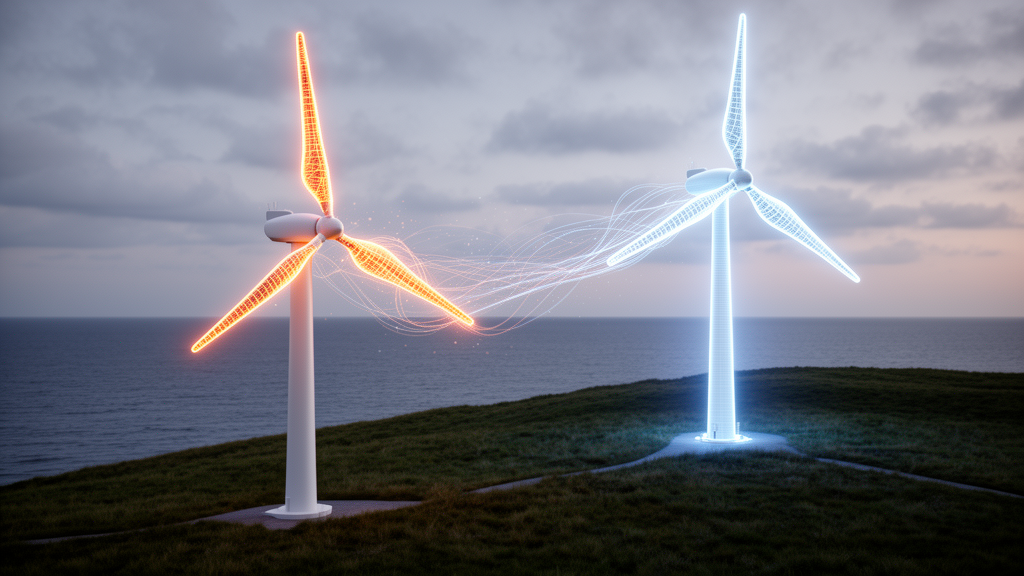
Wind turbines live brutal lives. Every gust, every shift in wind direction, every passing storm flexes their blades and towers millions of times over a service life measured in decades. Predicting how much fatigue damage accumulates inside these structures is one of the central challenges of wind energy engineering, because the stresses a turbine experiences depend on weather conditions that never stop changing. Now, researchers at the Technical University of Munich have unveiled a hybrid approach that marries physics-based simulation with machine learning, cutting fatigue load prediction errors from as much as 24 percent down to below 5 percent in field tests on a real operating turbine.
The work, published as a preprint under review at the journal Wind Energy Science by Hadi Hoghooghi and Carlo L. Bottasso of the university’s Wind Energy Institute, builds on a previously developed digital-shadow framework. A digital shadow, in this context, is a computational model of a physical turbine that runs alongside the real machine, continuously estimating quantities that cannot be directly measured, such as the bending moments acting along the blade structure. The Munich team’s innovation lies in how they correct the inevitable biases that creep into such models when reality refuses to behave exactly as the equations predict.
At the heart of the method is a linearized aeroelastic model, a computationally efficient mathematical description of how the turbine’s blades, drivetrain, and tower respond to aerodynamic forces. Linearized models are fast enough to run in real time, which is essential for a digital shadow that must keep pace with the living turbine. Their weakness, however, is accuracy. Simplifications made to keep the model tractable introduce systematic errors, or biases, that vary with the operating condition. A model that performs well in steady, uniform winds may drift badly when the rotor faces turbulent, wake-disturbed, or yawed inflow.
Hoghooghi and Bottasso’s solution is a learning-based bias correction layered on top of the physics model. A neural network is trained to learn the operating-condition-dependent discrepancies between the model’s predictions and actual measurements from the turbine. Crucially, the network does not replace the physics-based model; it augments it. The learned corrections adjust the model’s outputs while preserving its underlying structure, which means the digital shadow retains the interpretability and extrapolation behavior of an engineering model while gaining the data-fitting power of machine learning. This hybrid philosophy reflects a growing consensus in wind energy research: pure physics models are too rigid for messy atmospheric reality, while pure machine learning models are too opaque and data-hungry to be trusted with the structural safety of a multi-million-euro machine.
To validate the framework, the researchers turned to field data from a 3.5 MW eno126 turbine, gathered during two measurement campaigns in October 2020. The datasets were divided according to the complexity of the inflow conditions the turbine experienced: simple inflow, meaning relatively clean and uniform wind; complex inflow, involving turbulent or disturbed conditions such as those created by wakes from neighboring turbines; and mixed or transitional conditions that combine elements of both. After filtering, roughly 49 hours of simple-inflow data and 23 hours of complex-inflow data remained, with portions reserved for testing, along with an additional 7.5 hours of mixed and transitional data used to probe how well the method generalizes beyond its training conditions.
The headline result concerns blade bending moments evaluated at the 25 percent span location, a station partway along the blade where fatigue loads are critical to structural design. Without bias correction, the digital shadow’s damage equivalent load estimates, a standard fatigue metric that condenses a turbine’s entire loading history into a single number, carried errors of 14 to 24 percent. With the neural-network correction in place, those errors fell below 5 percent. The largest improvements appeared precisely where they were most needed: under complex inflow conditions, where the linearized model’s assumptions break down most severely and where uncorrected predictions were least trustworthy.
The team also developed a hybrid strategy that combines a baseline bias correction with the neural-network-based correction. The motivation is robustness. A neural network, however well trained, can behave unpredictably when fed conditions far outside its training distribution, and wind is nothing if not unpredictable. By blending the learned corrections with a simpler, more conservative baseline approach, the hybrid method maintains reliable performance across a wider range of operating and inflow conditions than either component could achieve alone. This kind of belt-and-braces design is likely to appeal to industrial operators, who must balance the promise of advanced analytics against the consequences of a rare but catastrophic misestimate.
The practical implications extend well beyond academic benchmarking. Accurate fatigue load estimation is the foundation of modern turbine monitoring and predictive maintenance. If an operator knows how much cyclic stress each blade has actually endured, maintenance can be scheduled based on real accumulated damage rather than conservative generic assumptions, extending component life and reducing downtime. For offshore turbines, where inspection visits are enormously expensive, the value of trustworthy digital shadows is even greater. Load estimates also feed into lifetime extension assessments, a rapidly growing concern as the first large generation of European wind turbines approaches the end of their design lives.
Yet the study has drawn pointed criticism during the open peer discussion that Copernicus journals conduct publicly. Reviewer J. Gordon Leishman acknowledged that the revised manuscript is shorter, more focused, and clearer in its comparisons between the uncorrected shadow, the baseline correction, the neural-network approaches, and the hybrid method. But he argued that the central scientific concern remains unresolved: the entire evaluation rests on a single turbine at a single site, instrumented in one way, during one autumn month. The so-called unseen test data, he noted, still come from the same machine and campaign, constituting holdout validation within one dataset rather than genuinely independent external validation. Because a learned correction may absorb turbine-specific structural properties, controller behavior, sensor characteristics, and site peculiarities, there is no evidence yet that the method transfers to another turbine, another season, or another site. Leishman also questioned the independence of the validation quantity itself, observing that root and inboard blade bending moments are structurally related, so agreement at a second spanwise station checks structural-load estimation without proving the underlying aerodynamic loading was correctly reconstructed. In a separate comment, he further raised a potential conflict-of-interest concern, noting that corresponding author Bottasso serves as Editor-in-Chief of Wind Energy Science and arguing that an independent editor should handle the manuscript.
These criticisms do not erase the significance of the result; they define its boundary. What Hoghooghi and Bottasso have demonstrated is that physics-plus-learning digital shadows can achieve remarkable accuracy on the turbine and conditions where they were trained and tested, with the gains concentrated exactly in the difficult flow regimes that matter most. The authors themselves flag wake flows, yawed conditions, offshore environments, additional turbine platforms, and strongly transient operation as future work, which is precisely the list of challenges any claim of broad applicability must eventually confront. If the method survives that wider testing, the payoff could be substantial: a generation of turbines whose structural health is known not from conservative design envelopes but from continuously corrected, physically grounded, learning-enhanced estimates of the real loads they carry through every gust. For an industry betting trillions on machines that must endure twenty-five years of punishment in the sky, that kind of visibility may prove one of the most consequential technologies of the energy transition.
Subject of Research: Hybrid physics and machine learning digital shadows for wind turbine fatigue load estimation
Article Title: Brief communication: Enhanced wind turbine fatigue load estimation using digital shadows with data-driven bias correction
Article References: Hoghooghi, H., & Bottasso, C. L. (2026). Brief communication: Enhanced wind turbine fatigue load estimation using digital shadows with data-driven bias correction. https://doi.org/10.5194/wes-2026-156
Image Credits: AI Generated
DOI: 10.5194/wes-2026-156
Keywords: wind energy, digital shadow, fatigue loads, bias correction, neural network, aeroelasticity, damage equivalent load, predictive maintenance, turbine monitoring, machine learning, blade bending moments, Wind Energy Science
News Source: Faith Mcneil. (October 9, 2026). AI-Boosted Digital Shadows Slash Wind Turbine Fatigue Prediction Errors. Scienmag.