• HOME
  • NEWS
  • EXPLORE
    • CAREER
      • Companies
      • Jobs
    • EVENTS
    • iGEM
      • News
      • Team
    • PHOTOS
    • VIDEO
    • WIKI
  • BLOG
  • COMMUNITY
    • FACEBOOK
    • INSTAGRAM
    • TWITTER
Monday, June 29, 2026
BIOENGINEER.ORG
No Result
View All Result
  • Login
  • HOME
  • NEWS
  • EXPLORE
    • CAREER
      • Companies
      • Jobs
        • Lecturer
        • PhD Studentship
        • Postdoc
        • Research Assistant
    • EVENTS
    • iGEM
      • News
      • Team
    • PHOTOS
    • VIDEO
    • WIKI
  • BLOG
  • COMMUNITY
    • FACEBOOK
    • INSTAGRAM
    • TWITTER
  • HOME
  • NEWS
  • EXPLORE
    • CAREER
      • Companies
      • Jobs
        • Lecturer
        • PhD Studentship
        • Postdoc
        • Research Assistant
    • EVENTS
    • iGEM
      • News
      • Team
    • PHOTOS
    • VIDEO
    • WIKI
  • BLOG
  • COMMUNITY
    • FACEBOOK
    • INSTAGRAM
    • TWITTER
No Result
View All Result
Bioengineer.org
No Result
View All Result
Home NEWS Science News Health

Scientists map toxic proteins linked to Alzheimer’s

Bioengineer by Bioengineer
June 20, 2019
in Health
Reading Time: 2 mins read
0
IMAGE
Share on FacebookShare on TwitterShare on LinkedinShare on RedditShare on Telegram

IMAGE

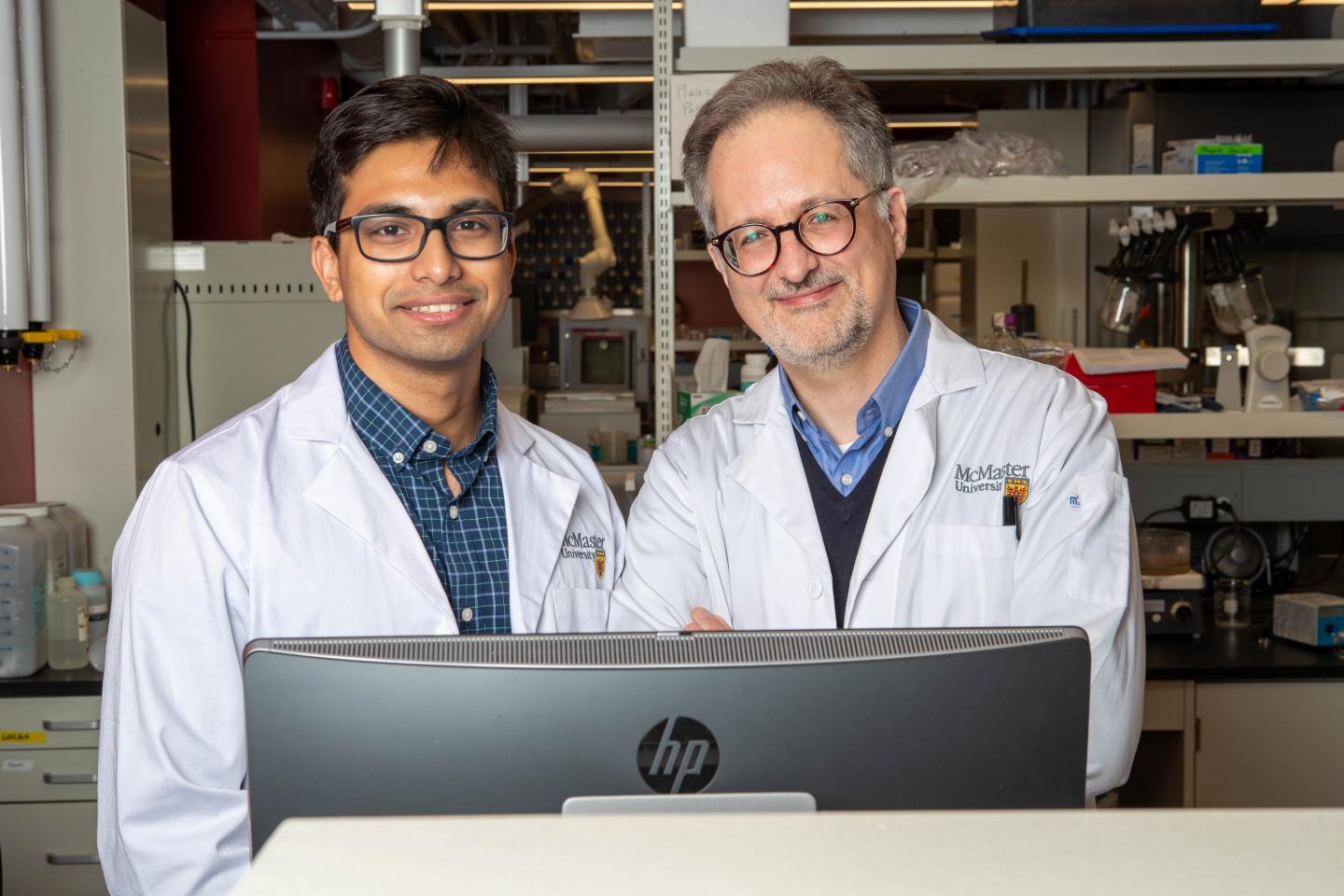
Credit: Georgia Kirkos, McMaster University

A team of researchers from McMaster University has mapped at atomic resolution a toxic protein linked to Alzheimer’s disease, allowing them to better understand what is happening deep within the brain during the earliest stages of the disease.

The findings, published on the front cover of the current edition of the Royal Society of Chemistry flagship journal Chemical Science, provide new insights into the behavior of one of the prime suspects of Alzheimer’s disease: a protein fragment known as amyloid beta, which clumps together into oligomers during the early stages of the disease.

Researchers liken amyloid beta oligomers to a neurotoxic ‘bomb’, causing the irreversible death of neurons.

“To defuse the bomb, we need to know with a high degree of precision which wires to cut and which to avoid,” explains Giuseppe Melacini, senior author and a professor in the Departments of Chemistry and Chemical Biology as well as Biochemistry and Biomedical Sciences at McMaster University.

“This is why it is critical to map the structural features that differentiate what is toxic and what is not. However, this is a challenging task due to the transient and elusive nature of these oligomers,” he says.

Melacini, who has studied the underlying mechanisms of Alzheimer’s for nearly two decades, is working with a team of physicists, chemists, biologists and dementia specialists at McMaster, including Maikel Rheinstädter, Richard Epand, Ryan Wylie and Chris Verschoor. Each team member brings a unique perspective and specialty to an investigation which requires highly specialized equipment, including wide-angle X-ray diffraction and nuclear magnetic resonance (NMR) to conduct the analysis at the atomic level.

For the study, the team used a library of natural products extracted from green tea that are believed to interfere with the formation of the toxic protein oligomers to varying degrees. Using this toolkit they were able to build oligomers with different toxicities, allowing the team to gain unprecedented insights into how they interact with neurons and cause cell death.

They hope this research can help them determine how to defuse the neurotoxic bomb.

“Alzheimer’s disease is a major medical, social and economic problem,” says Rashik Ahmed, the lead author on the paper and PhD candidate in the Department of Biochemistry and Biomedical Sciences. “This research is the first step towards identifying how we can stop the progression of Alzheimer’s disease before it becomes irreparable.”

By some estimates, there are more than half a million Canadians living with dementia and the number is expected to reach more than a million by the year 2031. Once symptoms emerge, there is no known cure for Alzheimer’s and treatment options are limited.

###

Media Contact
Michelle Donovan
[email protected]

Tags: AlzheimerBiochemistryCell BiologyChemistry/Physics/Materials SciencesMedicine/HealthneurobiologyNeurochemistry
Share12Tweet8Share2ShareShareShare2

Related Posts

Tracking Lanthanide-Labeled Microplastics in Plants

June 25, 2026

Neural Design Enables Zero-Shot Drug-Binding Proteins

June 25, 2026

Genomic Insights into Human Skin Fungi Diversity

June 25, 2026

Chiral Laser Gyroscopes Surpass Lock-In Limit

June 25, 2026
Please login to join discussion

POPULAR NEWS

  • Saying Goodbye to PGY-6: Pediatric Fellowship Realities

    103 shares
    Share 41 Tweet 26
  • Multi-Hospital Study Reveals Long Covid Burden Is Twice as High as Current Estimates

    92 shares
    Share 36 Tweet 23
  • Detection of EDCs in Breast Milk and Infant Urine Up to Six Months Highlights Early Exposure Risks

    77 shares
    Share 31 Tweet 19
  • New Drug Candidate Developed at McMaster Shows Potential for Treating Brain Cancer

    58 shares
    Share 23 Tweet 15

About

We bring you the latest biotechnology news from best research centers and universities around the world. Check our website.

Follow us

Recent News

Tracking Lanthanide-Labeled Microplastics in Plants

POSTECH Researchers Slash Cost of Reconstituted Cell-Free Systems by 95%

AI and Physics Collaborate to Design Advanced Hydrogen Storage Materials

Subscribe to Blog via Email

Success! An email was just sent to confirm your subscription. Please find the email now and click 'Confirm' to start subscribing.

Join 82 other subscribers
  • Contact Us

Bioengineer.org © Copyright 2023 All Rights Reserved.

Welcome Back!

Login to your account below

Forgotten Password?

Retrieve your password

Please enter your username or email address to reset your password.

Log In
No Result
View All Result
  • Homepages
    • Home Page 1
    • Home Page 2
  • News
  • National
  • Business
  • Health
  • Lifestyle
  • Science

Bioengineer.org © Copyright 2023 All Rights Reserved.