Scientists have shown that the loss of function of two paralogous starch biosynthetic genes contributes to an increase in resistant starch (RS) content in cooked rice, providing insights into the generation of high-RS varieties in rice and possibly other cereals.
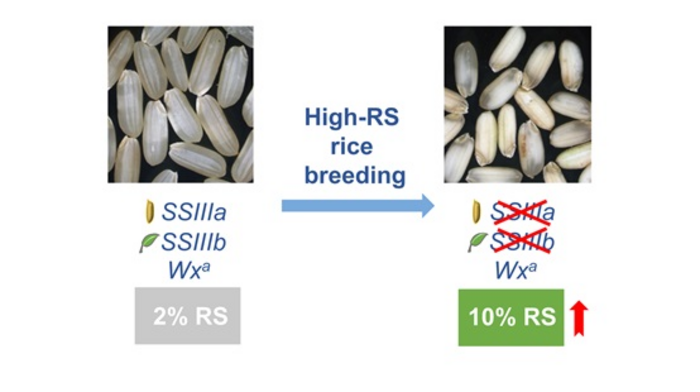
Credit: IGDB
Scientists have shown that the loss of function of two paralogous starch biosynthetic genes contributes to an increase in resistant starch (RS) content in cooked rice, providing insights into the generation of high-RS varieties in rice and possibly other cereals.
This study, conducted by Prof. LI Jiayang’s team from the Institute of Genetics and Developmental Biology (IGDB) of the Chinese Academy of Sciences and Prof. WU Dianxing’s team from the Zhejiang University, was published online in PNAS on May 1.
Sedentary lifestyles and long-term overeating lead to obesity, type 2 diabetes, and related complications, which have become a major threat to global health. This incidence could potentially be reduced through appropriate dietary approaches by regulating glucose homeostasis.
In contrast with rapidly digested starch, RS is a type of special starch that cannot be digested in the small intestine but is transferred to the large intestine for slow fermentation, which is beneficial to intestinal health and may improve various related conditions, such as inflammatory bowel disease, insulin resistance and type 2 diabetes, and weight management.
Rice is an excellent source of starch, but most cooked rice contained low levels of RS (< 2%). Therefore, the identification of new RS genes has important theoretical and practical significance for improving the nutritional value of rice.
SSIIIa, previously reported by LI and WU’s teams, is a high-RS gene. The RS content in the loss-of-function ssIIIa mutant in the indica rice background with a Wxa allele increased to ~6%. Although SSIIIa and Wx contributed to RS formation, more functional RS genes were still desired.
In view of this, the researchers used a high-RS mutant rs4 (~10% RS content) generated by physical mutagenesis. Through genetic analysis, resequencing, and cloning of the segregating population, they identified a novel high RS gene, SSIIIb, that harbors a frame-shift mutation in the rs4 mutant in addition to the SSIIIa deficiency.
They found that the ssIIIb single mutation had no effect on RS levels, but when it pyramided with ssIIIa to form the double mutant ssIIIa ssIIIb, RS levels further increased to 10% in the indica rice background. The increased RS levels in ssIIIa and ssIIIa ssIIIb mutants were associated with increased amylose and lipid levels.
Furthermore, the researchers showed that SSIIIb and SSIIIa proteins derive from paralogous genes of the rice SSIII family, whereas SSIIIb functions mainly in leaves and SSIIIa mainly in endosperm due to their divergent tissue-specific expression patterns. SSIII underwent gene duplication in different cereals, with one SSIII paralog being expressed mainly in leaves and another in the endosperm. SSII also showed an evolutionary pattern similar to that of SSIII. The duplication of SSIII and SSII was associated with high total starch content and low RS levels in the seeds of tested cereals, compared with low starch content and high RS levels in tested dicots.
These results provide important genetic resources for breeding high-RS rice varieties, and the evolutionary characteristics of these genes may facilitate the generation of high-RS varieties in different cereals.
This work was supported by the National Key R&D Program of China, the Hainan Excellent Talent Team, and the China Agriculture Research System.
Journal
Proceedings of the National Academy of Sciences
DOI
10.1073/pnas.2220622120
Method of Research
Experimental study
Subject of Research
Not applicable
Article Title
Loss of function of SSIIIa and SSIIIb coordinately confers high RS content in cooked rice
Article Publication Date
1-May-2023