• HOME
  • NEWS
  • EXPLORE
    • CAREER
      • Companies
      • Jobs
    • EVENTS
    • iGEM
      • News
      • Team
    • PHOTOS
    • VIDEO
    • WIKI
  • BLOG
  • COMMUNITY
    • FACEBOOK
    • INSTAGRAM
    • TWITTER
Wednesday, May 13, 2026
BIOENGINEER.ORG
No Result
View All Result
  • Login
  • HOME
  • NEWS
  • EXPLORE
    • CAREER
      • Companies
      • Jobs
        • Lecturer
        • PhD Studentship
        • Postdoc
        • Research Assistant
    • EVENTS
    • iGEM
      • News
      • Team
    • PHOTOS
    • VIDEO
    • WIKI
  • BLOG
  • COMMUNITY
    • FACEBOOK
    • INSTAGRAM
    • TWITTER
  • HOME
  • NEWS
  • EXPLORE
    • CAREER
      • Companies
      • Jobs
        • Lecturer
        • PhD Studentship
        • Postdoc
        • Research Assistant
    • EVENTS
    • iGEM
      • News
      • Team
    • PHOTOS
    • VIDEO
    • WIKI
  • BLOG
  • COMMUNITY
    • FACEBOOK
    • INSTAGRAM
    • TWITTER
No Result
View All Result
Bioengineer.org
No Result
View All Result
Home NEWS Science News Chemistry

Scientists have synthesized an unusual superconducting barium superhydride

Bioengineer by Bioengineer
January 12, 2021
in Chemistry
Reading Time: 2 mins read
0
IMAGE
Share on FacebookShare on TwitterShare on LinkedinShare on RedditShare on Telegram

IMAGE

Credit: Pavel Odinev / Skoltech

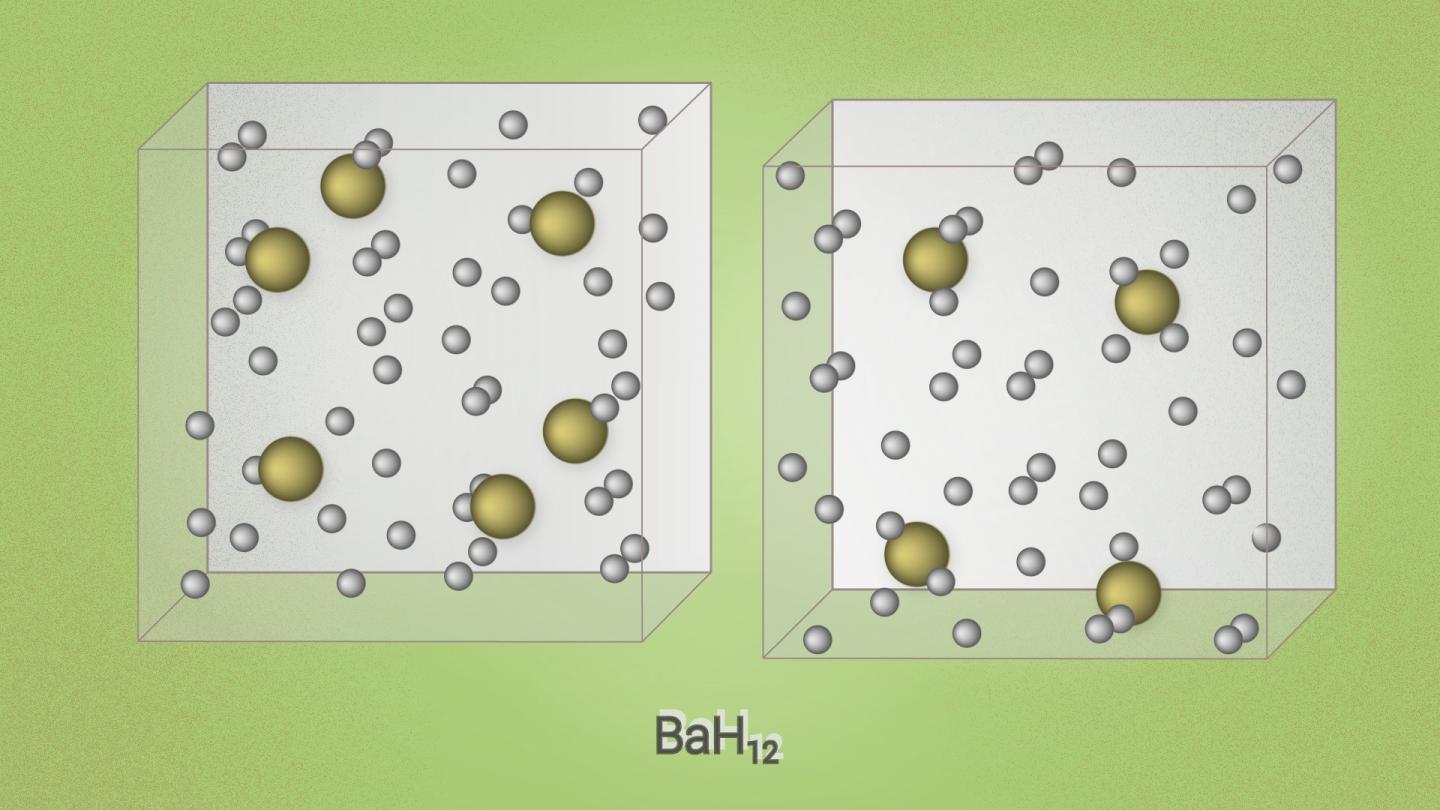
A group of scientists from Russia, China, and the United States predicted and then experimentally obtained barium superhydrides’ new unusual superconductors. The study was published in Nature Communications.

Chemists and physicists have been hunting down room-temperature superconductors since the first half of the 20th century. Initially, high hopes were placed on metallic hydrogen, but solid metallic hydrogen can become superconducting only at extremely high pressures of several million atmospheres, as it later transpired. Chemists then tried adding other elements to hydrogen in the hope of attaining superconductivity by stabilizing the metallic state under less challenging conditions. Scientists, including the research team led by Skoltech Professor Artem R. Oganov, predicted and experimentally obtained a set of compounds with a huge number of hydrogen atoms, such as ThH9 and ThH10 PrH9, NdH7, NdH9, YH6, and so on. Yet, the race for higher hydrogen content in such bizarre hydrides and especially for higher superconducting transition temperature is still on.

In their latest study, scientists from Oganov’s laboratory and their colleagues from China and the United States analyzed all possible barium hydrides using the unique theoretical approaches developed by Oganov and his students and implemented in their USPEX code. Finally, they selected BaH12, a compound with one of the highest hydrogen contents. The researchers obtained the compound experimentally, demonstrated its superconductivity, and studied its crystal structure. BaH12 turned out to be quite a remarkable compound with a structure formed by molecular groups of two and three hydrogen atoms and acting as a molecular superconductor. Thanks to its molecular structure, BaH12 is not a high-temperature superconductor: its critical temperature is -253 degrees Celsius. The study marks significant progress in understanding what structures may someday perform as room-temperature superconductors in real devices.

“On October 14, 2020, American scientists reported the discovery of a room-temperature superconductor, ushering in an era of room superconductivity. The new superconductor composition has not been disclosed, but its room-temperature superconductivity has been convincingly demonstrated. A century-long dream has come true! Recall that superconductivity was first observed in mercury at -269 degrees Celsius over 100 years ago. The new material is unlikely to have immediate practical applications, as it can only be synthesized in microscopic amounts under extremely high pressures of nearly three million atmospheres. We should continue searching for new materials and studying their properties so that we could someday figure out how to achieve room-temperature superconductivity under normal pressure,” Oganov says.

###

Media Contact
Ilyana Zolotareva
[email protected]

Original Source

https://www.skoltech.ru/en/2021/01/scientists-have-synthesized-an-unusual-superconducting-barium-superhydride/

Related Journal Article

http://dx.doi.org/10.1038/s41467-020-20103-5

Tags: Algorithms/ModelsAtomic/Molecular/Particle PhysicsBiomedical/Environmental/Chemical EngineeringChemistry/Physics/Materials SciencesComputer ScienceMaterialsTechnology/Engineering/Computer Science
Share12Tweet8Share2ShareShareShare2

Related Posts

Harnessing Neural Networks for Advances in Nonlinear Optics — Chemistry

Harnessing Neural Networks for Advances in Nonlinear Optics

May 12, 2026
Innovative Method Unveiled to Detect Signs of Dark Matter — Chemistry

Innovative Method Unveiled to Detect Signs of Dark Matter

May 12, 2026

Illuminating the Science Behind Historical Featherwork Art

May 12, 2026

Humans and Zebra Finches Share Similar Speech Learning Techniques #ASA190

May 11, 2026
Please login to join discussion

POPULAR NEWS

  • Research Indicates Potential Connection Between Prenatal Medication Exposure and Elevated Autism Risk

    842 shares
    Share 337 Tweet 211
  • New Study Reveals Plants Can Detect the Sound of Rain

    728 shares
    Share 290 Tweet 182
  • Salmonella Haem Blocks Macrophages, Boosts Infection

    62 shares
    Share 25 Tweet 16
  • Breastmilk Balances E. coli and Beneficial Bacteria in Infant Gut Microbiomes

    57 shares
    Share 23 Tweet 14

About

We bring you the latest biotechnology news from best research centers and universities around the world. Check our website.

Follow us

Recent News

Mayo Clinic to Undergo Leadership Transition, Honoring Dr. Gianrico Farrugia’s Transformational Impact

Study Finds Sustained Weight Loss Possible by Transitioning from Injectable Obesity Drugs to Daily Oral Orforglipron (ATTAIN-MAINTAIN)

Weight Loss Maintained Seven Times More Effectively with Continued Maximum Dose of Tirzepatide, Study Finds

Subscribe to Blog via Email

Enter your email address to subscribe to this blog and receive notifications of new posts by email.

Join 82 other subscribers
  • Contact Us

Bioengineer.org © Copyright 2023 All Rights Reserved.

Welcome Back!

Login to your account below

Forgotten Password?

Retrieve your password

Please enter your username or email address to reset your password.

Log In
No Result
View All Result
  • Homepages
    • Home Page 1
    • Home Page 2
  • News
  • National
  • Business
  • Health
  • Lifestyle
  • Science

Bioengineer.org © Copyright 2023 All Rights Reserved.