• HOME
  • NEWS
  • EXPLORE
    • CAREER
      • Companies
      • Jobs
    • EVENTS
    • iGEM
      • News
      • Team
    • PHOTOS
    • VIDEO
    • WIKI
  • BLOG
  • COMMUNITY
    • FACEBOOK
    • INSTAGRAM
    • TWITTER
Saturday, July 4, 2026
BIOENGINEER.ORG
No Result
View All Result
  • Login
  • HOME
  • NEWS
  • EXPLORE
    • CAREER
      • Companies
      • Jobs
        • Lecturer
        • PhD Studentship
        • Postdoc
        • Research Assistant
    • EVENTS
    • iGEM
      • News
      • Team
    • PHOTOS
    • VIDEO
    • WIKI
  • BLOG
  • COMMUNITY
    • FACEBOOK
    • INSTAGRAM
    • TWITTER
  • HOME
  • NEWS
  • EXPLORE
    • CAREER
      • Companies
      • Jobs
        • Lecturer
        • PhD Studentship
        • Postdoc
        • Research Assistant
    • EVENTS
    • iGEM
      • News
      • Team
    • PHOTOS
    • VIDEO
    • WIKI
  • BLOG
  • COMMUNITY
    • FACEBOOK
    • INSTAGRAM
    • TWITTER
No Result
View All Result
Bioengineer.org
No Result
View All Result
Home NEWS Science News Health

Scientists find sexual dimorphism in cannabinoid 1 receptor expression in mice

Bioengineer by Bioengineer
March 17, 2020
in Health
Reading Time: 2 mins read
0
IMAGE
Share on FacebookShare on TwitterShare on LinkedinShare on RedditShare on Telegram

IMAGE

Credit: WANG Feng


A major challenge in neuroscience lies in understanding how molecular and circuit differences in the brain synergistically contribute to sex differences in behavioral phenotypes. Sex differences in the brain may arise from the identity, distribution and relative abundance of cell types.

The cannabinoid 1 receptor (CB1R), the main receptor for cannabinoids and endocannabinoids (eCB), is the most abundantly expressed G protein-coupled receptor in the brain and is highly conserved in animal evolution. However, whole-brain mapping of CB1R expression in adult male and female mice had not previously been described in detail.

Recently, a research team led by Dr. WANG Feng from the Shenzhen Institutes of Advanced Technology (SIAT) of the Chinese Academy of Sciences demonstrated that CB1R mRNA expression displays a sexually dimorphic pattern in several regions in the adult mouse brain.

According to their current study published in Journal of Comparative Neurology on January 29, a systemic mapping of CB1R mRNA expression was conducted and compared for the first time in male and female adult C57BL/6J mouse (a common inbred strain of laboratory mouse) brains.

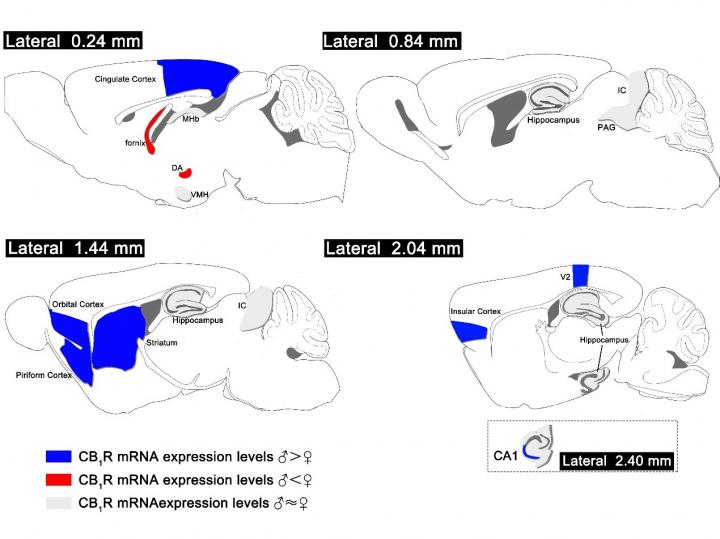
The researchers found that the neocortex, medial habenula, striatum, hippocampus and cerebellum were enriched with CB1R mRNA signals.

In the orbital cortex, insular cortex, cingulate cortex, piriform cortex, secondary visual cortex, caudate putamen and ventral hippocampus CA1, there were significantly more CB1R positive cells in males than in females. On the contrary, in the fornix and dorsal hypothalamus, CB1R positive cells were displayed more in females.

It is plausible that the difference in CB1R expression in the brain contributes to sex differences in various phenotypes. For example, the striatum, which harbors a greater amount of CB1R positive cells in males, has been widely recognized as the main affected region in Parkinson’s disease, which has a higher incidence in males. The dorsal hypothalamus, with a female-biased number of CB1R positive cells, is associated with maternal behaviors.

More interestingly, CB1R mRNA seems to fluctuate with the estrus cycle in female brain regions, including the medial amygdala, basolateral amygdala and parabrachial nucleus, which has not been reported before.

This study maps the localization of CB1R positive cells on a whole-brain scale in both genders for the first time. The findings provide a basis for understanding sexual dimorphism in physiological and pathological brain functions related to cannabinoids and endocannabinoids.

###

Media Contact
ZHANG Xiaomin
[email protected]

Original Source

http://english.cas.cn/

Related Journal Article

http://dx.doi.org/10.1002/cne.24868

Tags: BioinformaticsBiologyGeneticsneurobiologyPhysiology
Share12Tweet8Share2ShareShareShare2

Related Posts

Unlocking the Mysteries of Alzheimer’s Disease

July 2, 2026

Linking Single-Cell Transcriptomes to Mouse Visual Circuits

July 2, 2026

Cross-Stage, Cross-Species Malaria CD8+ T Cell Antigens Identified

July 2, 2026

Food Web Complexity Drives Biodiversity Impact

July 2, 2026
Please login to join discussion

POPULAR NEWS

  • Detection of EDCs in Breast Milk and Infant Urine Up to Six Months Highlights Early Exposure Risks

    77 shares
    Share 31 Tweet 19
  • Saying Goodbye to PGY-6: Pediatric Fellowship Realities

    103 shares
    Share 41 Tweet 26
  • New Drug Candidate Developed at McMaster Shows Potential for Treating Brain Cancer

    58 shares
    Share 23 Tweet 15
  • KTU Researchers Explore Ultrasound’s Role in Enhancing Blood Flow Beyond Diagnostics

    53 shares
    Share 21 Tweet 13

About

BIOENGINEER.ORG

We bring you the latest biotechnology news from best research centers and universities around the world. Check our website.

Follow us

Recent News

Steatosis Drives Liver Metastasis Diversity in CRC

Unlocking the Mysteries of Alzheimer’s Disease

Pensoft Introduces New Peer-Reviewed Journal of Regeneration to Advance Restorative Biology Across Species

Subscribe to Blog via Email

Enter your email address to subscribe to this blog and receive notifications of new posts by email.

Join 83 other subscribers
  • Contact Us

Bioengineer.org © Copyright 2023 All Rights Reserved.

Welcome Back!

Login to your account below

Forgotten Password?

Retrieve your password

Please enter your username or email address to reset your password.

Log In
No Result
View All Result
  • Homepages
    • Home Page 1
    • Home Page 2
  • News
  • National
  • Business
  • Health
  • Lifestyle
  • Science

Bioengineer.org © Copyright 2023 All Rights Reserved.