Higher thrombospondin-1 levels aid liver recovery after acetaminophen overdose in mice
Credit: Matthew McMillin
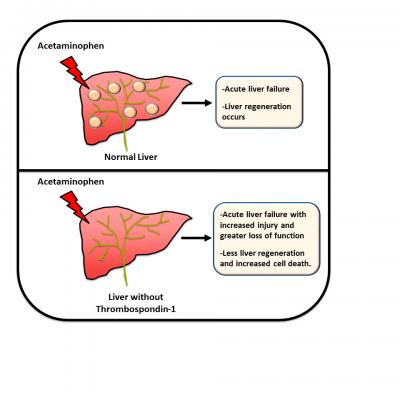
Orlando, Fla. (April 6, 2019) – Acetaminophen — a commonly used pain reliever and fever reducer — is the leading cause of quickly developing, or acute, liver failure in the U.S. Findings from a new mouse study suggest that treatments that increase levels of the protein thrombospondin-1 could help the liver recover from an overdose of acetaminophen.
“The only treatment available now for acetaminophen overdose must be administered early, before significant liver injury occurs,” said Matthew McMillin, PhD, who performed the research. “We are working to identify new drug targets to improve treatment options and reduce the need for liver transplantation, which is often the only option for patients with acute liver failure due to drug toxicity.”
McMillin, an assistant professor at the University of Texas at Austin and research biologist at Central Texas Veterans Health Care System, will present the research at the American Society for Investigative Pathology annual meeting during the 2019 Experimental Biology meeting to be held April 6-9 in Orlando, Fla.
McMillin and his colleagues found that mice with acute liver failure from acetaminophen toxicity had higher levels of thrombospondin-1 than mice with normal liver function. When they administered acetaminophen to genetically modified mice that lack thrombospondin-1, the liver injury and loss of liver function was more severe compared to unmodified mice. The researchers also observed impaired liver regeneration and increased cell death in the mice without thrombospondin-1.
“Our study is the first to investigate thrombospondin-1 during acetaminophen toxicity,” said McMillin. “We were able to identify cell communication pathways that do not work properly during acetaminophen-induced liver injury and thus lead to worse outcomes.”
Next, the researchers plan to give mice different drug treatments that manipulate thrombospondin-1 to find out which treatment might be suited for potential clinical studies. They also plan to examine patients with acetaminophen-induced acute liver failure to determine if their thrombospondin-1 findings from mice hold true in people.
Matthew McMillin will present this research on Saturday, April 6 at 7 p.m. during the Experimental Biology Welcome Reception in Valencia Ballroom ABCD, Orange County Convention Center and on Monday, April 8, from 11:45 a.m.-12:45 p.m. in room Exhibit Hall-West Hall B (poster A62 662.62 ) (abstract). Contact the media team for more information or to obtain a free press pass to attend the meeting.
Image available.
###
About Experimental Biology 2019
Experimental Biology is an annual meeting that attracts more than 14,000 scientists and exhibitors from five host societies and more than two dozen guest societies. With a mission to share the newest scientific concepts and research findings shaping clinical advances, the meeting offers an unparalleled opportunity for exchange among scientists from across the U.S. and the world who represent dozens of scientific areas, from laboratory to translational to clinical research. http://www.
About the American Society for Investigative Pathology (ASIP)
ASIP is a society of biomedical scientists who investigate mechanisms of disease. Investigative pathology is an integrative discipline that links the presentation of disease in the whole organism to its fundamental cellular and molecular mechanisms. ASIP advocates for the practice of investigative pathology and fosters the professional career development and education of its members. http://www.
Find more news briefs and tipsheets at: https:/
Media Contact
Anne Frances Johnson
[email protected]