• HOME
  • NEWS
  • EXPLORE
    • CAREER
      • Companies
      • Jobs
    • EVENTS
    • iGEM
      • News
      • Team
    • PHOTOS
    • VIDEO
    • WIKI
  • BLOG
  • COMMUNITY
    • FACEBOOK
    • INSTAGRAM
    • TWITTER
Saturday, February 7, 2026
BIOENGINEER.ORG
No Result
View All Result
  • Login
  • HOME
  • NEWS
  • EXPLORE
    • CAREER
      • Companies
      • Jobs
        • Lecturer
        • PhD Studentship
        • Postdoc
        • Research Assistant
    • EVENTS
    • iGEM
      • News
      • Team
    • PHOTOS
    • VIDEO
    • WIKI
  • BLOG
  • COMMUNITY
    • FACEBOOK
    • INSTAGRAM
    • TWITTER
  • HOME
  • NEWS
  • EXPLORE
    • CAREER
      • Companies
      • Jobs
        • Lecturer
        • PhD Studentship
        • Postdoc
        • Research Assistant
    • EVENTS
    • iGEM
      • News
      • Team
    • PHOTOS
    • VIDEO
    • WIKI
  • BLOG
  • COMMUNITY
    • FACEBOOK
    • INSTAGRAM
    • TWITTER
No Result
View All Result
Bioengineer.org
No Result
View All Result
Home NEWS Science News Biology

Scientists find mechanism behind precise spinal cord development

Bioengineer by Bioengineer
June 29, 2017
in Biology
Reading Time: 2 mins read
0
Share on FacebookShare on TwitterShare on LinkedinShare on RedditShare on Telegram
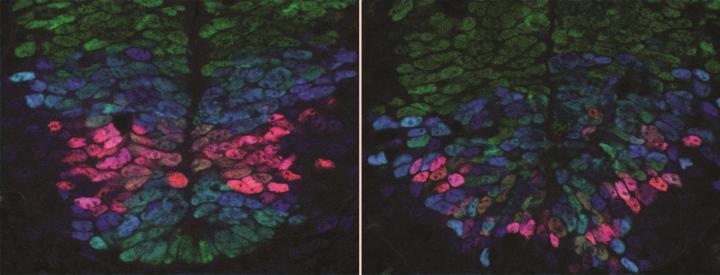
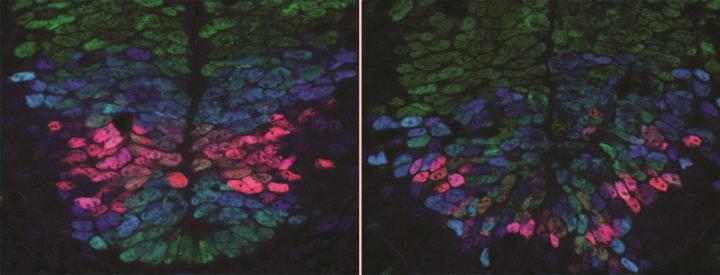
IMAGE

Credit: Anna Kicheva

Scientists have uncovered how nerve cells in the spinal cord are organised in precise patterns during embryo development – a finding that could give insight into regenerative medicine.

As embryos grow and develop they need the right cell types to end up in the right places inside forming organs. This is particularly important in the spinal cord where different nerve cell types must be accurately positioned so that circuits can assemble properly to control muscle movement. But until now the mechanism underlying nerve cell organisation in the spinal cord has remained poorly understood.

In a study published in Science, researchers at the Francis Crick Institute, the Institute of Science and Technology (Austria) and Ecole Polytechnique Fédérale de Lausanne (Switzerland) report that cells destined to become nerve cells in developing mouse embryos use two different signals spreading from opposite sides of the spinal cord – the back and belly side – to measure their position accurately. Based on this map, they turn into the appropriate nerve cell type. The research was funded by the European Research Council and Wellcome.

The team of biologists, physicists and engineers found that the amounts of the two signals originating from the back and belly sides of the body affect gene activity in developing nerve cells. Based on this gene activity in early development, the cells turn into the appropriate nerve cell type for that position in the spinal cord.

"We've made an important step in understanding how the diverse cell types in the spinal cord of a developing embryo are organised in a precise spatial pattern. The quantitative measurements and new experimental techniques we used, as well as the combined effort of biologists, physicists and engineers were key. This allowed us to gain new insight into the exquisite accuracy of embryonic development and revealed that cells have remarkable ability of to orchestrate precise tissue development," says Anna Kicheva, Group Leader at IST Austria.

"We have shed light on the long-standing question of how developing tissues produce the right cells in the right place in the right numbers," says James Briscoe, Group Leader at the Francis Crick Institute. "It's likely that similar strategies are used in other developing tissues and our findings might be relevant to these cases. In the long run this will help inform the use of stem cells in approaches such as tissue engineering and regenerative medicine. However, there is still much more to learn and we need to continue developing these interdisciplinary collaborations to further our biological understanding."

The paper 'Decoding of position in the developing neural tube from antiparallel morphogen gradients' is published in Science.

###

Media Contact

Greta Keenan
[email protected]
020-379-65252
@thecrick

http://www.crick.ac.uk

############

Story Source: Materials provided by Scienmag

Share12Tweet8Share2ShareShareShare2

Related Posts

Florida Cane Toad: Complex Spread and Selective Evolution

Florida Cane Toad: Complex Spread and Selective Evolution

February 7, 2026
New Study Uncovers Mechanism Behind Burn Pit Particulate Matter–Induced Lung Inflammation

New Study Uncovers Mechanism Behind Burn Pit Particulate Matter–Induced Lung Inflammation

February 6, 2026

DeepBlastoid: Advancing Automated and Efficient Evaluation of Human Blastoids with Deep Learning

February 6, 2026

Navigating the Gut: The Role of Formic Acid in the Microbiome

February 6, 2026
Please login to join discussion

POPULAR NEWS

  • Robotic Ureteral Reconstruction: A Novel Approach

    Robotic Ureteral Reconstruction: A Novel Approach

    82 shares
    Share 33 Tweet 21
  • Digital Privacy: Health Data Control in Incarceration

    63 shares
    Share 25 Tweet 16
  • Study Reveals Lipid Accumulation in ME/CFS Cells

    57 shares
    Share 23 Tweet 14
  • Breakthrough in RNA Research Accelerates Medical Innovations Timeline

    53 shares
    Share 21 Tweet 13

About

We bring you the latest biotechnology news from best research centers and universities around the world. Check our website.

Follow us

Recent News

Decoding Prostate Cancer Origins via snFLARE-seq, mxFRIZNGRND

Digital Health Perspectives from Baltic Sea Experts

Florida Cane Toad: Complex Spread and Selective Evolution

Subscribe to Blog via Email

Enter your email address to subscribe to this blog and receive notifications of new posts by email.

Join 73 other subscribers
  • Contact Us

Bioengineer.org © Copyright 2023 All Rights Reserved.

Welcome Back!

Login to your account below

Forgotten Password?

Retrieve your password

Please enter your username or email address to reset your password.

Log In
No Result
View All Result
  • Homepages
    • Home Page 1
    • Home Page 2
  • News
  • National
  • Business
  • Health
  • Lifestyle
  • Science

Bioengineer.org © Copyright 2023 All Rights Reserved.