The discovery that a Jurassic moth lacewing mimicked a co-occurring fossil lichen to promote survival predates modern lichen-insect associations by 165 million years
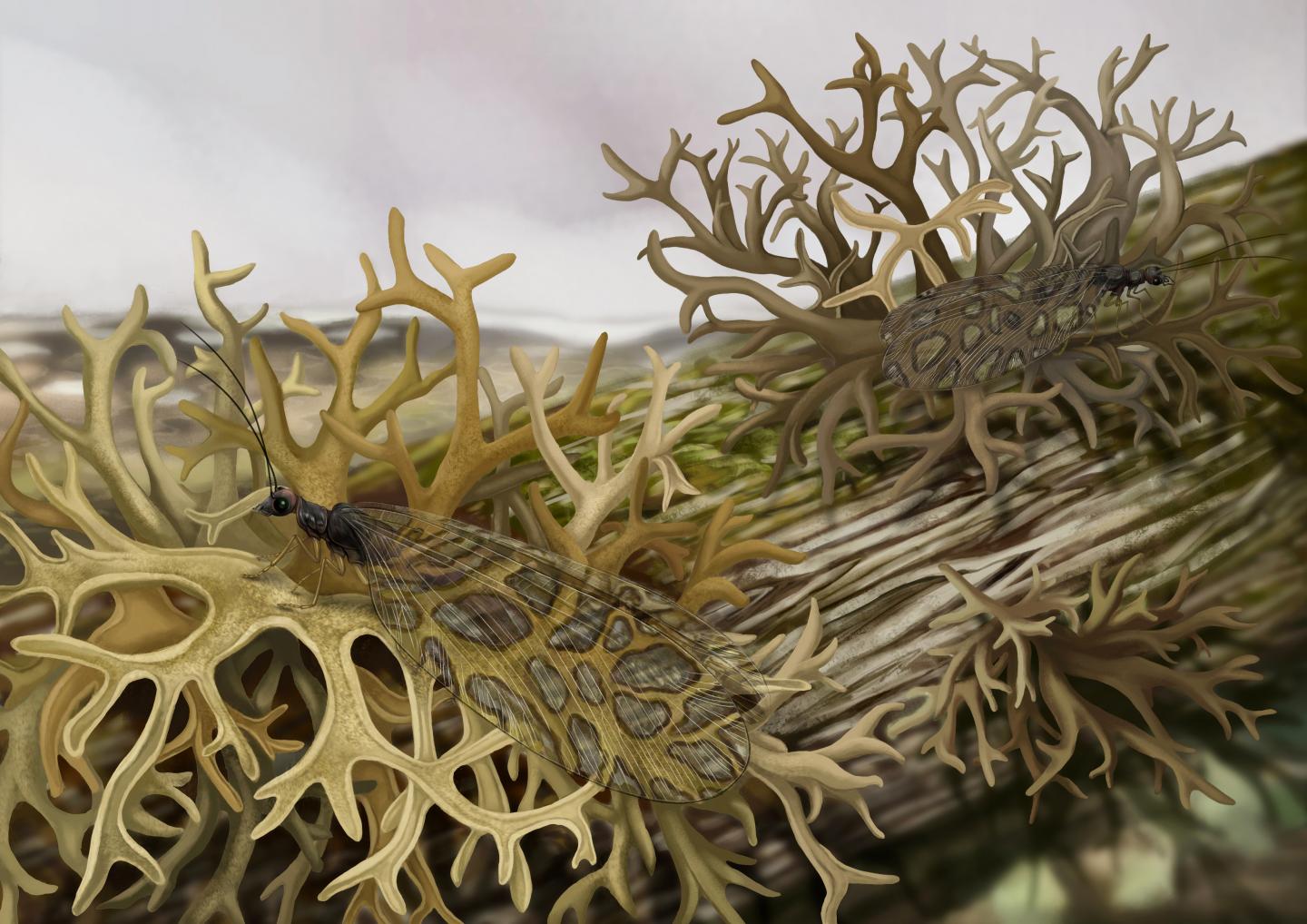
Credit: Xiaoran Zuo (CC BY 4.0)
Scientists have uncovered the earliest known evidence of an insect mimicking a lichen as a survival strategy, according to new findings published today in eLife.
The study suggests that the Jurassic moth lacewing Lichenipolystoechotes mimicked the fossil lichen Daohugouthallus to help conceal itself from predators. This interaction predates modern lichen-insect associations by 165 million years, indicating that the lichen-insect mimicry (or ‘mimesis’) system was well established during the mid-Mesozoic period and provided lacewings with highly-honed survival strategies.
Animals sometimes mimic other organisms or use camouflage to deceive predators. Lichens, which consist of a fungus and alga living in close proximity, sometimes have a plant-like appearance and are occasionally mimicked by modern animals and insects. One of the most well-known cases of a lichen-insect association is when the peppered moth acquired a mutation that turned it black during the Industrial Revolution in Britain, allowing the moth to blend in with tree trunks and lichen darkened by soot.
“As lichen models are almost absent in the fossil record of mimesis, it is still unclear as to when and how the mimicry association between lichen and insect first arose,” explains lead author Hui Fang, a PhD student at the College of Life Sciences and Academy for Multidisciplinary Studies, Capital Normal University, Beijing, China. “The key to answer this question is to find early examples of a lichen-like insect and a co-occuring lichen fossil.”
Fang and her team discovered deposits at the Daohugou 1 locality of Inner Mongolia in northeastern China that showed the 165-million-year-old lichen mimesis. The samples involved two lacewing species resembling a co-existing lichen from the latest Middle Jurassic.
After confirming the occurrence of the Jurassic lichen, the team then documented this mimetic relationship by describing structural similarities and detailed measurements of the lacewing and lichen. Their results suggest that when the lacewings rested in a lichen-rich habitat, a near-perfect match of their appearances would assist the insects’ concealment from predators.
“Our findings indicate that a micro-ecosystem consisting of lichens and insects existed 165 million years ago in Northeastern China,” concludes senior author Yongjie Wang, Associated Professor at the College of Life Sciences and Academy for Multidisciplinary Studies, Capital Normal University, Beijing. “This adds to our current understanding of the interactions between insects and their surroundings in the Mesozoic Era, and implies that there are many more interesting insect relationships awaiting discovery.”
###
Reference
The paper ‘Lichen mimesis in mid-Mesozoic lacewings’ can be freely accessed online at https:/
Media contact
Emily Packer, Media Relations Manager
eLife
[email protected]
01223 855373
About eLife
eLife is a non-profit organisation created by funders and led by researchers. Our mission is to accelerate discovery by operating a platform for research communication that encourages and recognises the most responsible behaviours. We work across three major areas: publishing, technology and research culture. We aim to publish work of the highest standards and importance in all areas of biology and medicine, including Ecology and Evolutionary Biology, while exploring creative new ways to improve how research is assessed and published. We also invest in open-source technology innovation to modernise the infrastructure for science publishing and improve online tools for sharing, using and interacting with new results. eLife receives financial support and strategic guidance from the Howard Hughes Medical Institute, the Knut and Alice Wallenberg Foundation, the Max Planck Society and Wellcome. Learn more at https:/
To read the latest Ecology research published in eLife, visit https:/
And for the latest in Evolutionary Biology, see https:/
Media Contact
Emily Packer
[email protected]
Original Source
https:/
Related Journal Article
http://dx.