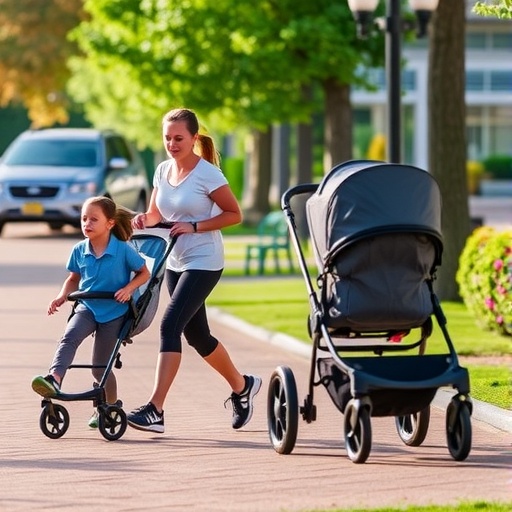
READING, Pa. — For parents trying to keep running in their lives after having a child, a stroller may be more than a way to transport a toddler. New research from Penn State Berks suggests that running with a stroller is not associated with a higher risk of overuse injuries and may, in some circumstances, be linked to a lower injury rate than running without one. The study, published in PLOS One on Aug. 12, 2026, found that parents who ran with a stroller experienced 55% fewer injuries for every 1,000 miles run than parents who ran without a stroller during the first three years after becoming parents. The finding challenges the common assumption that pushing a stroller automatically makes running more mechanically stressful or dangerous.
Researchers analyzed survey responses from 249 parents: 196 who regularly ran with a stroller and 53 who ran without one. Participants had run more than five miles per week before becoming parents, had children between six months and three years old during the relevant running period, and had become parents within the previous 20 years. They reported their running mileage from the time their child was born until the child reached age 10, along with injuries experienced during the first three years of parenthood. The two groups were broadly similar in age, height, weight, age at first parenthood and number of children, although the stroller-running group included a particularly large proportion of women.
Overall, 30% of the parents who ran without a stroller reported an overuse injury, compared with 19% of those who ran with a stroller. Non-stroller runners were also more likely to report multiple injuries during the first three years after becoming parents. Expressing injury frequency relative to running exposure produced a similar result: the rate per 1,000 miles was lower among stroller runners. Because the study collected information through a web-based survey rather than monitoring runners prospectively in a laboratory or clinical setting, the results show an association rather than proof that stroller use prevents injury. People who choose to run with a stroller may differ from other runners in ways that were not fully measured, including training habits, pace, motivation, recovery and access to childcare.
The researchers say the apparent protective effect may be explained by the biomechanics of pushing a stroller. Previous studies have shown that stroller running typically produces shorter strides, a greater forward lean, less rotation through the torso and a slower pace. These changes alter how forces are transmitted through the body with every foot strike. When a runner presses down and forward on the handlebar, some of the body’s weight is supported by the stroller, slightly “unweighting” the runner. That may reduce vertical ground-reaction forces and lower the impact transferred to the knees, hips and other weight-bearing joints.
Running injuries often develop through the accumulation of repeated loads rather than a single dramatic event. Each step produces a combination of vertical and horizontal forces, while muscles, tendons, ligaments and bones absorb and redistribute that energy. A modest reduction in loading repeated over thousands of steps could theoretically reduce mechanical stress, particularly when a runner is returning to activity after pregnancy or a prolonged period of reduced training. The investigators propose that the altered posture and reduced impact associated with stroller running may help explain why knee injuries, which are common among runners, appeared less frequently in the stroller group.
The stroller may also influence running behavior in ways that are difficult to separate from its mechanical effects. Pushing a stroller can naturally regulate speed and encourage a more consistent cadence, or step frequency. A controlled pace may reduce sudden accelerations and decelerations, while a steady cadence can help limit overstriding and excessive braking forces. The stroller may therefore function as both a physical support and a behavioral constraint, prompting runners to adopt a slower, more repeatable rhythm. These changes could be especially relevant for new parents, whose sleep, recovery and training schedules are often disrupted during the early years of a child’s life.
The study found that the stroller was most useful for maintaining running between six months and three years of age, when children were typically large enough to ride safely but still young enough to require transportation. From birth to six months, neither group ran much. By the time children reached one year, however, the groups were logging similar mileage, and stroller runners recorded 34% more miles between six and 12 months. Stroller use then declined as children grew older. This pattern suggests that the equipment may help solve a practical problem as much as a biomechanical one: parents can exercise without arranging separate childcare, making it easier to preserve a routine during a demanding transition.
Plantar fasciitis was common in both groups, accounting for 15% of reported injuries among stroller runners and 16% among non-stroller runners. The condition involves inflammation or irritation of the plantar fascia, a band of connective tissue running along the underside of the foot. Since most participants were women and many were the birthing parent, the researchers caution that these symptoms may reflect pregnancy and postpartum changes rather than stroller running itself. Weight gain during pregnancy can increase load on the feet, while hormonal changes can affect the elasticity and stability of connective tissues. The postpartum period may therefore alter injury susceptibility independently of running technique or equipment.
The authors emphasize that stroller running should not be interpreted as universally risk-free. The study population was relatively small for an injury investigation, and the survey did not capture every factor that could affect injury risk, including breastfeeding status, detailed pregnancy and delivery history, whether participants had additional children during the study period, training intensity, surface type, footwear or medical diagnoses. Recall bias is also possible because participants were asked to remember running and injuries over extended periods. Future research could combine wearable sensors, motion analysis and prospective injury tracking to determine whether stroller running actually reduces joint loading in real-world conditions and whether different stroller designs produce different biomechanical effects.
For now, the findings offer encouraging news to parents who want to remain active while caring for a young child. Rather than making running inherently more hazardous, a stroller may reduce impact, moderate pace and make exercise more feasible during early parenthood. Allison Altman-Singles, an associate professor of kinesiology and mechanical engineering at Penn State Berks, said the study is among the first to examine injury patterns specifically in parents who run. First author Houn “Grace” Kim conducted the work as a Penn State Berks undergraduate, with contributions from Andrew Friesen. The research team plans to investigate why some parents choose stroller running and how the equipment changes movement mechanics, potentially revealing how a simple parenting tool can reshape both exercise habits and the forces acting on the human body.
Subject of Research: People
Article Title: Injury risk and running habits in parents: Does stroller use make a difference?
News Publication Date: 12-Aug-2026
Web References: https://journals.plos.org/plosone/article?id=10.1371/journal.pone.0354371 ; https://www.psu.edu/news/research/story/running-stroller-lowers-impact-potential-injury-risk-researchers-find
References: PLOS One, DOI: 10.1371/journal.pone.0354371
Keywords: stroller running, running injuries, overuse injuries, parenting, biomechanics, physical exercise, sports medicine, plantar fasciitis, knee injuries, postpartum health, musculoskeletal system, injury risk
Tags: 249 parents survey on running with childrenimpact of strollers on running biomechanicsinjury rates in parent runnerslong-term effects of stroller runninglower injury risk with stroller useoveruse injury comparison stroller vs. no strolleroveruse injury prevention in runnersparental running health studiespostpartum running safetyrunning with children safety researchrunning with stroller injury riskstroller running benefits for parents