Animal-borne tri-axial accelerometers have become one of the fastest-growing tools in ecology, letting researchers record the fine-scale movements of free-ranging animals and infer everything from feeding events to energy expenditure. Yet according to a comment article published on 16 October 2026 in the journal Animal Biotelemetry, the field is built on a shaky foundation: the methodological details needed to repeat, compare, and ethically evaluate accelerometer studies are routinely left out of the scientific record.
The authors ground their argument in a concrete case study. In June 2026, they systematically reviewed the literature on accelerometers attached directly to sea turtles, searching Web of Science and Google Scholar for combinations of sea turtle terms and accelerometer terms. The search returned 33 results from Web of Science and 557 from Google Scholar. After excluding studies that focused on the wrong taxon, did not attach accelerometers to sea turtles, were not peer-reviewed, or merely reanalysed previously collected data, 40 publications remained relevant. Six of these used bi-axial rather than tri-axial devices, but the authors judged their reporting requirements to be essentially the same and included them in the overall summaries.
For each of the 40 studies, the team scored ten methodological parameters as either reported or not reported: study species, individual biometrics such as mass or carapace length, captivity status, attachment location described in enough detail to reproduce the deployment, attachment method, device model or sufficient detail to reproduce a custom device, sampling frequency, dynamic range, parameters sufficient to recreate the data segmentation method, and data resolution. Variables that could only be inferred from photographs, such as attachment position, were conservatively scored as not reported, because consistency across deployments could not be verified. Onboard processing was excluded from the scoring since it is only likely to be reported when actually used.
The results revealed a striking split between general and accelerometer-specific reporting. Study species, captivity status, and attachment method were reported in every single study. Device description, sampling frequency, segmentation details, and individual biometrics appeared in more than 75 percent of publications. But the parameters most critical for interpreting accelerometer signals themselves fared far worse: attachment location, dynamic range, and data resolution were each reported in fewer than half of the studies. In other words, researchers consistently documented what animal was tagged and how the device was fixed to it, while omitting the technical settings that determine what the device actually measured.
Why do these omissions matter so much? Accelerometers record acceleration along three orthogonal axes, conventionally called heave, sway, and surge, capturing both static acceleration from gravity and dynamic acceleration from movement. The signal that ends up in a dataset depends on a chain of decisions. The same behaviour produces different raw signals on different device models because of differences in sensor design and onboard processing. The recorded values also combine whole-body and local movements, so the anatomical mounting position changes both signal amplitude and the contribution of each axis. Harvey-Carroll and colleagues, one of the comment’s co-authors, previously reported significantly improved accuracy in behavioural classification when accelerometers were placed on the third scute of a sea turtle’s carapace rather than the first. In pigeons, Garde and colleagues reported higher dynamic body acceleration values from devices on the upper back compared with the lower back.
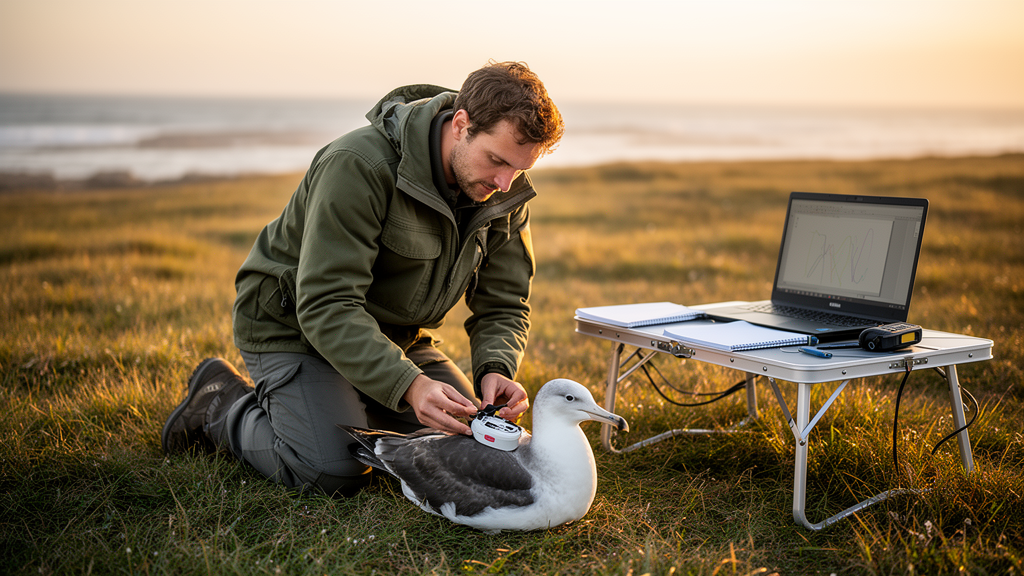
Attachment method adds another layer of variation. Whether a device is glued, taped, harnessed, bolted, or fitted to a collar determines how tightly it couples to the animal’s body, and any independent motion can enhance or dampen acceleration on individual axes. Martin and colleagues showed that activity data from accelerometers attached loosely and firmly to dog collars was poorly correlated. Rigid attachment is generally recommended to reduce relative motion, although loose attachments can still yield accurate behavioural classification in some systems. Attachment choices can even alter the movement being measured, by changing an animal’s aerodynamic or hydrodynamic profile or causing discomfort, which indirectly changes the signal itself. Without knowing the device model, placement, and attachment details, the authors conclude, accelerometer outputs are unlikely to be directly comparable between studies.
Deployment settings introduce further pitfalls. Sampling frequency determines which behaviours are observable at all: low rates risk missing extreme acceleration values, while high rates consume storage and battery. In pied flycatchers, Yu and colleagues found that rapid transient behaviours required sampling at 100 hertz, whereas longer-duration behaviours were captured at 12.5 hertz, and signals associated with swallowing became aliased and undetectable when data were subsampled to 25 or 12.5 hertz. Following the Nyquist–Shannon sampling theorem, devices should sample at least twice as fast as the fastest movement of interest, though Yu’s team found that twice the Nyquist frequency was needed for sufficient signal representation, and even 1.4 times for short-burst classification and energetic estimates. Dynamic range is equally consequential: set too low, the sensor saturates and systematically underestimates high-acceleration events; set too high, resolution suffers and subtle movements are lost. Some devices also allow user-defined bit resolution, which mathematically determines how many discrete measurement levels span the dynamic range, and some apply lossy onboard compression or derive summary metrics before transmission, details that manufacturers often present incompletely.
Post-processing choices compound the problem. Raw data are typically segmented into smoothing windows, whose length can mask local extremes or rapid postural changes. Shepard and colleagues demonstrated that smoothing window length influenced estimates of overall dynamic body acceleration, with appropriate windows varying by behaviour and species: in Imperial shags, values stabilised with running means of at least 2 seconds for flight and running and 2 to 3 seconds for swimming, while slower-moving whale sharks and leatherback turtles required roughly 4 seconds. Machine learning increasingly automates behavioural classification, but a systematic review by Wilson and colleagues found that 79 percent of studies using supervised models lacked sufficient validation procedures to detect overfitting, reinforcing the need for standardised reporting of model design, particularly where models might be reused across study systems.
The consequences extend beyond technical reproducibility. The authors note that negative effects of biologgers on animal welfare and survival have been reported across a range of taxa, and that device placement and attachment method can affect welfare and survival directly. When individual mass, attachment location, or attachment method go unreported, it becomes difficult to evaluate welfare impacts or establish best practices for minimising harm. Missing dynamic range and attachment details also make meta-analysis unreliable, since comparisons across studies can be confounded by unknown physical and settings differences, potentially obscuring real ecological patterns. The team is candid about the limits of their own work: it is not clear from their review, or any previous work they are aware of, what impact this underreporting has had on study conclusions, and they stress that they aim to highlight an opportunity rather than criticise foundational studies.
To close the gap, the authors propose a framework of minimum reporting standards for animal-borne accelerometer studies, extending the general biologging parameters previously recommended by Bodey and colleagues, such as study species, number of devices deployed, number of tagged animals, mean animal mass, method of attachment, device mass, and length of deployment, with accelerometer-specific requirements. They call for reporting the exact make, model, and firmware of devices, with complete technical descriptions and shared software for custom units, and they urge collaboration between researchers and manufacturers so that manuals are preserved in version-controlled, persistent repositories such as Zenodo or Dryad. They also recommend thorough testing of devices and attachment methods before field deployment, and encourage researchers to share the justifications behind their parameter choices. While the comment focuses on accelerometers, the authors argue that its principles apply broadly across biologging, including GPS tags, heart rate monitors, and temperature loggers, and that establishing clear device-specific reporting standards is a necessary step toward more rigorous, ethical, and impactful research in animal ecology and behaviour.
Subject of Research: Methodological reporting standards for animal-borne accelerometer studies in biologging research
Article Title: A call for minimum standards in methodological reporting for studies using animal-borne accelerometers
Article References: Carroll, D., Harvey-Carroll, J., Crespo-Picazo, J. L., García-Párraga, D., & March, D. (2026). A call for minimum standards in methodological reporting for studies using animal-borne accelerometers. Animal Biotelemetry, 14(1), Article 42. https://doi.org/10.1186/s40317-026-00506-9
Image Credits: AI Generated
DOI: 10.1186/s40317-026-00506-9
Keywords: biologging, accelerometers, animal-borne devices, reporting standards, reproducibility, sea turtles, animal welfare, meta-analysis, behavioural classification, sampling frequency, dynamic range, ecology
News Source: Drew Townsend. (October 27, 2026). Scientists Demand Minimum Reporting Standards for Animal-Borne Accelerometer Studies. Scienmag.