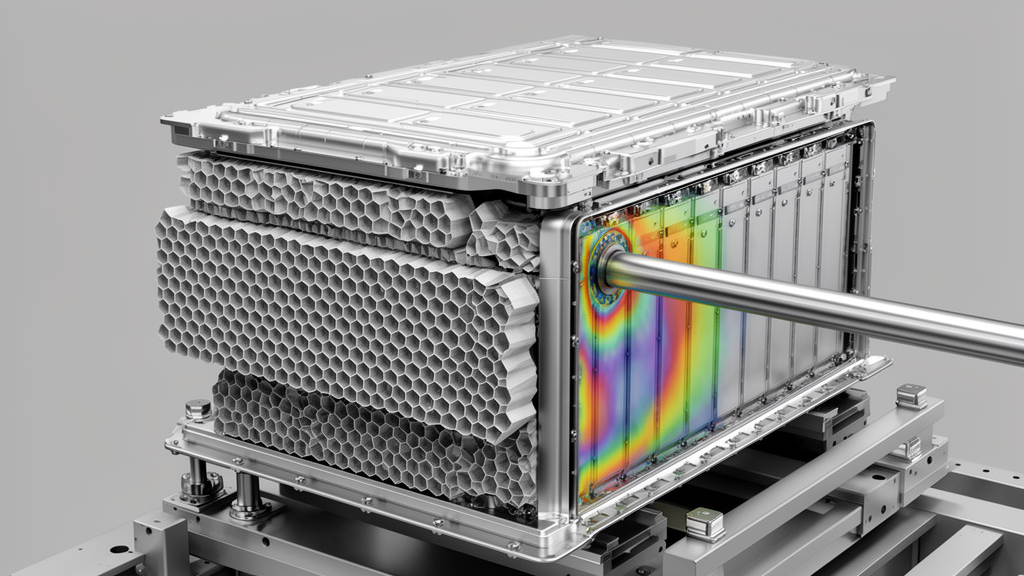
Floor-mounted battery packs have become the default layout for modern electric cars because they use space efficiently and drop the centre of gravity, but the same flat, low-slung arrangement leaves the cells with very little crush space on the side of the vehicle. A new review in Frontiers in Mechanical Engineering argues that this makes side impacts, especially narrow pole strikes and low obstacles such as kerbs and guardrail bases, among the most demanding crash scenarios for electric vehicles. When a concentrated lateral load pushes through the rocker or sill, it can propagate into the pack perimeter, compress cells, damage separators, initiate internal short circuits and potentially trigger thermal runaway. The authors, Yuan Li, Na Wang and Jinyu Zhang of Shandong Huayu University of Technology in China, together with an affiliation at Universiti Malaysia Pahang Al-Sultan Abdullah in Malaysia, organise the literature into a three-stage protection sequence: redirect the concentrated load through the body-in-white, absorb residual energy at the pack perimeter, and redistribute what remains inside the pack before it becomes localised in vulnerable cells.
The review stresses that side impact is a structurally distinct problem from frontal crashing. Frontal designs exploit longitudinal rails and a comparatively long deformation path, whereas a narrow pole concentrates deformation around the rocker, B-pillar, floor and battery-side structures in a very short distance. The hazard is also not confined to the full-height cylindrical poles used in conventional regulatory tests. Citing finite-element simulations of a commercially available sedan striking rigid obstacles of different heights, the authors highlight a non-monotonic relationship between obstacle height and battery intrusion, governed by the interaction between vehicle roll dynamics and structural stiffness. When the obstacle sat below window-frame level, the longer roll moment arm let part of the impact energy dissipate through vehicle roll, reducing battery intrusion. But when the obstacle dropped into the threshold-beam and battery-side-beam region, supporting members were bypassed, the equivalent contact stiffness fell sharply and battery intrusion became significant. The authors conclude that side-impact assessment should span a range of obstacle heights rather than relying on a single full-height pole configuration.
A central theme of the review is that no single global crash metric can stand in for battery safety. Intrusion, peak force, residual deformation, acceleration and energy absorption must be interpreted jointly and related to local cell deformation and failure risk. A low peak force can coexist with excessive intrusion, while a heavily stiffened structure may restrict deformation yet transmit greater loads into the pack or the passenger compartment. The authors frame structural metrics as intermediate indicators within a hierarchical mechanical–electrical–thermal failure sequence: contact-force history, intrusion, residual deformation and pack acceleration determine the compression, bending and local deformation imposed on individual cells, and sufficient cell deformation can damage the casing, electrodes, jellyroll or separator and initiate an internal short circuit, whose electrical heating may then raise the risk of thermal runaway and propagation to neighbouring cells.
At the vehicle level, the reviewed studies illustrate two complementary design routes. Mortazavi Moghaddam and colleagues integrated a dedicated energy-absorbing element into the sill to manage pole intrusion, internal energy and sill-section loads. Yang and colleagues first optimised seven major side load-bearing components, cutting their combined mass by 2 percent while raising energy absorption by 22.2 percent; because battery deformation remained excessive, they then added reinforced side longitudinal beams and a bionic thin-walled absorber, reducing battery-side intrusion by roughly 43.5 to 43.8 percent. Industrial work emphasises load sharing and manufacturability: Nivesh and colleagues evaluated cell force, pack acceleration, frame compression and load distribution between the body-in-white and the pack, while Kusnoorkar and colleagues showed through full-vehicle simulation and component validation that a steel tube-in-tube reinforcement could match a reference aluminium design with potential mass, cost and manufacturing benefits. The review concludes that the preferred strategy depends on the available lateral crush distance and the continuity of surrounding load paths, and that material choice alone does not determine performance, since section topology, joining and load sharing can matter as much as density.
The second protection layer is the pack perimeter, where side frames, crash walls and sacrificial absorbers must dissipate energy while preserving clearance around the cells. Uerlich and colleagues demonstrated a direct competition between energy-absorbing volume and available cell volume, and Pan and colleagues showed that coordinated selection of material grade and wall thickness could reduce enclosure mass while improving crashworthiness. Candidate architectures each carry trade-offs. Thin-walled and multicell sections suit cases where predictable progressive crushing and conventional joining are priorities; metallic foams can improve specific energy absorption and cut peak force within constrained cavities but depend on density uniformity; auxetic structures can spread highly localised loading, though the evidence is dominated by numerical studies sensitive to geometry, impact position and manufacturing variability; composites offer mass-specific stiffness and absorption benefits but raise questions of damage detection, joining, cost and repair. Under pack-level side-pole loading, Scurtu and colleagues reported that a re-entrant auxetic absorber reduced the number of damaged cells by up to 35.2 percent while weighing less than the baseline absorber, and Kawsar and colleagues found that a multicell square-tube crash wall cut bottom-shell intrusion in the critical region by more than 45 percent.
The third layer operates inside the pack itself. Conventional aligned cell arrays simplify packaging but can create direct paths for cell-to-cell load transfer under localised lateral intrusion. Chen and colleagues proposed a staggered cell arrangement for side-pole loading, evaluated with a baseline simulation model built from a commercially available battery pack. Compared with the aligned layout, the staggered arrangement created an additional load path that spread the impact over a wider region of the pack, reducing total jellyroll energy dissipation by up to 7.4 percent and reducing energy dissipation in the most severely damaged jellyrolls by 2.6 to 7.4 percent. The benefit depended on whether the pole aligned with the middle or edge region of a cell, showing that layout performance remains sensitive to impact location. The review notes that evidence for internal load redistribution is still comparatively limited, dominated by numerical evaluation of a small number of concepts, and that broader validation across cell formats, impact locations and pack architectures is needed before general design rules can be established.
Lightweight optimisation runs through every layer as a cross-cutting constraint. Extra rails, thicker enclosure walls and dedicated absorbers may reduce battery intrusion, but they add non-cell mass, lower system-level specific energy and affect vehicle stiffness and passenger-compartment acceleration. Thorat and colleagues reported associations between increased vehicle mass and stiffness, higher passenger-compartment accelerations, and reductions in system-level energy density and driving range, relationships the review treats as correlational rather than causal. Concept-level studies combine finite-element analysis with surrogate modelling and evolutionary optimisation: Arslan and Karamangil optimised a glass-fibre-reinforced polymer side profile with honeycomb and auxetic geometries, reporting a design 23.9 percent lighter and 38.6 percent less costly than the selected reference with a 3 percent improvement in the reported crash-performance measure, while Yay and colleagues used surrogate models and the NSGA-II algorithm to optimise an aluminium-foam-filled battery box, achieving a 50.71 percent increase in specific energy absorption and an 11.56 percent reduction in peak crushing force. Such concept studies can reveal large theoretical gains, but the resulting geometries may be difficult to manufacture, join or repair.
By contrast, Zhang and colleagues restricted design variables to discrete, manufacturable thickness increments within a Gaussian-process and NSGA-II framework. Their representative solution reduced enclosure mass from 149.40 to 115.20 kilograms while peak deformation rose only from 66.17 to 66.25 millimetres in independent finite-element reruns. The review argues that neither approach is universally preferable: material and topology optimisation suit concept screening, whereas constrained sizing optimisation fits later engineering stages, and Pareto improvements remain conditional on the chosen objectives, constraints, material models and impact configuration. Changing the pole position, occupant-load constraint, allowable intrusion or cell-failure criterion can shift the preferred solution. Cell-to-body integration adds a further system-level trade-off, since permanently bonded assemblies can complicate post-crash inspection, damage isolation, component replacement and repair; Liu and colleagues identified repair complexity, life-cycle serviceability, insurance costs and residual-value effects as insufficiently quantified aspects of cell-to-body and cell-to-chassis adoption.
The authors close with a set of future directions. Side-impact assessment should represent a wider range of localised obstacle geometries, varying obstacle heights, impact position, radius, angle and velocity to test whether a proposed load path remains effective beyond its design configuration. Structural responses must be linked to experimentally calibrated battery-failure criteria, with cell-level failure boundaries established across relevant loading modes, directions, rates, states of charge, temperatures and ageing states, and with sensitivity and uncertainty analyses to check whether apparent safety margins survive material, cell and manufacturing variability. Mechanical impact should be treated as the initiating stage of a coupled process: a mechanically predicted cell-failure threshold does not describe subsequent electrical heating, thermal runaway or propagation, so models should pass predicted deformation, contact conditions and potential short-circuit locations to electrical and thermal analyses. Manufacturability and physical validation should be built in early, with validation progressing from material and component tests to representative subsystem and vehicle-level impacts before a concept is called production-ready.
Data-driven methods may also support post-crash reconstruction and rapid battery-damage assessment; Ma and colleagues used simulation-generated images to infer collision conditions and predict internal cell deformation, though broader use will require datasets covering relevant vehicle architectures, impact conditions and damage modes, with explicit uncertainty estimates and independent validation against experimental or real-world crash data. The overall message of the review is that effective battery protection depends on coordinated action across the vehicle, the enclosure and the internal pack architecture, and that improvements in numerical crash metrics alone do not establish cell safety. Reported percentage improvements across studies should not be ranked directly, the authors caution, because vehicle architectures, impact conditions, material models and evaluation metrics differ. As electric vehicles multiply on the road, the difference between a well-redirected pole load and a localised cell crush may come down to how well these three protection layers are designed as one system.
Subject of Research: A review of structural side-impact protection strategies for floor-mounted battery packs in electric vehicles, covering load redirection, pack-perimeter energy absorption, internal load redistribution and lightweight optimisation.
Article Title: Side-impact protection of floor-mounted battery packs in electric vehicles: a review of load-path design, energy absorption, and lightweight optimisation
Article References: Li, Y., Wang, N., & Zhang, J. (2026). Side-impact protection of floor-mounted battery packs in electric vehicles: a review of load-path design, energy absorption, and lightweight optimisation. Frontiers in Mechanical Engineering, 12, Article 2004811. https://doi.org/10.3389/fmech.2026.2004811
Image Credits: AI Generated
DOI: 10.3389/fmech.2026.2004811
Keywords: electric vehicles, battery packs, side pole impact, crashworthiness, energy absorption, load path design, lightweight optimisation, cell-to-body integration, thermal runaway, battery enclosure, intrusion, structural safety
News Source: Faith Mcneil. (October 28, 2026). Review maps how EV battery packs survive side pole impacts through layered load paths and lightweight design trade-offs. Scienmag.