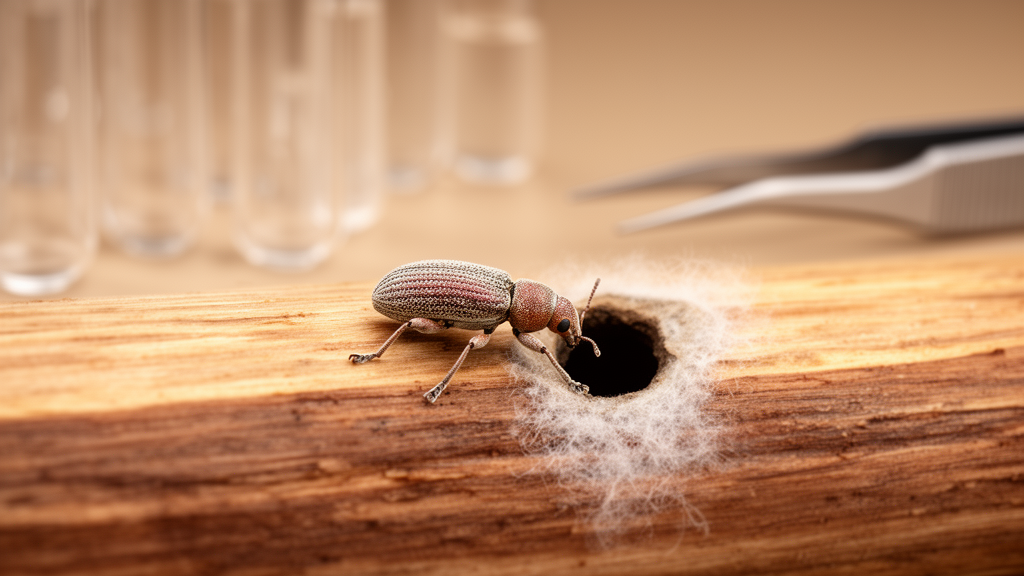
A team of researchers has built the first working genetic toolkit for the filamentous fungi that ambrosia beetles farm for food, opening a door into one of biology’s most intriguing mutualisms that has long resisted molecular study. The study, published in the journal Fungal Biology and Biotechnology on 23 July 2026, describes methods for generating protoplasts and transforming several major fungal partners of Xyleborus ambrosia beetles, including Raffaelea arxii, Raffaelea fusca, Harringtonia aguacate, and Graphium ambrosium, using reporter constructs driven by promoter sequences borrowed from the laurel wilt pathogen Harringtonia lauricola. Until now, with the exception of H. lauricola itself, genetic tools for ambrosia beetle symbionts have been almost entirely absent, leaving the genetic basis of how these fungi establish associations with their beetle hosts essentially unexplored.
Ambrosia beetles are specialized wood-boring weevils in the subfamilies Scolytinae and Platypodinae of the weevil family Curculionidae. Adult beetles burrow into the xylem of trees and other woody plants, excavating tunnel systems called galleries where they rear their brood and inoculate the gallery walls with their symbiotic fungi. These fungi grow as lush fungal gardens and constitute the sole source of nutrition for the beetles. The lifestyle is polyphyletic, having evolved independently at least a dozen times, and each adoption has involved an independent lineage of fungi, including members of the orders Ophiostomatales, Microascales, Hypocreales, Polyporales, and Saccharomycetales. A defining feature of these symbioses is the evolution of specialized beetle organs called mycangia, pouches that house viable propagules of the fungal partners while the beetles disperse to new trees.
Xyleborus beetles possess paired pre-oral mycangia, two small pouches located behind the mandibles within the pre-oral cavity, and associate primarily with ambrosia fungi in the ophiostomatalean genera Raffaelea, Dryadomyces, and Harringtonia, all previously classified as Raffaelea, along with other filamentous and yeast-like fungi whose specific roles remain less well defined. The fidelity between these beetles and their fungi is relatively loose, which has drawn particular interest as the human-mediated spread of ambrosia beetles and their fungi into non-native ranges has turned some of these mutualists into devastating plant pathogens. In the early 2000s, the beetle Xyleborus glabratus and its fungal partner Harringtonia lauricola were introduced into the United States, where the fungus has since caused laurel wilt disease in plants of the family Lauraceae. The pathogen has spread from its original invasive beetle vector to be farmed and vectored by a number of native Xyleborus species, complicating management of the disease.
Because of its importance as a plant pathogen, H. lauricola has emerged as a model fungus for studying ambrosia fungal interactions with both plant and insect hosts, with established laboratory techniques for culturing, for rearing colonies of some of its beetle hosts, and for molecular genetic manipulation. Aside from this species, genetic tools for other ambrosia beetle symbionts are lacking, in part because of an absence of genomic resources and established manipulation methods. The research team, composed of Ross A. Joseph, Abolfazl Masoudi, and Nemat O. Keyhani, had previously demonstrated consistent isolation of a consortium of fungal species from laboratory colonies of the ambrosia beetle Xyleborus affinis, including the two previously described Raffaelea species R. arxii and R. fusca, and previously undescribed species of Neocosmospora and Graphium, since named Neocosmospora affinis and Graphium ambrosium. The central question of the new work was whether protocols and promoter sequences developed for H. lauricola could be used to transform and drive gene expression in these other fungi.
The first step was to identify a suitable selection marker. The researchers tested six fungal symbionts for sensitivity to the antifungal agent hygromycin by spotting normalized spore suspensions onto plates containing 0, 50, 100, or 200 micrograms per milliliter of the antibiotic and monitoring growth over 21 days. With the exception of H. lauricola, whose growth inhibition had previously been shown to require more than 200 micrograms per milliliter, all strains showed high sensitivity, with little to no growth at 50 micrograms per milliliter. Based on these results, the team designed and synthesized plasmids carrying the hygromycin resistance gene HPH together with either red or green fluorescent protein genes, with expression of both driven by a 1500 base pair fragment of the H. lauricola glyceraldehyde dehydrogenase promoter. The plasmids were built on a pUC19 backbone, terminated by a minimal 119 base pair terminator sequence from Aspergillus terreus, and are now available from Addgene under IDs 253867, 253868, 253869, and 253870.
Protoplasts, fungal cells stripped of their cell walls, were generated by growing each fungus in potato dextrose broth for seven days and then digesting the tissue with Glucanex, a lysing enzyme preparation from Trichoderma harzianum, in a buffered osmotic solution. Transformation followed a polyethylene glycol-mediated protocol in which linearized plasmid DNA was mixed with protoplasts on ice before PEG treatment and plating under osmotic stabilization. Microscopy with DAPI nuclear staining showed that all isolates produced mononucleate blastospores in liquid culture and multinucleate hyphae, while cells recovered from the protoplasting procedure were mononucleate, a property that simplifies transformation and screening because each transformant carries genetic material in a single nucleus. Protoplast recovery was highest for R. fusca, exceeding 10 to the 10 protoplasts per 50 milliliter culture, while R. arxii, H. lauricola, and G. ambrosium yielded 4 to 8 times 10 to the 9, and H. aguacate and N. affinis yielded 4 to 7 times 10 to the 8.
Transformation efficiencies for the constitutive RFP and GFP vectors were equivalent within each strain but varied strikingly across species, and, surprisingly, did not track phylogeny. Graphium ambrosium, a member of the Microascales and the most distantly related fungus tested relative to H. lauricola, from which the promoters were derived, showed the highest efficiency, with more than 100 transformants per 10 to the 8 protoplasts, even exceeding H. lauricola itself. H. lauricola, H. aguacate, and R. fusca showed robust efficiencies of 15 to 50 transformants per 10 to the 8 protoplasts, while R. arxii was low, at 1 to 5. More than 95 percent of colonies screened directly on transformation plates with a fluorescence dissecting microscope displayed the expected green or red signal, and fluorescence in spores and hyphae was confirmed by microscopy, generally distributed through the cytoplasm. In some transformants, including R. arxii RFP, H. aguacate RFP, and R. fusca GFP, fluorescence localized to punctate spots that did not overlap with DAPI-stained nuclei, suggesting targeting to vacuoles or other compartments. R. arxii GFP transformants were consistently difficult to obtain, showing slow fluorescence development, slow growth, or hygromycin sensitivity, and the authors caution that the low total number of transformants for this fungus warrants care in interpretation.
Beyond constitutive reporters, the team developed inducible expression systems by identifying H. lauricola homologs of the Aspergillus AlcA alcohol dehydrogenase and GlaA glucoamylase genes through BLAST searches against the H. lauricola genome, then selecting a 1300 base pair AlcA promoter and a 900 base pair GlaA promoter based on the presence and position of conserved regulatory motifs such as CreA, CAAT, and TATA-like boxes. These promoters driving RFP were transformed into H. lauricola and G. ambrosium at efficiencies of 30 to 50 transformants per 10 to the 7 protoplasts. When transformants were grown on minimal media containing glycerol, sorbitol, glucose, maltose, or ethanol as sole carbon sources, the AlcA promoter showed leaky expression under all conditions, though ethanol produced clearly the strongest induction, possibly because the fungi themselves produce ethanol during growth on other carbon sources. The GlaA promoter behaved far more tightly, with little to no signal except a clear induction on maltose. Intriguingly, in H. lauricola but not G. ambrosium, growth on glucose produced large globose cells displaying marked red fluorescence, a phenomenon the authors suggest may merit further study for a possible role in the beetle association.
One notable failure proved as informative as the successes. Despite generating protoplasts from Neocosmospora affinis, a member of the Hypocreales, and making several transformation attempts with every vector developed, the researchers obtained no transformants of this species. They suggest either that the delivery method was insufficient to introduce DNA into this fungus or that H. lauricola promoters could not drive gene expression in it, and they note that using promoters derived from the target fungus itself would likely improve success, although a genome sequence for N. affinis is not yet available. The authors emphasize that the fluorescent strains they created can now be used to monitor symbiotic colonization of the beetle host, fungal development within host galleries, host preferences, and, by labeling different strains with GFP and RFP, to test hypotheses about mycangial colonization and competition within fungal gardens. They also point to potential extension to other ophiostomatalean ambrosia fungi, including the plant pathogens Raffaelea quercivora and Raffaelea quercus-mongolicae, which could shed light on both the mutualism and pathogenicity of these dual-nature fungi.
The work moves ambrosia beetle-fungus systems beyond purely ecological observation and into mechanistic and molecular study, offering the possibility of developing parallel experimental systems across the polyphyletic ambrosia symbioses to compare their underlying features. Inducible promoters are particularly valuable when a gene product may be toxic to the host cell, such as a secondary metabolite, or when researchers want to express a gene conditionally, for example after a culture has accumulated sufficient biomass or during a distinct developmental stage. Future studies using these promoter systems as sensors during infection of plant hosts and colonization of beetle hosts could reveal the nutritional landscapes within host tissues, detailing what beetles provision to their fungal partners during mycangial symbiosis and what fungi exploit during plant infection. For a group of fungi that sustain thousands of beetle species yet have remained genetically intractable, the arrival of a simple, transferable transformation protocol marks a substantial step toward understanding how these ancient partnerships are built and maintained.
Subject of Research: Development of protoplast-mediated transformation methods and H. lauricola promoter-based genetic tools for ambrosia beetle fungal symbionts
Article Title: Genetic tools for transformation of Xyleborus ambrosia beetle fungal symbionts
Article References: Joseph, R. A., Masoudi, A., & Keyhani, N. O. (2026). Genetic tools for transformation of Xyleborus ambrosia beetle fungal symbionts. Fungal Biology and Biotechnology, 13(1), Article 13. https://doi.org/10.1186/s40694-026-00217-z
Image Credits: AI Generated
DOI: 10.1186/s40694-026-00217-z
Keywords: ambrosia beetles, fungal symbiosis, genetic transformation, protoplasts, Harringtonia lauricola, laurel wilt, fluorescent reporters, inducible promoters, mycangia, Xyleborus, Raffaelea, Graphium ambrosium
News Source: Juliet Wilcox. (October 28, 2026). Scientists Crack Gene Tools for Ambrosia Beetle Fungal Partners. Scienmag.