• HOME
  • NEWS
  • EXPLORE
    • CAREER
      • Companies
      • Jobs
    • EVENTS
    • iGEM
      • News
      • Team
    • PHOTOS
    • VIDEO
    • WIKI
  • BLOG
  • COMMUNITY
    • FACEBOOK
    • INSTAGRAM
    • TWITTER
Monday, June 1, 2026
BIOENGINEER.ORG
No Result
View All Result
  • Login
  • HOME
  • NEWS
  • EXPLORE
    • CAREER
      • Companies
      • Jobs
        • Lecturer
        • PhD Studentship
        • Postdoc
        • Research Assistant
    • EVENTS
    • iGEM
      • News
      • Team
    • PHOTOS
    • VIDEO
    • WIKI
  • BLOG
  • COMMUNITY
    • FACEBOOK
    • INSTAGRAM
    • TWITTER
  • HOME
  • NEWS
  • EXPLORE
    • CAREER
      • Companies
      • Jobs
        • Lecturer
        • PhD Studentship
        • Postdoc
        • Research Assistant
    • EVENTS
    • iGEM
      • News
      • Team
    • PHOTOS
    • VIDEO
    • WIKI
  • BLOG
  • COMMUNITY
    • FACEBOOK
    • INSTAGRAM
    • TWITTER
No Result
View All Result
Bioengineer.org
No Result
View All Result
Home NEWS Science News Cancer

Scent-trained dog detects thyroid cancer

Bioengineer by Bioengineer
March 7, 2020
in Cancer
Reading Time: 2 mins read
0
Share on FacebookShare on TwitterShare on LinkedinShare on RedditShare on Telegram

A trained scent dog accurately identified whether patients’ urine samples had thyroid cancer or were benign (noncancerous) 88.2 percent of the time, according to a new study, to- be presented Friday at the Endocrine Society’s 97th annual meeting in San Diego.

“Current diagnostic procedures for thyroid cancer often yield uncertain results, leading to recurrent medical procedures and a large number of thyroid surgeries performed unnecessarily,” said the study’s senior investigator, Donald Bodenner, MD, PhD, chief of endocrine oncology at the University of Arkansas for Medical Sciences (UAMS) in Little Rock.

“Scent-trained canines could be used by physicians to detect the presence of thyroid cancer at an early stage and to avoid surgery when unwarranted,” Bodenner commented.

Although Bodenner is not yet basing patient treatment decisions on the canine technique, he said the dog’s diagnostic accuracy is only slightly less than that of fine-needle aspiration biopsy, the method generally used first to test thyroid nodules for cancer. Canine scent detection has the advantages of being noninvasive and inexpensive, he said.

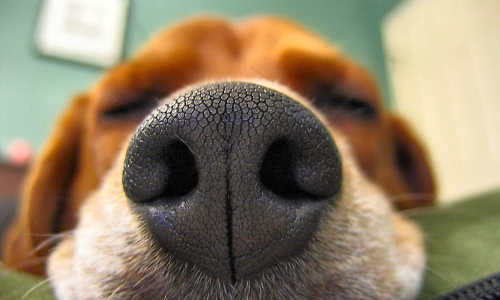
Bodenner’s colleague at UAMS and a study-coauthor, Arny Ferrando, PhD, previously “imprinted,” or scent-trained, a rescued male German Shepherd-mix named Frankie to recognize the smell of cancer in thyroid tissue obtained from multiple patients. Ferrando, who noted that dogs have at least 10 times more smell receptors than humans do, said, “Frankie is the first dog trained to differentiate benign thyroid disease from thyroid cancer by smelling a person’s urine.”

In this study, 34 patients gave a urine sample at their first visit to the university thyroid clinic before they went on to have a biopsy of suspicious thyroid nodules and surgery. The surgical pathology result was diagnosed as cancer in 15 patients and benign thyroid disease in 19. These urine samples were presented, by a gloved dog handler, one at a time to Frankie to sniff. Neither the dog handler nor the study coordinator, who recorded the dog’s responses after the handler announced them, knew the cancer status of the 34 urine samples.

The handler interspersed some urine samples that had a known cancer status so he could reward the dog for correct answers: alerting to a cancer sample by lying down, and turning away from a benign sample to alert the absence of cancer.

The dog’s alert matched the final surgical pathology diagnosis in 30 of the 34 study samples, the investigators reported. The sensitivity, or true-positive rate, was 86.7 percent, meaning Frankie correctly identified nearly 87 percent of the pathology-proven thyroid cancers. The specificity–the true-negative rate–was 89.5 percent, which meant Frankie knew that a benign sample was actually benign almost 9 of every 10 times. There were two false-negative results and two false-positives using canine scent detection.

Bodenner said they plan to expand their program by collaborating with Auburn University College of Veterinary Medicine in Auburn, Ark. The veterinary school reportedly will dedicate two of its bomb-sniffing dogs to become trained thyroid cancer-sniffing dogs using UAMS patient samples.

Andrew Hinson, MD, a research assistant at UAMS, will present the study findings at the meeting.

Story Source:

The above story is based on materials provided by Endocrine Society

Share14Tweet9Share2ShareShareShare2

Related Posts

Study Reveals Cancer Diagnostic Delays Linked to Population-Based Screening Using Cell-Free DNA Multicancer Early Detection Test

May 31, 2026

Peptide-Directed, Hypoxia-Sensitive AAV System Enables Tumor-Specific Delivery of Chemokines and PNAi in Non-Small Cell Lung Cancer

May 30, 2026

Tile-Based Radiation Therapy Reduces Recurrence Risk in Brain Metastases, ASCO Study Finds

May 30, 2026

Gene Testing Safely Spares Many Breast Cancer Patients from Chemotherapy

May 30, 2026
Please login to join discussion

POPULAR NEWS

  • ESMO 2025: mRNA COVID Vaccines Enhance Efficacy of Cancer Immunotherapy

    319 shares
    Share 128 Tweet 80
  • Multi-Hospital Study Reveals Long Covid Burden Is Twice as High as Current Estimates

    81 shares
    Share 32 Tweet 20
  • Common Food Preservatives Associated with Elevated Blood Pressure and Increased Heart Disease Risk

    56 shares
    Share 22 Tweet 14
  • AI-Powered Atlas Uncovers Extensive Whole-Body Damage Linked to Obesity

    53 shares
    Share 21 Tweet 13

About

We bring you the latest biotechnology news from best research centers and universities around the world. Check our website.

Follow us

Recent News

Impact of Immigration Restrictions on the US Healthcare Workforce

Study Reveals Cancer Diagnostic Delays Linked to Population-Based Screening Using Cell-Free DNA Multicancer Early Detection Test

Innovative AI Technique Predicts Radiation Dosage Prior to Treatment in Advanced Prostate Cancer

Subscribe to Blog via Email

Success! An email was just sent to confirm your subscription. Please find the email now and click 'Confirm' to start subscribing.

Join 82 other subscribers
  • Contact Us

Bioengineer.org © Copyright 2023 All Rights Reserved.

Welcome Back!

Login to your account below

Forgotten Password?

Retrieve your password

Please enter your username or email address to reset your password.

Log In
No Result
View All Result
  • Homepages
    • Home Page 1
    • Home Page 2
  • News
  • National
  • Business
  • Health
  • Lifestyle
  • Science

Bioengineer.org © Copyright 2023 All Rights Reserved.