• HOME
  • NEWS
  • EXPLORE
    • CAREER
      • Companies
      • Jobs
    • EVENTS
    • iGEM
      • News
      • Team
    • PHOTOS
    • VIDEO
    • WIKI
  • BLOG
  • COMMUNITY
    • FACEBOOK
    • INSTAGRAM
    • TWITTER
Sunday, May 10, 2026
BIOENGINEER.ORG
No Result
View All Result
  • Login
  • HOME
  • NEWS
  • EXPLORE
    • CAREER
      • Companies
      • Jobs
        • Lecturer
        • PhD Studentship
        • Postdoc
        • Research Assistant
    • EVENTS
    • iGEM
      • News
      • Team
    • PHOTOS
    • VIDEO
    • WIKI
  • BLOG
  • COMMUNITY
    • FACEBOOK
    • INSTAGRAM
    • TWITTER
  • HOME
  • NEWS
  • EXPLORE
    • CAREER
      • Companies
      • Jobs
        • Lecturer
        • PhD Studentship
        • Postdoc
        • Research Assistant
    • EVENTS
    • iGEM
      • News
      • Team
    • PHOTOS
    • VIDEO
    • WIKI
  • BLOG
  • COMMUNITY
    • FACEBOOK
    • INSTAGRAM
    • TWITTER
No Result
View All Result
Bioengineer.org
No Result
View All Result
Home NEWS Science News Chemistry

SARS-CoV-2 RNA discovery unlocks new potential treatments

Bioengineer by Bioengineer
May 25, 2021
in Chemistry
Reading Time: 3 mins read
0
IMAGE
Share on FacebookShare on TwitterShare on LinkedinShare on RedditShare on Telegram

IMAGE

Credit: Molecular Cell

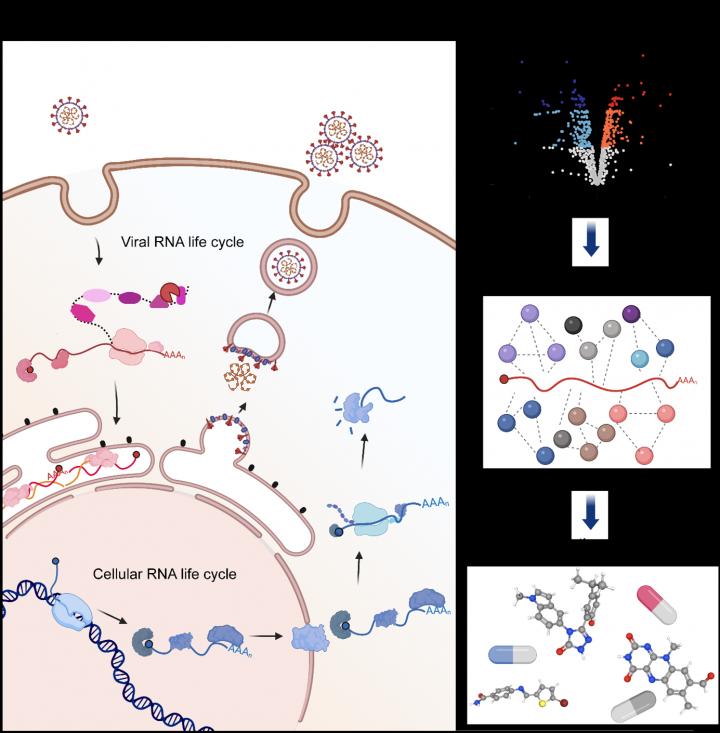
An international and multidisciplinary team led by researchers at the University of Oxford, University of Glasgow, and University of Heidelberg, has uncovered the interactions that SARS-CoV-2 RNA establishes with the host cell, many of which are fundamental for infection. These discoveries pave the way for the development of new therapeutic strategies for COVID-19 with broad-range antiviral potential.

The genetic information of SARS-CoV-2 is encoded in an RNA molecule instead DNA. This RNA must be multiplied, translated, and packaged into new viral particles to produce the viral progeny. Despite the complexity of these processes, SARS-CoV-2 only encodes a handful of proteins able to engage with viral RNA. To circumvent this

limitation SARS-CoV-2 hijacks cellular proteins and repurposes it for its own benefit. However, the identity of these proteins has remained unknown until now.

Researchers from the University of Oxford in collaboration with other labs across UK and Europe have developed a new approach to discover in a comprehensive manner the proteins that ‘stick’ to SARS-CoV-2 RNA in infected cells. With this method, authors uncovered that SARS-CoV-2 RNA hijacks more than a hundred cellular proteins, which appear to play critical roles in the viral life cycle.

This work, published in Molecular Cell, identifies many potential therapeutic targets with hundreds of available drugs targeting them. In a proof-of-principle experiment, authors selected four drugs targeting four different cellular proteins. These drugs caused from moderate to strong effects in viral replication.

‘These exciting results are only the beginning,’ said Alfredo Castello, one of the researchers that has led the work. ‘With hundreds of compounds that target these critical cellular proteins, it will be possible to identify novel antivirals. Our efforts, together with those of the scientific community, should focus now on testing these drugs in infected cells and animal models to uncover which ones are the best antivirals.’

An unexpected observation of this study is that viruses from different origin such as SARS-CoV-2 and Sindbis, hijack a similar repertoire of cellular proteins. This discovery is very important, as cellular proteins with important and wide-spread roles in virus infection have potential as target for broad-spectrum antiviral treatments.

‘In this stage of the pandemic in which vaccines have proved their value,’ added Alfredo Castello. ‘It becomes fundamental to develop new therapeutic approach to counteract emergent vaccine-resistant variants or novel pathogenic viruses with pandemic potential.’

Professor Shabaz Mohammed adds: ‘These new methods to discover the interactors of viral RNA builds on nearly 6 years of joined effort between the Castello and Mohammed labs using Sindbis virus as discovery model. This pre-existent work allowed us to react rapidly at the beginning of the COVID-19 pandemic and study the interactions between SARS-CoV-2 and the host cell in a reduced timeframe. Our methodology will now be ready to respond rapidly to future viral threads.’

###

The paper ‘Global analysis of protein-RNA interactions in SARS-CoV-2 infected cells reveals key regulators of infection’ is published in the journal Molecular Cell. The work was led by Dr Wael Kamel and Marko Noerenberg, postdoctoral researchers at Glasgow and Oxford, and Berati Cerikan, postdoctoral fellow at the University of Heidelberg.

Media Contact
Gen Juillet
[email protected]

Related Journal Article

http://dx.doi.org/10.1016/j.molcel.2021.05.023

Tags: BiochemistryCell BiologyInfectious/Emerging DiseasesMedicine/HealthMicrobiologyMolecular BiologyVirology
Share13Tweet8Share2ShareShareShare2

Related Posts

Miniature Sensor Uses Light to Detect Touch — Chemistry

Miniature Sensor Uses Light to Detect Touch

May 8, 2026
Iron Minerals Determine Whether Dissolved Organic Matter Fuels Microbes or Becomes Long-Term Carbon Storage — Chemistry

Iron Minerals Determine Whether Dissolved Organic Matter Fuels Microbes or Becomes Long-Term Carbon Storage

May 8, 2026

Kate Evans Appointed Associate Lab Director for Biological and Environmental Systems Science at ORNL

May 8, 2026

Advancing Multiscale Modeling and Overcoming Operational Challenges in Autothermal COâ‚‚-to-Methanol Reactors

May 8, 2026
Please login to join discussion

POPULAR NEWS

  • Research Indicates Potential Connection Between Prenatal Medication Exposure and Elevated Autism Risk

    840 shares
    Share 336 Tweet 210
  • New Study Reveals Plants Can Detect the Sound of Rain

    727 shares
    Share 290 Tweet 181
  • Scientists Investigate Possible Connection Between COVID-19 and Increased Lung Cancer Risk

    68 shares
    Share 27 Tweet 17
  • Salmonella Haem Blocks Macrophages, Boosts Infection

    61 shares
    Share 24 Tweet 15

About

We bring you the latest biotechnology news from best research centers and universities around the world. Check our website.

Follow us

Recent News

Evaluating Digoxin Use in Patients with Symptomatic Rheumatic Heart Disease

Evaluating the Effectiveness and Safety of Digitalis Glycosides in Treating Heart Failure

Urdu Fall Risk Questionnaire Adapted for Elderly

Subscribe to Blog via Email

Success! An email was just sent to confirm your subscription. Please find the email now and click 'Confirm' to start subscribing.

Join 82 other subscribers
  • Contact Us

Bioengineer.org © Copyright 2023 All Rights Reserved.

Welcome Back!

Login to your account below

Forgotten Password?

Retrieve your password

Please enter your username or email address to reset your password.

Log In
No Result
View All Result
  • Homepages
    • Home Page 1
    • Home Page 2
  • News
  • National
  • Business
  • Health
  • Lifestyle
  • Science

Bioengineer.org © Copyright 2023 All Rights Reserved.