Credit: ©Science China Press
In 1805, Thomas Young took the mechanical equilibrium at the solid/liquid/gas three-phase contact line into consideration (the balance of forces acting on the contact line formed by the intersection of the liquid-gas interface and the solid surface), and introduced the macroscopic concept of “contact angle” and Young’s equation. Based on the assumptions of isotropic, homogeneous, and smooth surface, Young’s equation gives the relationship between the intrinsic contact angle of the solid surface and the interfacial free energy at the solid/liquid/gas three-phase contact line.
However, it is difficult to obtain such a perfect surface in reality, and surfaces are usually heterogeneous. Although the macroscopic surface is smooth, the microscopic surface tends to be chaotic. The contact angle obtained in this way cannot be called the intrinsic contact angle.
To explore the intrinsic wettability of materials, the team of Prof. Xiaolin Wang from the Institute for Superconducting and Electronic Materials, Australian Institute for Innovative Materials, University of Wollongong and Prof. Lei Jiang and Prof. Tian Ye from the Technical Institute of Physics and Chemistry, Chinese Academy of Sciences jointly studied the wettability behavior of different crystal faces of sapphire (α-Al2O3) single crystals. Related results were published in the National Science Review (NSR) with the title “Crystal Face Dependent Intrinsic Wettability of Metal Oxide Surfaces”.
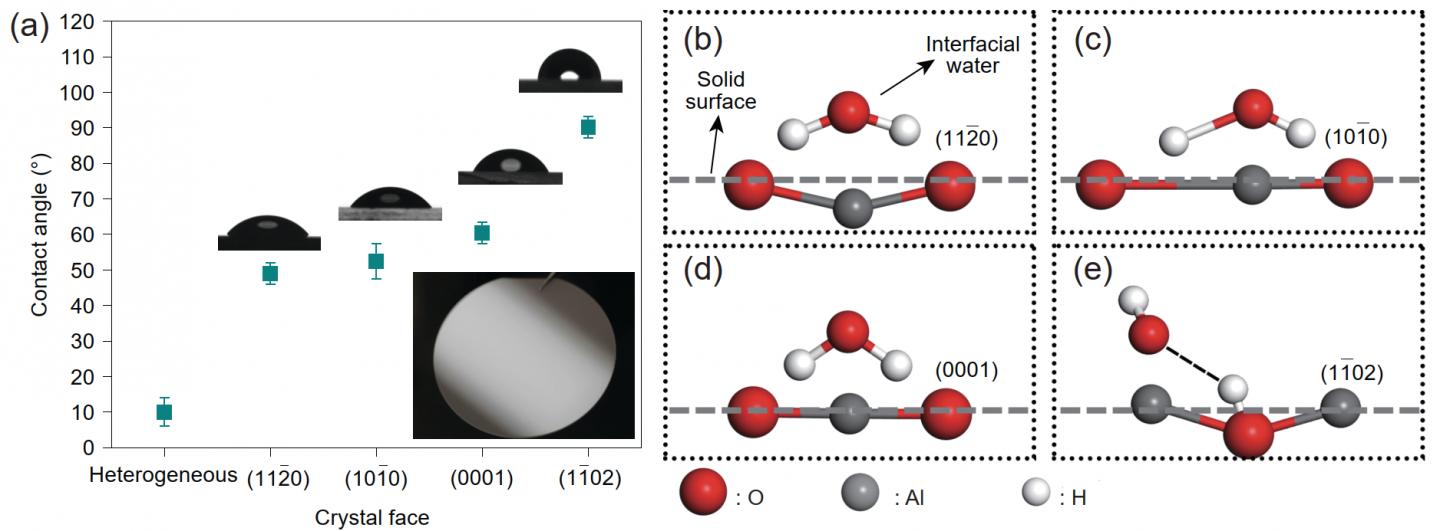
¯1¯As we all know, the surface of alumina is hydrophilic, and the contact angle of the polycrystalline surface of alumina is about 10°. During the experiment, researchers were surprised to find that the intrinsic contact angles of all four α-Al2O3 single crystals with different crystal faces are far greater than 10°, and the contact angle of the (1-102) crystal face is very close to 90°. The previous study in our group had proven that the intrinsic hydrophilic and hydrophobic boundary of the surface material is about 65°, so the (1-102) crystal surface is hydrophobic.
Through DFT simulation of the structures of the adsorbed interfacial water molecules at different crystal faces, it was found that compared with hydrophilic (11-20), (10-10) and (0001) crystal faces, the adsorbed water molecules at (1-102) crystal face is in a standing state; that is, the hydrogen atoms of the hydrophobic crystal face are at the highest point of the first layer of adsorbed water. Therefore, water molecules from water droplets at the three-phase contact line can only form one hydrogen bond with one hydrogen atom. Since one hydrogen bond interaction is relatively weak and then the three-phase contact line is easily anchored. But on the hydrophilic crystal faces, the oxygen atoms of the adsorbed interfacial water molecule are at the highest point. In this case, there are two lone pairs of electrons of one oxygen atom to form two hydrogen bond interactions with water molecules of water droplets at the three-phase contact line. Hence, the three-line contact line is easier to spread.
So far, this work started from the atomic-level flat alumina crystal interface and proved that the orientation of adsorbed interfacial water molecules has a huge impact on macroscopic wettability of solid surfaces with the similar chemical composition (aluminum and oxygen) and almost no topographic structure (atomically flat). This work focuses on the study of intrinsic wettability of the solid interface, which may provide inspirations to improve the catalytic efficiency, prepare excellent functional materials, and improve the performance of composite devices.
###
See the article:
Zhongpeng Zhu, Zhenwei Yu, Frank F. Yun, Deng Pan, Ye Tian*, Lei Jiang, and Xiaolin Wang*
Crystal Face Dependent Intrinsic Wettability of Metal Oxide Surfaces
Natl Sci Rev; doi: 10.1093/nsr/nwaa166
https:/
The National Science Review is the first comprehensive scholarly journal released in English in China that is aimed at linking the country’s rapidly advancing community of scientists with the global frontiers of science and technology. The journal also aims to shine a worldwide spotlight on scientific research advances across China.
Media Contact
Lei Jiang
[email protected]
Related Journal Article
http://dx.