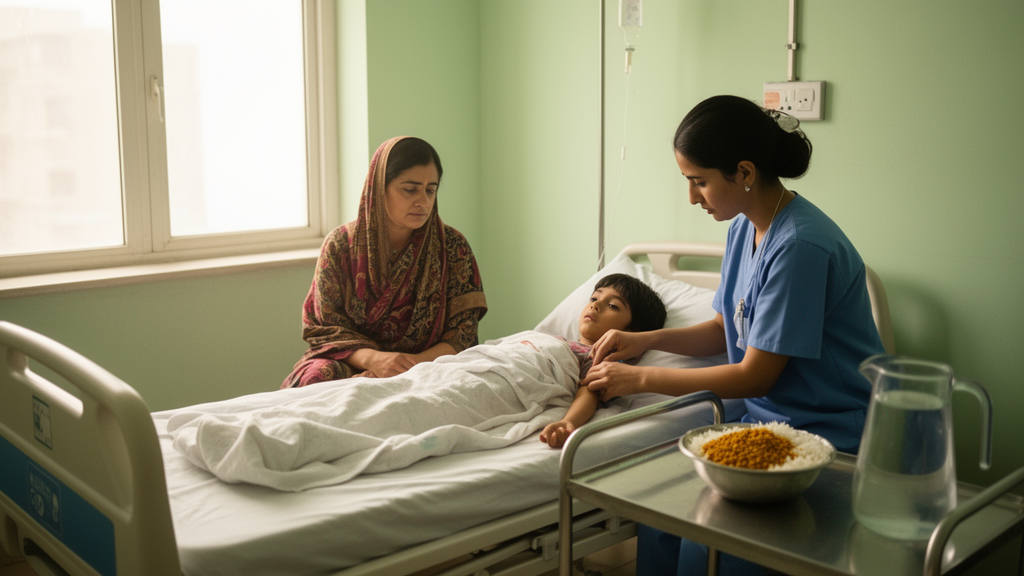
Nearly one in three children under five admitted to three tertiary care hospitals in Peshawar, Pakistan, was underweight, and more than a quarter showed stunting, according to a multicentre cross-sectional study published in BMC Public Health. The survey, conducted between March 2025 and February 2026, enrolled 650 young children and used multivariable statistical models to identify which environmental, socioeconomic and clinical factors are associated with undernutrition in this hospital-based population.
Underweight affected 30.8 percent of the children, stunting 27.5 percent, wasting 4.3 percent and kwashiorkor 1.7 percent. No child in the sample was classified as overweight or obese, meaning the nutritional burden in this admitted cohort ran in the direction of deficiency rather than excess. Because the study recruited children already hospitalized, these percentages describe the admitted population and cannot be generalized to all children in Peshawar or the wider Khyber Pakhtunkhwa province, a limitation the authors state explicitly.
To examine the drivers of undernutrition, the researchers built a composite outcome and ran a multivariable logistic regression that included the study site as a fixed effect, adjusting for systematic differences between the three hospitals. Several factors emerged with higher odds of undernutrition. Children from households with unimproved sanitation had 2.66 times the odds of undernutrition compared with those with improved sanitation, with a 95 percent confidence interval of 1.83 to 3.86 and a p-value below 0.001, making sanitation the strongest single association in the model.
Other significant associations followed. Urban residence carried 1.58 times the odds of undernutrition (95 percent CI 1.05 to 2.37), household food insecurity 1.45 times the odds (95 percent CI 1.03 to 2.04), and a recent episode of diarrhoea 1.90 times the odds (95 percent CI 1.18 to 3.06). Admission to Khyber Teaching Hospital, one of the three sites, was itself associated with 1.68 times the odds relative to the reference hospital (95 percent CI 1.09 to 2.59).
Taken together, the model points to a convergence of water and sanitation deficits, economic strain and infectious exposure in the children most likely to arrive malnourished. Not every candidate factor behaved as expected. Early complementary feeding was associated with lower odds of undernutrition (adjusted odds ratio 0.63, 95 percent CI 0.44 to 0.90), while high dietary diversity showed no statistically significant association with composite undernutrition (adjusted odds ratio 0.87, 95 percent CI 0.56 to 1.35).
The authors report the dietary diversity null result plainly: in this cohort, the variety of foods offered, on its own, did not distinguish malnourished from adequately nourished children once other variables were held constant. The study went beyond prevalence and risk factors to ask how undernutrition relates to what happens after admission. Using negative binomial regression, a model suited to count data with skewed distributions, the researchers examined length of hospital stay.
Underweight at admission was associated with a 63 percent higher expected length of stay, with an incidence rate ratio of 1.63 (95 percent CI 1.44 to 1.84). Stunting, wasting and kwashiorkor were not statistically associated with longer stays, indicating that the chronic, low-weight-for-age form of undernutrition, rather than the acute forms, was the signal that predicted prolonged hospitalization in this dataset. Recovery at discharge told an even starker story.
Children who were undernourished at admission had 65 percent lower odds of complete recovery by the time they left hospital, with an adjusted odds ratio of 0.35 (95 percent CI 0.22 to 0.54). Low household income independently produced a similar pattern, cutting the odds of complete recovery roughly in half (adjusted odds ratio 0.51, 95 percent CI 0.35 to 0.74). These findings link nutritional status and household economics directly to hospital outcomes, suggesting that the consequences of undernutrition extend beyond growth measurements into the clinical trajectory of the acute illnesses that bring children through the hospital door.
The authors frame their results against a policy backdrop that has long recognized the problem. Pakistan’s National Nutrition Policy of 2018 and the primary health care principles of the Alma-Ata Declaration both exist on paper, yet implementation gaps persist, and robust multifactorial data linking environmental, socioeconomic and clinical factors to nutritional status have been scarce for Khyber Pakhtunkhwa. The findings point toward targeted water, sanitation and hygiene interventions, nutrition-sensitive programs, and strengthened screening through the Lady Health Worker programme, Pakistan’s community-based network of frontline health workers.
As with any cross-sectional, hospital-based design, caution is warranted in interpretation. The data capture a single point in time, so the reported associations cannot establish that unimproved sanitation or food insecurity causes undernutrition, only that they travel together in this admitted population. The prevalence estimates describe hospitalized children, not the community at large, and children who never reach a tertiary hospital may face different or worse conditions. Still, for a region where such linked datasets have been rare, the study offers a quantified map of where the risks cluster, and it documents that the children most affected by undernutrition are also the ones least likely to leave hospital fully recovered.
Subject of Research: Factors associated with childhood malnutrition and hospitalization outcomes among children under five in Peshawar, Pakistan
Article Title: Factors associated with childhood malnutrition and hospitalization outcomes among children under five admitted to tertiary hospitals in Peshawar, Pakistan: a multicentre cross-sectional study
Article References: Khan, S., Pari, B., & Khan, R. (2026). Factors associated with childhood malnutrition and hospitalization outcomes among children under five admitted to tertiary hospitals in Peshawar, Pakistan: a multicentre cross-sectional study. BMC Public Health. https://doi.org/10.1186/s12889-026-29651-9
Image Credits: AI Generated
DOI: 10.1186/s12889-026-29651-9
Keywords: childhood malnutrition, undernutrition, stunting, wasting, sanitation, food insecurity, diarrhoea, complementary feeding, length of stay, Peshawar, Pakistan, cross-sectional study
News Source: Harold Sullivan. (October 28, 2026). Sanitation Gaps, Food Insecurity Tied to Malnutrition in Hospitalized Pakistani Children. Scienmag.