• HOME
  • NEWS
  • EXPLORE
    • CAREER
      • Companies
      • Jobs
    • EVENTS
    • iGEM
      • News
      • Team
    • PHOTOS
    • VIDEO
    • WIKI
  • BLOG
  • COMMUNITY
    • FACEBOOK
    • INSTAGRAM
    • TWITTER
Sunday, May 24, 2026
BIOENGINEER.ORG
No Result
View All Result
  • Login
  • HOME
  • NEWS
  • EXPLORE
    • CAREER
      • Companies
      • Jobs
        • Lecturer
        • PhD Studentship
        • Postdoc
        • Research Assistant
    • EVENTS
    • iGEM
      • News
      • Team
    • PHOTOS
    • VIDEO
    • WIKI
  • BLOG
  • COMMUNITY
    • FACEBOOK
    • INSTAGRAM
    • TWITTER
  • HOME
  • NEWS
  • EXPLORE
    • CAREER
      • Companies
      • Jobs
        • Lecturer
        • PhD Studentship
        • Postdoc
        • Research Assistant
    • EVENTS
    • iGEM
      • News
      • Team
    • PHOTOS
    • VIDEO
    • WIKI
  • BLOG
  • COMMUNITY
    • FACEBOOK
    • INSTAGRAM
    • TWITTER
No Result
View All Result
Bioengineer.org
No Result
View All Result
Home NEWS Science News Chemistry

Safety zone saves giant moons from fatal plunge

Bioengineer by Bioengineer
March 9, 2020
in Chemistry
Reading Time: 2 mins read
0
IMAGE
Share on FacebookShare on TwitterShare on LinkedinShare on RedditShare on Telegram

IMAGE

Credit: Nagoya University


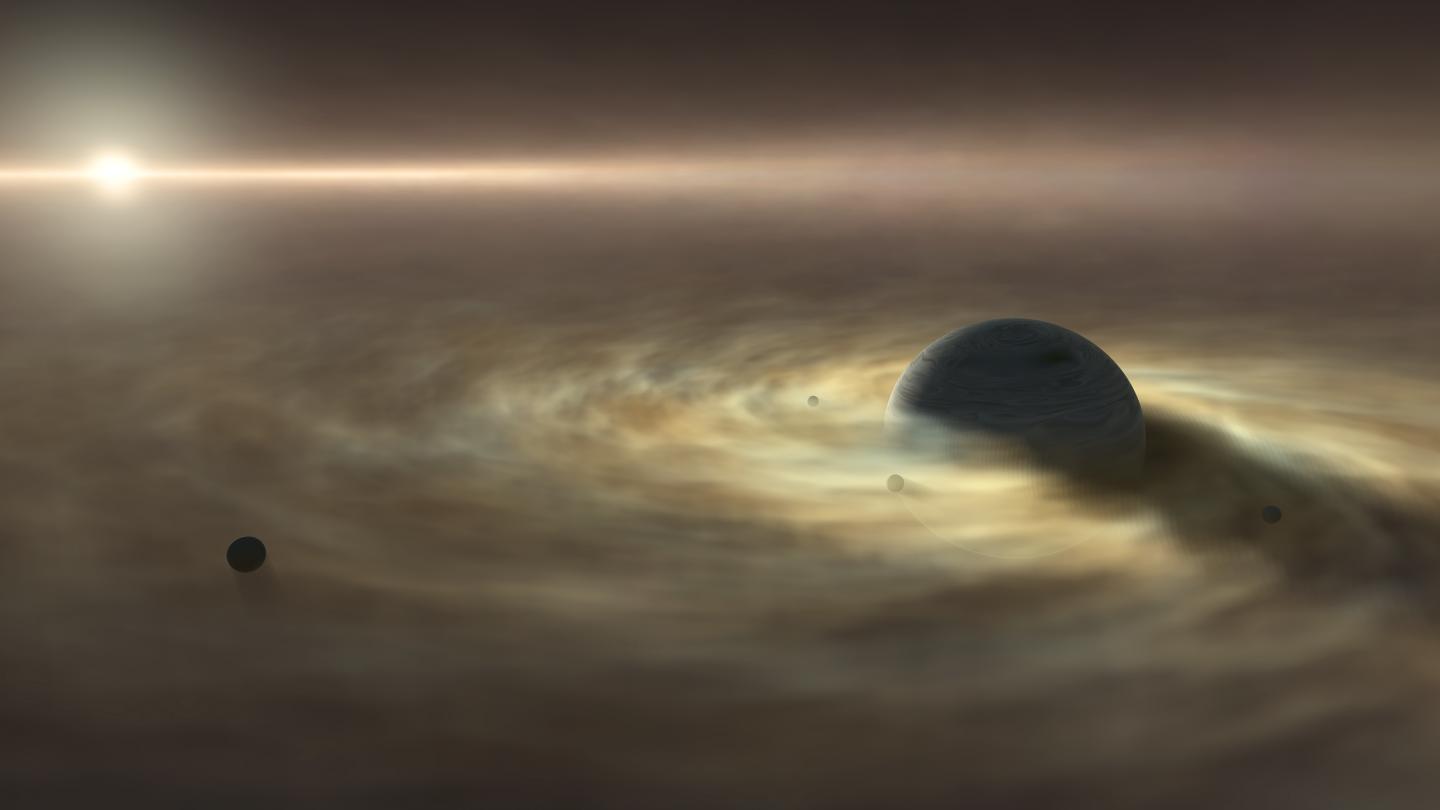
Numerical simulations showed that the temperature gradient in the disk of gas around a young gas giant planet could play a critical role in the development of a satellite system dominated by a single large moon, similar to Titan around Saturn. Researchers found that dust in the circumplanetary disk can create a “safety zone,” which keeps the moon from falling into the planet as the system evolves.

Astronomers believe that many of the moons we see in the Solar System, especially large moons, formed along with the parent planet. In this scenario, moons form from the gas and dust spinning around the still forming planet. But previous simulations have resulted in either all large moons falling into the planet and being swallowed-up or in multiple large moons remaining. The situation we observe around Saturn, with many small moons but only one large moon, does not fit in either of these models.

Yuri Fujii, a Designated Assistant Professor at Nagoya University, and Masahiro Ogihara, a Project Assistant Professor at the National Astronomical Observatory of Japan (NAOJ), created a new model of circumplanetary disks with a more realistic temperature distribution by considering multiple sources of opacities including dust and ice. Then, they simulated the orbital migration of moons considering pressure from disk gas and the gravity of other satellites.

Their simulations show that there is a “safety zone” where a moon is pushed away from the planet. In this area, warmer gas inside the orbit pushes the satellite outward and prevents it from falling into the planet.

“We demonstrated for the first time that a system with only one large moon around a giant planet can form,” says Fujii. “This is an important milestone to understand the origin of Titan.”

But Ogihara cautions, “It would be difficult to examine whether Titan actually experienced this process. Our scenario could be verified through research of satellites around extrasolar planets. If many single-exomoon systems are found, the formation mechanisms of such systems will become a red-hot issue.”

These results were published as Fujii and Ogihara “Formation of single-moon systems around gas giants” in Astronomy and Astrophysics Letters in March 2020. The simulations in this research used the PC Cluster operated by NAOJ.

###

Media Contact
Dr. Hinako Fukushi
[email protected]

Original Source

https://www.cfca.nao.ac.jp/en/pr/20200309

Related Journal Article

http://dx.doi.org/10.1051/0004-6361/201937192

Tags: AstronomyAstrophysicsPlanets/MoonsSpace/Planetary Science
Share12Tweet8Share2ShareShareShare2

Related Posts

Study Reveals How Valproate Affects Early Brain Development: Insights into the Antiepileptic Drug’s Impact — Chemistry

Study Reveals How Valproate Affects Early Brain Development: Insights into the Antiepileptic Drug’s Impact

May 22, 2026
Sustainable Chemistry: Iron Replaces Noble Metals in Catalytic Reactions — Chemistry

Sustainable Chemistry: Iron Replaces Noble Metals in Catalytic Reactions

May 22, 2026

Advancing Thin-Film Device Manufacturing with Imaging Ellipsometry for Enhanced Process Control

May 22, 2026

Simple Adjustment in 3D Printing Enhances Fit of Dental Crowns

May 22, 2026
Please login to join discussion

POPULAR NEWS

  • ESMO 2025: mRNA COVID Vaccines Enhance Efficacy of Cancer Immunotherapy

    314 shares
    Share 126 Tweet 79
  • New Study Reveals Plants Can Detect the Sound of Rain

    734 shares
    Share 293 Tweet 183
  • Research Indicates Potential Connection Between Prenatal Medication Exposure and Elevated Autism Risk

    847 shares
    Share 339 Tweet 212
  • Common Food Preservatives Associated with Elevated Blood Pressure and Increased Heart Disease Risk

    56 shares
    Share 22 Tweet 14

About

We bring you the latest biotechnology news from best research centers and universities around the world. Check our website.

Follow us

Recent News

AI Insights Uncover Causes of Injury Deaths

Comparing Robust Intelligent Controls for 3-DOF Robots

Predicting Flashover on Polluted Insulators with CNN-LSTM

Subscribe to Blog via Email

Enter your email address to subscribe to this blog and receive notifications of new posts by email.

Join 83 other subscribers
  • Contact Us

Bioengineer.org © Copyright 2023 All Rights Reserved.

Welcome Back!

Login to your account below

Forgotten Password?

Retrieve your password

Please enter your username or email address to reset your password.

Log In
No Result
View All Result
  • Homepages
    • Home Page 1
    • Home Page 2
  • News
  • National
  • Business
  • Health
  • Lifestyle
  • Science

Bioengineer.org © Copyright 2023 All Rights Reserved.