Credit: University of Bath
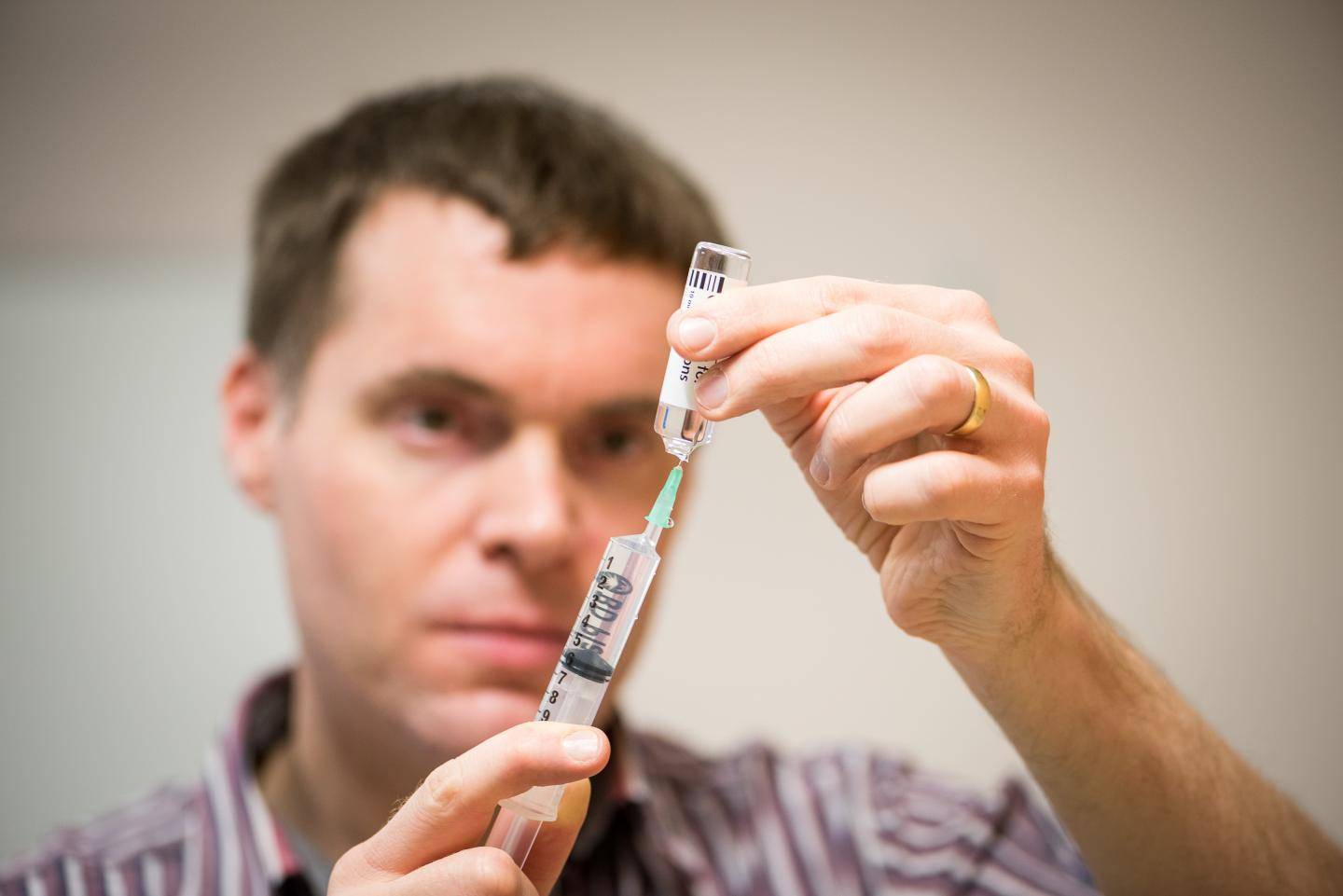
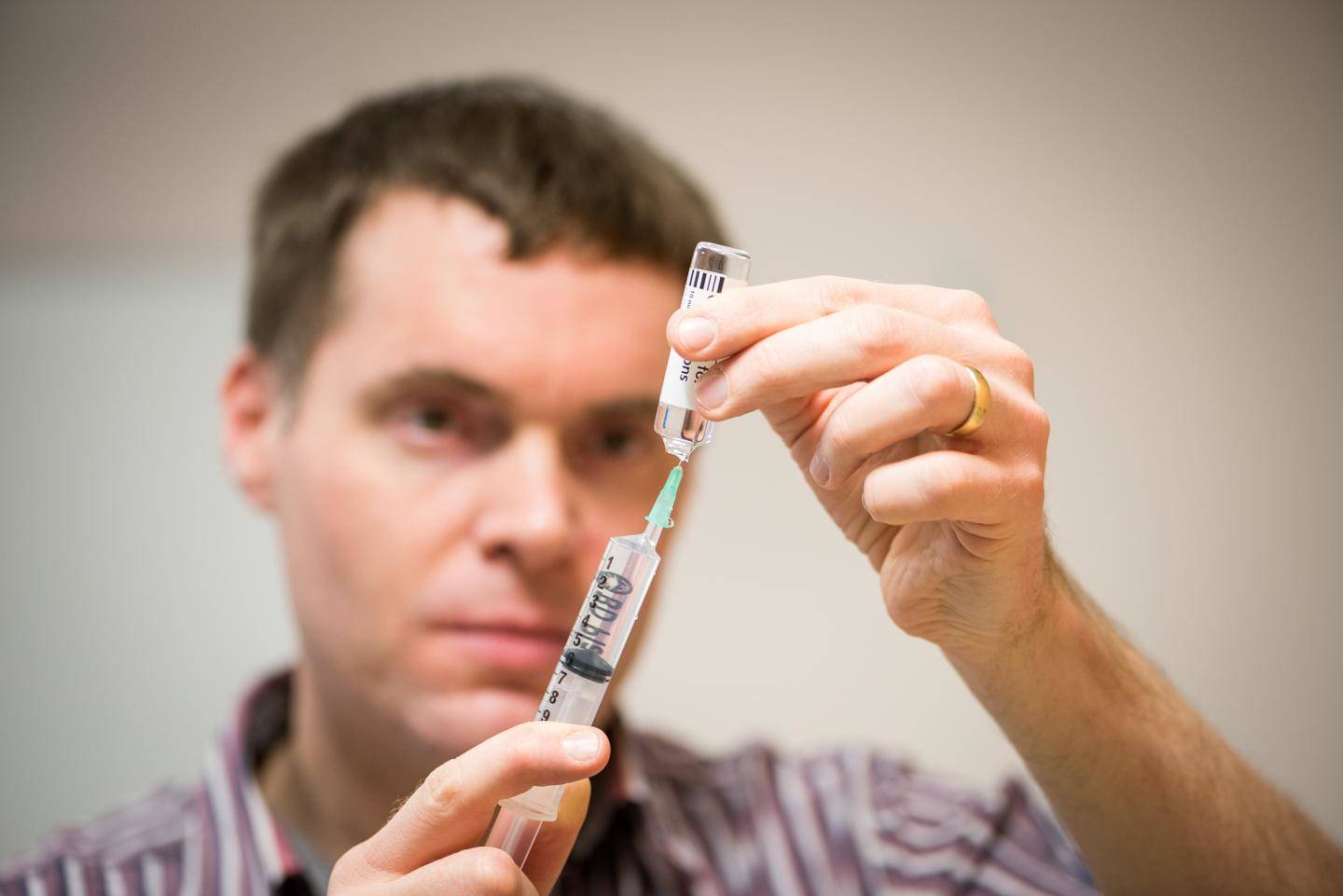
Due to the complicated nature of preparing injections, mistakes are made in around a third of doses. Although these are often minor errors, it is a statistic that University of Bath pharmacist Dr Matthew Jones wants to change with a new project to improve patient safety.
Dr Jones has been awarded a National Institute for Health Research (NIHR) Transitional Research Fellowship to move from the laboratory into clinical research, as he seeks to makes injections and other medical procedures safer.
The little research completed so far suggests that about 35% of injections given in hospital include at least one error. Many of these mistakes will be minor and unlikely to harm the patient, but we don't know how many patients are harmed by injection errors. Dr Jones will see if changing the injected medicines guidance can reduce these problems, improve patient safety and possibly save the NHS time and money.
Dr Jones, who specialises in using evidence to help patients and professionals make good decisions, said: "People probably picture pharmacists behind a counter supplying medicines, but what we actually do most often is give advice, to patients and other medical professionals.
"Mistakes can be caused by unclear or ambiguous advice and patients can be harmed. There's lots of research about the best way to provide written information for patients but not about how professionals write for each other.
"I want to see if we can take techniques for improving patient information and apply that to information written by one professional for another professional."
He has chosen to work on the injected medicines guidance as injections are some of the most complicated types of medicine with a high error rate. The guidelines are typically written by pharmacists but used by nurses.
The first part of the two-year project will see 30 nurses giving feedback on existing guidance to modify it so they find it easier to follow and use. The document will evolve through several phases.
Then Dr Jones will take both the original and modified guidance into hospitals and ask hundreds of nurses in the middle of real shifts to perform injections on an artificial arm. They will be randomly allocated a version of the guidance and observed to see if they make any mistakes before being asked about their experience using the document.
The hope is that making the guidance better will cut down on mistakes, and could speed up the process of giving injections, both of which would be good for patients and the NHS.
Dr Jones said: "Making up an injectable medicine and then injecting it is a complicated, convoluted process. Most mistakes will be minor, but of course not all, and it's a risk. The injectable medicines guide is written by pharmacists, but used most often by nurses.
"We're trained in different ways, have different styles, sometimes we talk different professional languages and we need to cross that divide."
Alongside the experiments, Dr Jones will undertake work to model the potential economic benefits of cutting down on mistakes during injections, for example in reducing additional treatments or legal costs.
The two year fellowship will begin in January. During the project Dr Jones will collaborate with Professor Margaret Watson in the Department of Pharmacy & Pharmacology and colleagues the Universities of Leeds and Bristol, and UCL. If successful the findings could be used to inform changes to guidance for other kinds of medicine.
Dr Jones said: "It's a great opportunity to learn lots of new things and hopefully make a real difference to patient safety, I'm grateful to NIHR for the fellowship."
###
The NIHR Transitional Research Fellowship offers 18 – 24 months funding to support researchers to make a transition from basic or experimental science research to an area of applied health or clinical research which is within NIHR remit.
For further information, please contact Chris Melvin in the University of Bath Press Office on +44-0-1225-383-941 or [email protected]
Media Contact
Chris Melvin
[email protected]
44-012-253-83841
@uniofbath
http://www.bath.ac.uk
Original Source
http://www.bath.ac.uk/announcements/safer-injections-targeted-with-new-university-of-bath-project/