• HOME
  • NEWS
  • EXPLORE
    • CAREER
      • Companies
      • Jobs
    • EVENTS
    • iGEM
      • News
      • Team
    • PHOTOS
    • VIDEO
    • WIKI
  • BLOG
  • COMMUNITY
    • FACEBOOK
    • INSTAGRAM
    • TWITTER
Saturday, August 22, 2026
BIOENGINEER.ORG
No Result
View All Result
  • Login
  • HOME
  • NEWS
  • EXPLORE
    • CAREER
      • Companies
      • Jobs
        • Lecturer
        • PhD Studentship
        • Postdoc
        • Research Assistant
    • EVENTS
    • iGEM
      • News
      • Team
    • PHOTOS
    • VIDEO
    • WIKI
  • BLOG
  • COMMUNITY
    • FACEBOOK
    • INSTAGRAM
    • TWITTER
  • HOME
  • NEWS
  • EXPLORE
    • CAREER
      • Companies
      • Jobs
        • Lecturer
        • PhD Studentship
        • Postdoc
        • Research Assistant
    • EVENTS
    • iGEM
      • News
      • Team
    • PHOTOS
    • VIDEO
    • WIKI
  • BLOG
  • COMMUNITY
    • FACEBOOK
    • INSTAGRAM
    • TWITTER
No Result
View All Result
Bioengineer.org
No Result
View All Result
Home NEWS Science News Health

Rutgers scientists discover new role for sensory signals in the brain

Bioengineer by Bioengineer
April 11, 2019
in Health
Reading Time: 2 mins read
0
IMAGE
Share on FacebookShare on TwitterShare on LinkedinShare on RedditShare on Telegram

Findings could help lead to new treatments for Parkinson’s disease, psychiatric disorders
IMAGE

Credit: Alex Yonk

Learning how to tie a shoe or shoot a basketball isn’t easy, but the brain somehow integrates sensory signals that are critical to coordinating movements so you can get it right.

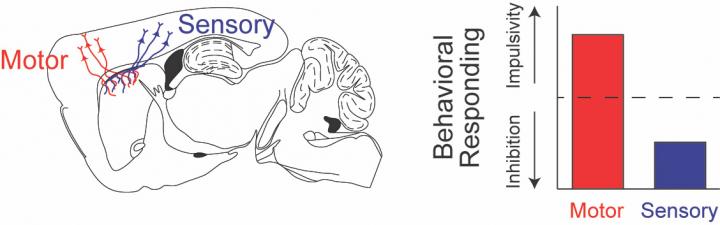
Now, Rutgers scientists have discovered that sensory signals in the brain’s cerebral cortex, which plays a key role in controlling movement and other functions, have a different pattern of connections between nerve cells and different effects on behavior than motor signals. The motor area of the cortex sends signals to stimulate muscles.

The research on neural signals, published in the journal Current Biology, could help lead to new treatments for movement disorders such as Parkinson’s disease and Huntington’s disease or psychiatric conditions such as obsessive compulsive disorder.

Scientists at Rutgers University-New Brunswick and Rutgers-Newark investigated a brain region called the striatum in mice. The striatum, which integrates signals from the sensory and motor areas of the cerebral cortex, is severely compromised in diseases such as Parkinson’s and Huntington’s.

“We found that stimulation of sensory cortex signals caused mice to stop their actions during a behavioral task, but motor cortex signals caused them to perform the task more impulsively,” said senior author David J. Margolis, an assistant professor in the Department of Cell Biology and Neuroscience in the School of Arts and Sciences at Rutgers-New Brunswick.

Future research will investigate the patterns of signaling between the cerebral cortex and striatum during different types of learning paradigms in mice to understand nerve cell connection mechanisms. The ultimate goal is to understand how abnormal cortex-striatum signaling is involved in neurological and psychiatric disorders.

###

The lead author is Christian R. Lee in the Department of Cell Biology and Neuroscience. Co-authors include Alex J. Yonk, Joost Wiskerke and Kenneth G. Paradiso in that department and James M. Tepper, a Distinguished Professor in the Center for Molecular and Behavioral Neuroscience at Rutgers-Newark. The research was funded by the Rutgers Brain Health Institute Pilot Grant Program, National Institutes of Health and National Science Foundation.

Media Contact
Todd Bates
[email protected]

Original Source

https://news.rutgers.edu/rutgers-scientists-discover-new-role-sensory-signals-brain/20190410#.XK3rZehKi70

Related Journal Article

http://dx.doi.org/10.1016/j.cub.2019.03.028

Tags: Cell BiologyMedicine/HealthMolecular BiologyneurobiologyParkinsonPhysiology
Share12Tweet8Share2ShareShareShare2

Related Posts

Real-world study examines psychotic complications of subcutaneous foslevodopa/foscarbidopa infusions in 198 patients

Real-world study examines psychotic complications of subcutaneous foslevodopa/foscarbidopa infusions in 198 patients

August 22, 2026

Blood-flow signals from liver vessels direct region-specific liver function through Wnt pathways

August 22, 2026

Proteomics Links Environmental and Genetic Parkinson’s Models to Purine Metabolism

August 22, 2026

Wearable Devices Track Activity Rhythms to Reveal Biological Aging Over Time

August 22, 2026
Please login to join discussion

POPULAR NEWS

  • Real-world study examines psychotic complications of subcutaneous foslevodopa/foscarbidopa infusions in 198 patients

    29 shares
    Share 12 Tweet 7
  • Blood-flow signals from liver vessels direct region-specific liver function through Wnt pathways

    29 shares
    Share 12 Tweet 7
  • Ge/SiGe Quantum-Well Photodetectors Integrated with SiN Waveguides on 200-mm Silicon Wafers

    29 shares
    Share 12 Tweet 7
  • Consensus Roadmap Guides Clinical Trials for Rare Childhood CNS Tumors

    29 shares
    Share 12 Tweet 7

About

We bring you the latest biotechnology news from best research centers and universities around the world. Check our website.

Follow us

Recent News

Real-world study examines psychotic complications of subcutaneous foslevodopa/foscarbidopa infusions in 198 patients

Blood-flow signals from liver vessels direct region-specific liver function through Wnt pathways

Ge/SiGe Quantum-Well Photodetectors Integrated with SiN Waveguides on 200-mm Silicon Wafers

Subscribe to Blog via Email

Success! An email was just sent to confirm your subscription. Please find the email now and click 'Confirm' to start subscribing.

Join 85 other subscribers
  • Contact Us

Bioengineer.org © Copyright 2023 All Rights Reserved.

Welcome Back!

Login to your account below

Forgotten Password?

Retrieve your password

Please enter your username or email address to reset your password.

Log In
No Result
View All Result
  • Homepages
    • Home Page 1
    • Home Page 2
  • News
  • National
  • Business
  • Health
  • Lifestyle
  • Science

Bioengineer.org © Copyright 2023 All Rights Reserved.