Study hopes to aid aviation authorities worldwide to protect wildlife and prevent costly damage.
Credit: Samantha Ball UCC
- – World’s wildlife, from giraffes to voles, kangaroos to coyotes being hit by aircraft.
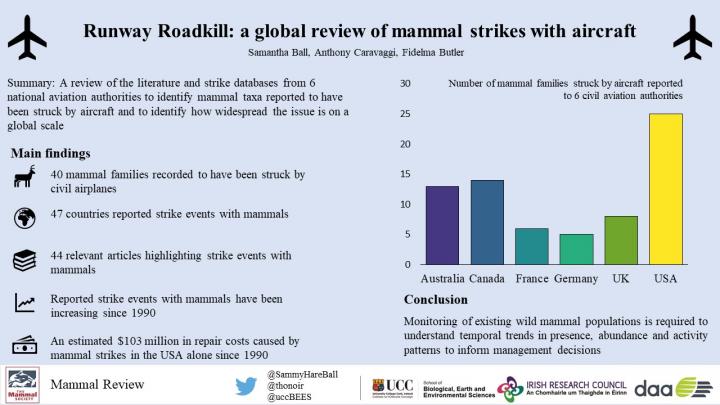
– Study identifies incidences at airports in 47 countries across the globe.
– ‘Runway Roadkill’ increasing by up to 68% annually and has caused damage that has cost in excess of $103 million in the United States alone over a 30 year period.
– It is hoped study could pave way for international efforts to protect wildlife and reduce costly aircraft damage.
From giraffes to the world’s smallest mammals, the world’s wildlife is being increasingly struck by aircraft, a global study finds.
Airports from Sydney to London and the USA to Germany were examined by researchers who found that incidences of mammal strikes with aircraft – so-called ‘runway roadkill’ – are increasing significantly year-on-year, are costing aviation authorities millions per annum, but are under-reported internationally.
The international study led by University College Cork (UCC) researcher Samantha Ball, found that ‘runway roadkill’ has been increasing by up to 68% annually and have caused damage that has cost in excess of $103 million in the United States alone over a 30 year period.
The global review of mammal strikes with aircraft, is funded by the Irish Research Council and the Dublin Airport Authority and is published in Mammal Review.
It is hoped the findings of the study may aid aviation authorities worldwide to increase mitigation measures to protect wildlife and prevent costly damage.
Ms Ball of UCC’s School of Biological, Earth & Environmental Sciences said mammals are incredibly diverse and those involved in strike events are no exception.
“As we identified 47 countries which have reported strikes with mammals, the species involved ranged from some of the world’s smallest mammals, such as voles, all the way up to the mighty giraffe and included mammals of all sizes in between. As strike events can affect everything from passenger safety, airline economics and local conservation, understanding the species composition and ecology of the local fauna at an airfield is paramount for effective strike mitigation,” she said.
However, most aircraft strikes involve birds, meaning there has been comparatively little research to date on collisions with mammals.
The airport environment can provide productive habitat for wildlife due to expanses of semi-natural grasslands, creating favourable ecological habitats, often in heavily urbanised areas.
Airport operators have a legal obligation to reduce wildlife hazard at airfields. It is therefore important for airports to understand the relative risk associated with each species, in order to prioritise and implement effective Wildlife Hazard Management Plans (WHMP).
By analysing published information and mammal strike data from national aviation authorities in Australia, Canada, France, Germany, the United Kingdom, and the United States, researchers found that bats accounted for the greatest proportion of strikes in Australia; rabbits and dog-like carnivores in Canada, Germany, and the United Kingdom; and bats and deer in the United States. Average mammal strikes per year ranged from 1.2 to 38.7 across the countries analysed, for every million aircraft movements.
Researchers identified:
- – Reports of around 10 strikes a year with kangaroos
– Around 40 strikes a year with coyotes
– Around 60 strikes with skunks.
– Around 100 strikes a year with fruit bats in Australia
– Over 100 strikes annually in recent years with leporids (rabbits and hares) in only three countries in Europe (France, Germany, UK).
They also found that:
- – More mammals were struck during the landing phase of an aircraft’s rotation than any other phase.
– Dusk was identified as having the highest strike rate per hour for Australia and the USA and night conferred the greatest risk in Canada and Germany.
– In the USA, it is estimated that mammal strikes are five times more likely to cause damage to aircraft than bird strikes.
– Under-reporting of strikes is recognised on both an international and national level: estimates suggest that only 5-47% of wildlife strikes are reported to aviation authorities, and the reporting of strike events remains voluntary in many countries.
The researchers argue that the ecological and behavioural traits of mammal populations in proximity to and inhabiting airports need to be understood and integrated into WHMPs if effective management policies are to be developed and implemented.
“Therefore, mitigation measures developed in the USA for the specific fauna of North America may not be effective for high-risk species in other parts of the world. As air travel is a global industry, increased research efforts targeted at high risk mammal families outside the USA would benefit not only the national aviation authorities responsible for the research, but also international authorities and airline operators. A more thorough understanding of the ecology of mammal groups inhabiting and using airfields is required to maximise the efficacy of any mitigation measures,” their paper argues.
###
https:/
Media Contact
Joe Leogue
[email protected]
Related Journal Article
http://dx.