Respiratory syncytial virus and human metapneumovirus are among the most frequent causes of acute respiratory infections worldwide, hitting children under two years old hardest and placing a heavy clinical burden on older adults and people with chronic obstructive pulmonary disease. A new review published in Frontiers in Cellular and Infection Microbiology argues that these viruses may do more than trigger acute illness: they may also interfere with the lung’s own repair machinery by infecting mesenchymal stem cells, the stromal cells that help restore tissue homeostasis after injury. The author, Rocio Tirado Mendoza of the National Autonomous University of Mexico, synthesizes evidence that viral infection of these cells could blunt their immunomodulatory and reparative functions, potentially contributing to airway remodeling and the initiation or progression of non-atopic asthma and COPD.
The review frames the problem with striking epidemiological figures. According to Mexico’s Conventional Epidemiological Surveillance System, health authorities reported more than 17 million new cases of acute respiratory infections between week 40 of 2025 and week 20 of 2026, of which roughly 206,000 were confirmed to have a viral cause. Globally, acute respiratory infections are a leading cause of medical consultation and hospitalization, particularly in pediatrics, and the Pan American Health Organization estimates that approximately four million people die annually from these infections. Children aged zero to two years and older adults are the most susceptible groups, and mortality typically stems from severe complications such as pneumonia, bronchitis, and bronchiolitis. Pneumonia remains the leading cause of childhood mortality worldwide in children under five years of age.
Beyond the acute phase, the review examines how severe early-life infections may set the stage for chronic disease. Severe respiratory syncytial virus infection during childhood has been associated with metabolic changes in the respiratory epithelium and alterations in the epithelial barrier that may affect lung development. The combination of a shifted respiratory microbiome, a compromised epithelial barrier, and a deficient Th1 and Th17 immune response may predispose young children to allergen sensitization, exaggerated responses to environmental pollutants, and recurrent infections, all identified as risk factors for non-atopic asthma. Severe RSV infection may also promote the differentiation of Th17 lymphocytes, which are linked to airway hyper-reactivity, and may drive overexpression and sensitization of Toll-like receptor 4, producing an exaggerated immune response with bronchial hyperreactivity upon reinfection.
Human metapneumovirus, described as the second most clinically important human respiratory virus after RSV in pediatric practice, follows a similar pattern. Although HMPV infection recurs throughout life and is often mild, it can occasionally complicate into severe bronchiolitis and pneumonia requiring hospitalization, intensive care admission, and intubation. Evidence suggests that HMPV infection during infancy may be a significant risk factor for the development of preschool asthma within the first five years of life, mirroring what has been reported for RSV and rhinovirus. In adults, the virus can exacerbate respiratory difficulties in people with COPD, asthma, or weakened immune systems, and one report found HMPV detected in 18.2 percent of hospitalized COPD patients.
Much of the mechanistic insight into HMPV comes from murine models, which are susceptible to infection. These studies have shown that HMPV can induce airway remodeling and mucus production, and other researchers have documented asthma-like manifestations, including airway obstruction and airway hyperresponsiveness, associated with chronic inflammatory processes that may persist for months. Viral RNA has been detected long after the acute phase, and some authors suggest that persistence within neuronal projections in the lung, an immunoprivileged site, may explain the prolonged presence of the virus. HMPV infection also reshapes the adaptive immune response, inducing a Th1-type response early in infection followed by a Th2-type response characterized by high interleukin-10, low interferon-gamma, and a delayed cytotoxic T-cell response. Primary HMPV infection may even alter the response to pharmacological treatment for exacerbated airway hyperresponsiveness long after the initial infection.
The review devotes particular attention to neutrophilic, or Th2-low, asthma, a subtype distinguished from allergic Th2-high asthma by the absence of atopic family history, a non-eosinophilic inflammatory pattern, and a Th17-mediated immune response. Epithelial cells in the respiratory tract increase production of interleukin-33 in response to viral infection, and elevated IL-33 promotes Th17 responses that drive neutrophilic inflammation. IL-17A released by Th17 cells activates epithelial cells, fibroblasts, and neutrophils, triggering the release of chemokines such as IL-6 and CXCL8 that recruit and activate neutrophils in the airways. These cells secrete elastases and other bioactive mediators that contribute to lung tissue damage and excessive mucus production. Activated neutrophils also release neutrophil extracellular traps, web-like structures composed of DNA, histones, and granule proteins such as myeloperoxidase and elastase, which have been detected in bronchial biopsies of asthmatic patients and which stimulate further CXCL8 production from airway epithelial cells.
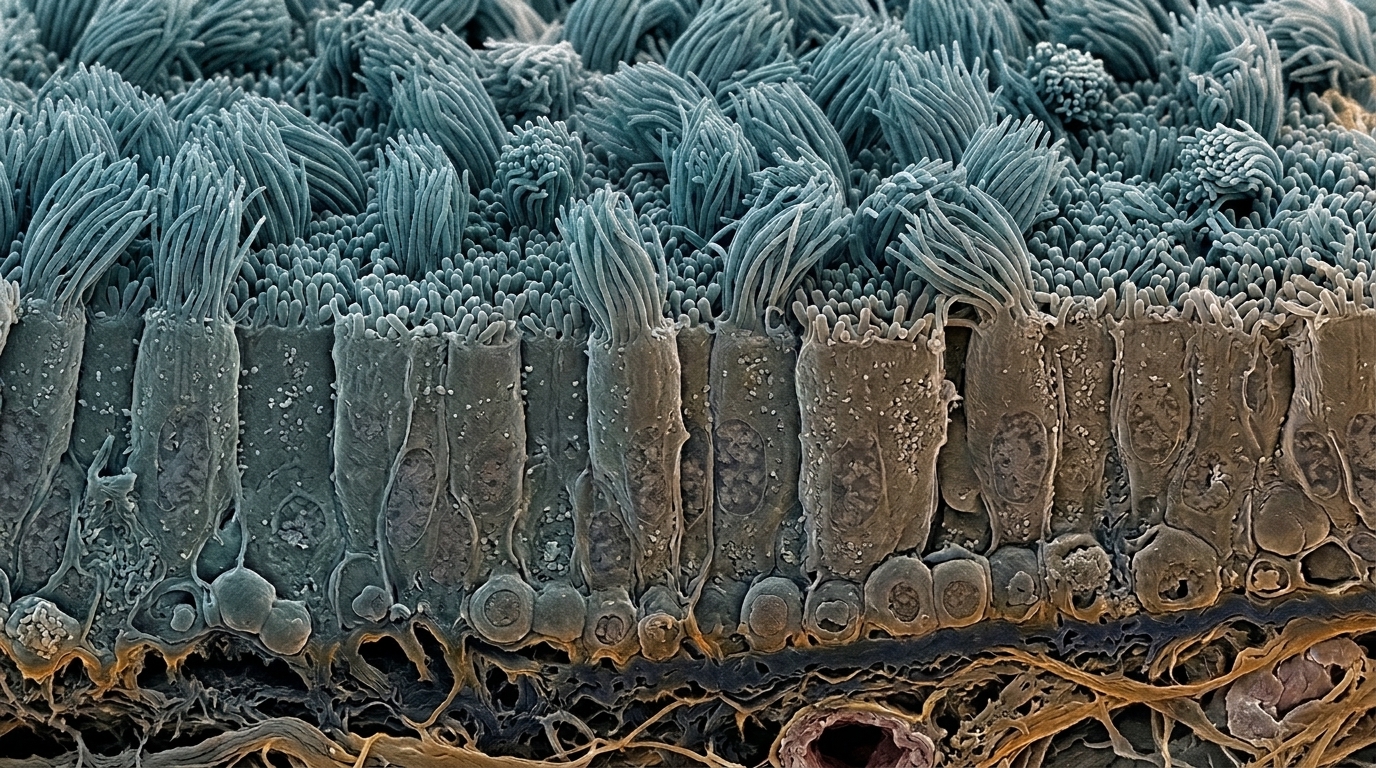
Against this inflammatory backdrop, mesenchymal stem cells emerge as potential guardians of lung homeostasis. In the lower airways, lung-resident mesenchymal stem cells, which the review identifies with basal epithelial cells possessing multipotent capacity, can differentiate into multiciliate cells, club cells that produce antimicrobial and immunomodulatory peptides, and goblet cells that produce mucus. Type II alveolar epithelial cells act as facultative progenitors of the alveolar epithelium. Lung-resident MSCs regulate neighboring epithelial, endothelial, and immune cells through direct cell-to-cell contact and paracrine signaling, promoting cytoprotection, proliferation, and repair. They are considered hypoimmunogenic because they produce low levels of inflammatory mediators until their immunomodulatory functions are activated by interleukin-1 beta, interferon-gamma, and tumor necrosis factor alpha, cytokines generated by activated cells responding to airway pathogens or allergic factors.
The central concern of the review is that these reparative cells are themselves susceptible and permissive to infection by RSV and HMPV, a process that may be facilitated by surface expression of Toll-like receptors 2, 4, and 6, which may function as viral entry molecules. The evidence is stronger for RSV. RSV has been shown to replicate in human MSCs and modify their cytokine, chemokine, antiviral, and immunomodulatory responses, including changes in IL-1 beta, IL-6, IL-8, SDF-1, interferon-beta, and IDO-dependent pathways. RSV-infected human MSCs overexpress Toll-like receptors and show altered cytoskeletal organization. Studies using pediatric lung-resident MSCs and an ovine model of human RSV infection demonstrated that the virus could invade and activate lung-resident MSCs in vivo, expand the pulmonary MSC pool, and induce transcriptional programs associated with antiviral defense, tissue repair, differentiation, remodeling, and angiogenesis.
The evidence for HMPV is more limited but points in a similar direction. Available in vitro data indicate that HMPV infection modifies MSC cytoskeletal architecture, alters surface phenotype, and affects secretion of growth factors involved in tissue repair, with decreased epidermal growth factor and vascular endothelial growth factor and increased angiopoietin-2 and PDGF-AA. These changes suggest HMPV may impair or reprogram the reparative properties of MSCs, although direct in vivo evidence connecting HMPV-infected MSCs to airway remodeling, asthma development, or COPD progression remains insufficient, and the author explicitly flags this as a research gap. Compounding the problem, chronic lung diseases such as non-atopic asthma and COPD are already associated with lung-resident MSCs that have reduced immunomodulatory function and diminished repair responses, and a 2025 study showed that asthmatic inflammation reduces the number of MSCs residing in the lower airways, with the remaining cells exhibiting a loss of functional properties that may contribute to disease progression.
The review is careful to distinguish association from causation. Epidemiological and clinical studies have shown that severe early-life RSV bronchiolitis is associated with recurrent wheezing and later asthma, but these studies do not demonstrate that MSC infection is the causal mediator of those outcomes. Similarly, work implicating lung-resident MSC dysfunction in chronic lung disease supports a plausible mechanistic link between impaired repair, altered immunomodulation, profibrotic differentiation, and airway remodeling, yet does not establish that viral infection of MSCs directly causes asthma or COPD progression. The author calls for future studies using lineage-tracing models, conditional viral infection systems, lung organoids, epithelial-MSC co-culture models, single-cell longitudinal analyses, and prospective human studies linking viral infection, MSC dysfunction, remodeling biomarkers, and long-term obstructive airway outcomes. Until such evidence accumulates, the idea that RSV and HMPV subvert the lung’s stem cell repair system remains a compelling but unproven hypothesis, one that could reshape how researchers think about the long-term consequences of early-life viral infections.
Subject of Research: How RSV and HMPV infection of lung mesenchymal stem cells may affect pulmonary repair, remodeling, and chronic respiratory disease risk
Article Title: The MSC–RSV/HMPV interface: impacts on pulmonary homeostasis, remodeling, and risk of non-atopic asthma and COPD
Article References: Tirado Mendoza, R. (2026). The MSC–RSV/HMPV interface: impacts on pulmonary homeostasis, remodeling, and risk of non-atopic asthma and COPD. Frontiers in Cellular and Infection Microbiology, 16, Article 1952735. https://doi.org/10.3389/fcimb.2026.1952735
Image Credits: AI Generated
DOI: 10.3389/fcimb.2026.1952735
Keywords: RSV, human metapneumovirus, mesenchymal stem cells, non-atopic asthma, COPD, airway remodeling, lung homeostasis, neutrophilic asthma, neutrophil extracellular traps, respiratory tract infections, Th17 immune response, tissue repair
News Source: Ophelia Keating. (November 5, 2026). RSV and HMPV may infect lung stem cells, reshaping repair and asthma risk. Scienmag.