• HOME
  • NEWS
  • EXPLORE
    • CAREER
      • Companies
      • Jobs
    • EVENTS
    • iGEM
      • News
      • Team
    • PHOTOS
    • VIDEO
    • WIKI
  • BLOG
  • COMMUNITY
    • FACEBOOK
    • INSTAGRAM
    • TWITTER
Thursday, May 21, 2026
BIOENGINEER.ORG
No Result
View All Result
  • Login
  • HOME
  • NEWS
  • EXPLORE
    • CAREER
      • Companies
      • Jobs
        • Lecturer
        • PhD Studentship
        • Postdoc
        • Research Assistant
    • EVENTS
    • iGEM
      • News
      • Team
    • PHOTOS
    • VIDEO
    • WIKI
  • BLOG
  • COMMUNITY
    • FACEBOOK
    • INSTAGRAM
    • TWITTER
  • HOME
  • NEWS
  • EXPLORE
    • CAREER
      • Companies
      • Jobs
        • Lecturer
        • PhD Studentship
        • Postdoc
        • Research Assistant
    • EVENTS
    • iGEM
      • News
      • Team
    • PHOTOS
    • VIDEO
    • WIKI
  • BLOG
  • COMMUNITY
    • FACEBOOK
    • INSTAGRAM
    • TWITTER
No Result
View All Result
Bioengineer.org
No Result
View All Result
Home NEWS Science News Biology

Role of cooperativity in hydrophobic interactions revealed in real-time monitoring

Bioengineer by Bioengineer
July 6, 2017
in Biology
Reading Time: 2 mins read
0
Share on FacebookShare on TwitterShare on LinkedinShare on RedditShare on Telegram
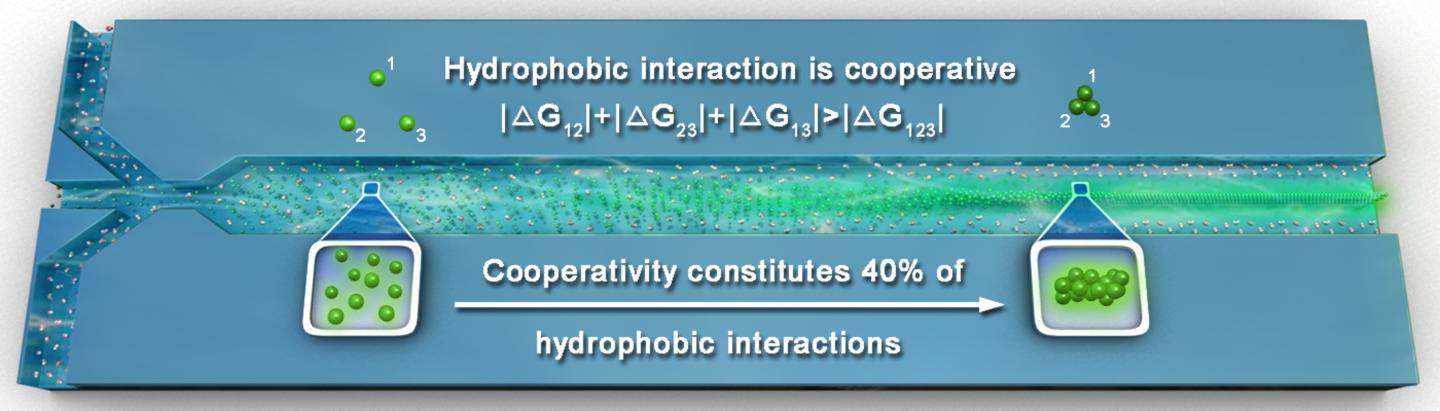
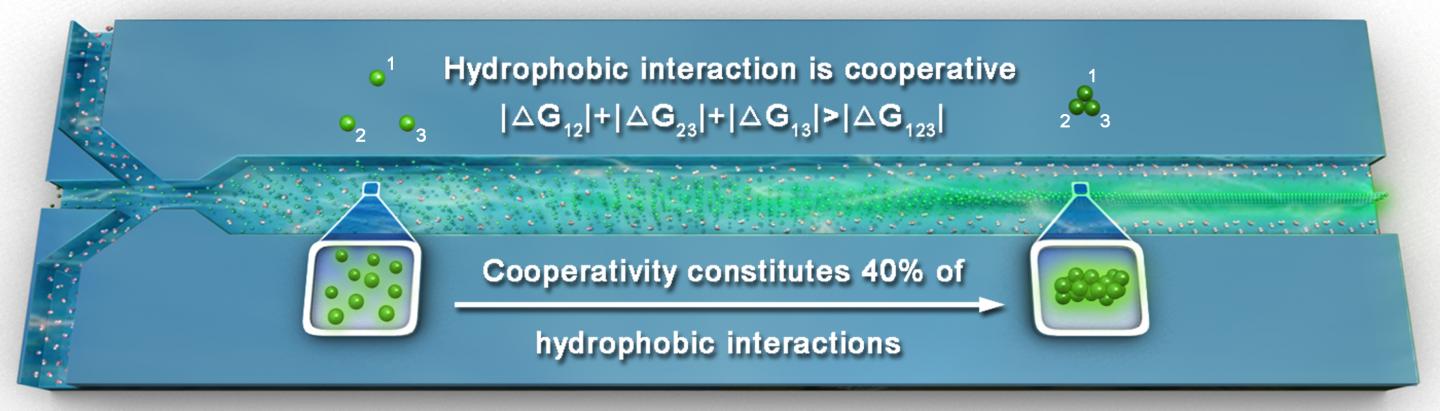
IMAGE

Credit: Department of Chemistry, HKUST

Hydrophobic interactions is one major type of intermolecular force that plays a vital role in many life processes in Chemistry and Physics. In biological systems, hydrophobic interactions can stabilize the internal cores of proteins and form lipid vesicles that store nutrients in our cells.In proteins, hydrophobic interactions can stabilize the internal cores and form lipid vesicles that store nutrients in our cells. What is so intriguing about hydrophobic interaction is that it exhibits a cooperative property called cooperativity, which does not exist in other fundamental intermolecular forces, such as dipole-dipole interactions and Van der Waals forces. Cooperativity means that in the presence of multiple molecules (at least more than two), the overall strength of the interaction between the molecules is much greater than that when there are only two molecules acting in pairs.

A major gap in the textbook knowledge of hydrophobic interaction and its cooperativity that have profound implications in many fundamental processes in nature is: to what extent cooperativity contributes to hydrophobic interactions that stabilize the assembly of macromolecules? One gigantic roadblock to solving this long-standing puzzle is the extreme difficulty to quantify cooperativity by experiments, as cooperativity is originated from the collective motions of water hydrogen bond networks surrounding hydrophobic solutes.

In a breakthrough, scientists from The Hong Kong University of Science and Technology overcame these challenges by designing an innovative microfluidic mixer that monitors the fluorescence induced by hydrophobic aggregation. This scientific advance not only allows the quantification of molecular hydrophobic interaction and its cooperativity in bulk solution, but also provides a clear and quantitative evidence for the critical role of cooperativity in hydrophobic aggregation that is being consolidated by their kinetic nucleation-growth theory.

Their findings were published in the journal Nature Communications on May 31, 2017 (doi: 10.1038/ncomms15639).

"To quantify hydrophobic interactions, we real-time monitored hydrophobic aggregation in bulk solution at microsecond time scale," said Prof. Xuhui Huang, corresponding author of the manuscript. "To achieve this, we probed fluorescence induced by aggregation upon rapid mixing of water and hydrophobic solute using the microfluidic device. We then fitted the measured fluorescence to the kinetics nucleation-growth theory".

"The state-of-the-art microfluidic device allows us to track the aggregation of the solute molecule at very short, microsecond timescales due to the fine dimensions of the solute jet (at submicron in diameter) focused by microfluidic flow. Our results demonstrated that the attachment of a hydrophobic monomer to its aggregate in water occurs at sub-microsecond." Prof. Shuhuai Yao, the other corresponding author further elaborated.

###

Media Contact

Johnny Tam
[email protected]
852-235-88556

http://www.ust.hk

Related Journal Article

http://dx.doi.org/10.1038/ncomms15639

############

Story Source: Materials provided by Scienmag
Share12Tweet8Share2ShareShareShare2

Related Posts

Early Delivery Improves Outcomes for Mothers and Babies in Hypertensive Pregnancies — Biology

Early Delivery Improves Outcomes for Mothers and Babies in Hypertensive Pregnancies

May 21, 2026
How Atlantic Herring Rewired Their Reproductive Strategy to Thrive in Changing Oceans — Biology

How Atlantic Herring Rewired Their Reproductive Strategy to Thrive in Changing Oceans

May 20, 2026

Study Finds Young Fraser River Chinook Salmon Swimming in Chemical Mixture

May 20, 2026

Thousands of UK Beekeepers Contribute Honey to Advance Environmental Science

May 20, 2026
Please login to join discussion

POPULAR NEWS

  • blank

    New Study Reveals Plants Can Detect the Sound of Rain

    733 shares
    Share 292 Tweet 183
  • ESMO 2025: mRNA COVID Vaccines Enhance Efficacy of Cancer Immunotherapy

    302 shares
    Share 121 Tweet 76
  • Research Indicates Potential Connection Between Prenatal Medication Exposure and Elevated Autism Risk

    846 shares
    Share 338 Tweet 212
  • Breastmilk Balances E. coli and Beneficial Bacteria in Infant Gut Microbiomes

    58 shares
    Share 23 Tweet 15

About

We bring you the latest biotechnology news from best research centers and universities around the world. Check our website.

Follow us

Recent News

NutriGrow Delphi Sets Standards for Preterm Nutrition Reporting

Critical Path Institute Unveils New Coalition to Propel Human-Relevant Drug Development Tools

Critical Path Institute Grants $249,719 to Odylia Therapeutics to Propel Gene Therapy for USH1C-Related Vision Loss

Subscribe to Blog via Email

Enter your email address to subscribe to this blog and receive notifications of new posts by email.

Join 82 other subscribers
  • Contact Us

Bioengineer.org © Copyright 2023 All Rights Reserved.

Welcome Back!

Login to your account below

Forgotten Password?

Retrieve your password

Please enter your username or email address to reset your password.

Log In
No Result
View All Result
  • Homepages
    • Home Page 1
    • Home Page 2
  • News
  • National
  • Business
  • Health
  • Lifestyle
  • Science

Bioengineer.org © Copyright 2023 All Rights Reserved.