• HOME
  • NEWS
  • EXPLORE
    • CAREER
      • Companies
      • Jobs
    • EVENTS
    • iGEM
      • News
      • Team
    • PHOTOS
    • VIDEO
    • WIKI
  • BLOG
  • COMMUNITY
    • FACEBOOK
    • INSTAGRAM
    • TWITTER
Wednesday, July 8, 2026
BIOENGINEER.ORG
No Result
View All Result
  • Login
  • HOME
  • NEWS
  • EXPLORE
    • CAREER
      • Companies
      • Jobs
        • Lecturer
        • PhD Studentship
        • Postdoc
        • Research Assistant
    • EVENTS
    • iGEM
      • News
      • Team
    • PHOTOS
    • VIDEO
    • WIKI
  • BLOG
  • COMMUNITY
    • FACEBOOK
    • INSTAGRAM
    • TWITTER
  • HOME
  • NEWS
  • EXPLORE
    • CAREER
      • Companies
      • Jobs
        • Lecturer
        • PhD Studentship
        • Postdoc
        • Research Assistant
    • EVENTS
    • iGEM
      • News
      • Team
    • PHOTOS
    • VIDEO
    • WIKI
  • BLOG
  • COMMUNITY
    • FACEBOOK
    • INSTAGRAM
    • TWITTER
No Result
View All Result
Bioengineer.org
No Result
View All Result
Home NEWS Science News Chemistry

Robotic gripping mechanism mimics how sea anemones catch prey

Bioengineer by Bioengineer
January 14, 2020
in Chemistry
Reading Time: 3 mins read
0
IMAGE
Share on FacebookShare on TwitterShare on LinkedinShare on RedditShare on Telegram

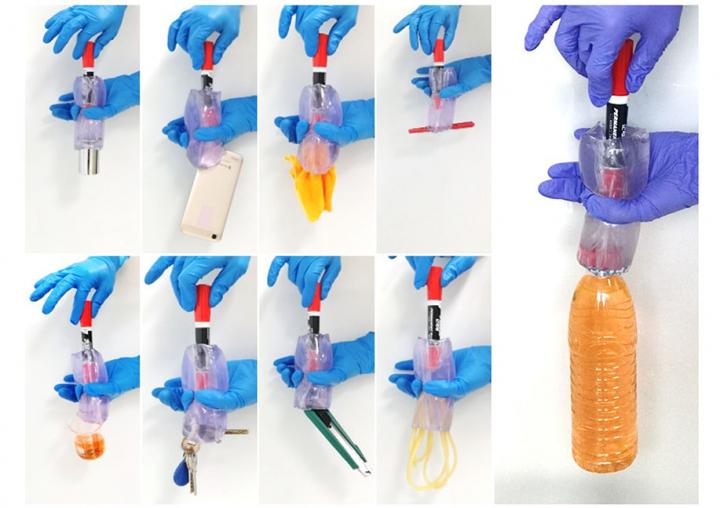
The doughnut-shaped, plastic rubber device crimps its skin to latch onto anything from cloth to beakers filled with liquid.
IMAGE

Credit: Weifeng Yuan


WASHINGTON, January 14, 2020 — Most robotic gripping mechanisms to date have relied on humanlike fingers or appendages, which sometimes struggle to provide the fine touch, flexibility or cost-effectiveness needed in some circumstances to hold onto objects. Recent work looks to provide a path forward for gripping robots from an unlikely source — the doughnut-shaped sea anemone.

Researchers at the Southwest University of Science and Technology and Tsinghua University in China demonstrated a robotic gripping mechanism that mimics how a sea anemone catches its prey. The bionic torus captures and releases objects by crimping its skin. The grasper not only is relatively cheap and easy to produce but also can grab a variety of objects of different sizes, shapes, weights and materials. They discuss their work in this week’s Applied Physics Letters, from AIP Publishing.

“In industries, multi-fingered dexterous hands are widely used to perform grabbing tasks. However, these end-effectors consist of a large number of components, like joints and sensors, which are difficult to control,” said author Weifeng Yuan.

The thermoplastic rubber skin that lines the exterior of the liquid-filled ring rolls inward when the inner skin of the gripper experiences a pulling force, sucking in whatever target being grabbed.

Researchers can adjust various features of the torus, such as the rolling direction and length of the skin, to control whether items are engulfed, swallowed or released.

“We found that sea anemones can capture sea creatures with different shapes and sizes, so we decided to investigate the mechanism of the predation strategy, and we believed that the study would be helpful to the design of adaptive soft graspers,” Yuan said.

The group demonstrated the device by latching onto objects, ranging from a piece of cloth to a cellphone to a glass beaker filled with liquid.

Yuan said a flexible gripper has the potential to grasp fragile objects in narrow spaces or extreme, high-pressure environments, such as collecting samples of deep-sea organisms or conveying pipes. What’s more, the grasper can also be built on the nanoscale to manipulate individual cells. Yuan sees potential in developing surgical instruments.

“Our grasper can grasp a steel bar from a table one minute and an egg from a basket the next without resetting control parameters,” Yuan said.

The group hopes to continue fleshing out the potential for such a unique device, such as increasing the strength-to-weight ratio by using air instead of liquids.

###

The article, “Bionic torus as a self-adaptive soft grasper in robots,” is authored by Hongbin Zang, Bing Liao, Xin Lang, Zi-Long Zhao, Weifeng Yuan and Xi-Qiao Feng. The article appeared in Applied Physics Letters on Jan. 14, 2020 (DOI: 10.1063/1.5128474) and can be accessed at https://aip.scitation.org/doi/10.1063/1.5128474.

ABOUT THE JOURNAL

Applied Physics Letters features rapid reports on significant discoveries in applied physics. The journal covers new experimental and theoretical research on applications of physics phenomena related to all branches of science, engineering, and modern technology. See https://aip.scitation.org/journal/apl.

Media Contact
Larry Frum
[email protected]
301-209-3090

Related Journal Article

http://dx.doi.org/10.1063/1.5128474

Tags: BiologyBiomechanics/BiophysicsChemistry/Physics/Materials SciencesTechnology/Engineering/Computer Science
Share12Tweet8Share2ShareShareShare2

Related Posts

Salt adaptation linked to higher disease risk, Mizzou study finds

Salt adaptation linked to higher disease risk, Mizzou study finds

July 6, 2026
Intelligent Microgrid Management Promises Lower Household Energy Bills and Reduced Diesel Emissions — Chemistry

Intelligent Microgrid Management Promises Lower Household Energy Bills and Reduced Diesel Emissions

July 4, 2026

Graz University of Technology Deciphers the Structural Secrets of MOF Thin Films

July 2, 2026

Breaking Thermodynamic Limits: Wavelength-Driven Catalysis Advances Ammonia Synthesis

July 2, 2026
Please login to join discussion

POPULAR NEWS

  • Detection of EDCs in Breast Milk and Infant Urine Up to Six Months Highlights Early Exposure Risks

    77 shares
    Share 31 Tweet 19
  • New Drug Candidate Developed at McMaster Shows Potential for Treating Brain Cancer

    58 shares
    Share 23 Tweet 15
  • Saying Goodbye to PGY-6: Pediatric Fellowship Realities

    103 shares
    Share 41 Tweet 26
  • KTU Researchers Explore Ultrasound’s Role in Enhancing Blood Flow Beyond Diagnostics

    53 shares
    Share 21 Tweet 13

About

We bring you the latest biotechnology news from best research centers and universities around the world. Check our website.

Follow us

Recent News

Flame retardant BDE-209 targets molecularly linked to ulcerative colitis

Ultra-high frequency particle impacts mimic rockbursts to shatter hard rock

Kidney transplant outcomes in older adults studied by German researchers

Subscribe to Blog via Email

Success! An email was just sent to confirm your subscription. Please find the email now and click 'Confirm' to start subscribing.

Join 83 other subscribers
  • Contact Us

Bioengineer.org © Copyright 2023 All Rights Reserved.

Welcome Back!

Login to your account below

Forgotten Password?

Retrieve your password

Please enter your username or email address to reset your password.

Log In
No Result
View All Result
  • Homepages
    • Home Page 1
    • Home Page 2
  • News
  • National
  • Business
  • Health
  • Lifestyle
  • Science

Bioengineer.org © Copyright 2023 All Rights Reserved.