

• HOME
  • NEWS
  • EXPLORE
    • CAREER
      • Companies
      • Jobs
    • EVENTS
    • iGEM
      • News
      • Team
    • PHOTOS
    • VIDEO
    • WIKI
  • BLOG
  • COMMUNITY
    • FACEBOOK
    • INSTAGRAM
    • TWITTER
Sunday, September 13, 2026
BIOENGINEER.ORG
No Result
View All Result
  • Login
  • HOME
  • NEWS
  • EXPLORE
    • CAREER
      • Companies
      • Jobs
        • Lecturer
        • PhD Studentship
        • Postdoc
        • Research Assistant
    • EVENTS
    • iGEM
      • News
      • Team
    • PHOTOS
    • VIDEO
    • WIKI
  • BLOG
  • COMMUNITY
    • FACEBOOK
    • INSTAGRAM
    • TWITTER
  • HOME
  • NEWS
  • EXPLORE
    • CAREER
      • Companies
      • Jobs
        • Lecturer
        • PhD Studentship
        • Postdoc
        • Research Assistant
    • EVENTS
    • iGEM
      • News
      • Team
    • PHOTOS
    • VIDEO
    • WIKI
  • BLOG
  • COMMUNITY
    • FACEBOOK
    • INSTAGRAM
    • TWITTER
No Result
View All Result
Bioengineer.org
No Result
View All Result
Home NEWS Science News Biology

RNA discovery could help boost plant heat, drought tolerance

Bioengineer by Bioengineer
September 18, 2017
in Biology
Reading Time: 2 mins read
0
Share on FacebookShare on TwitterShare on LinkedinShare on RedditShare on Telegram
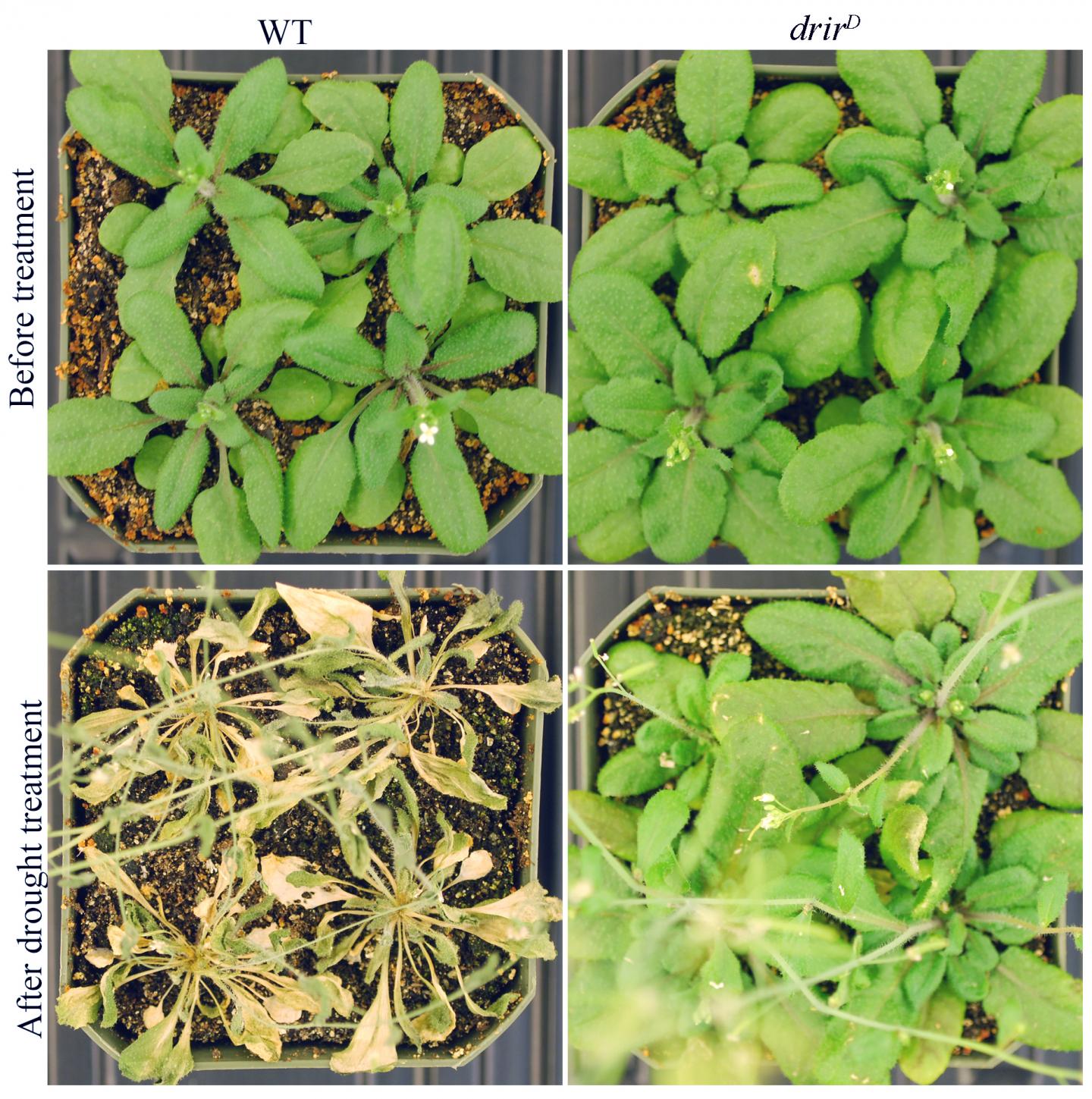
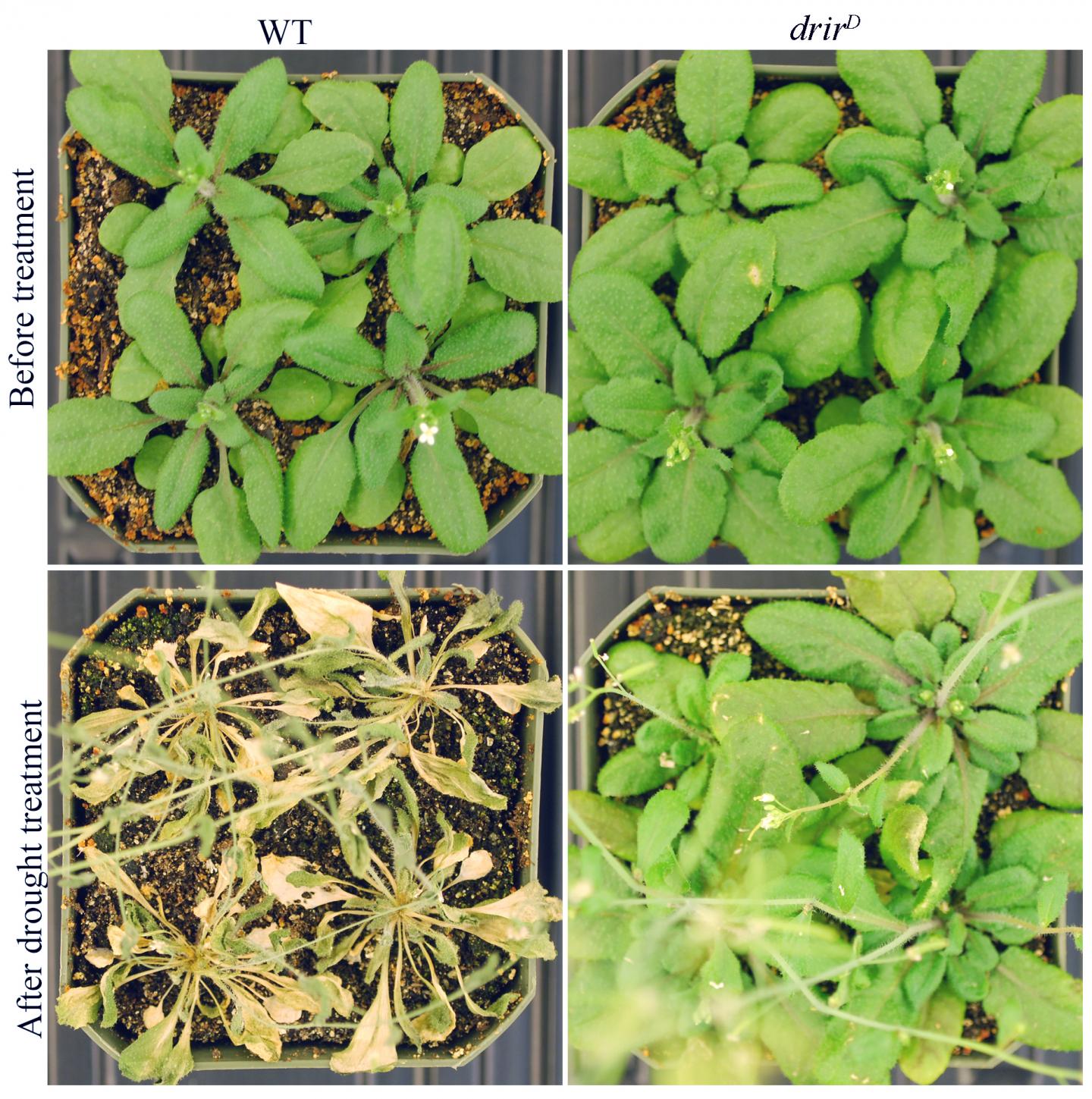
IMAGE

Credit: Texas A&M AgriLife Research

DALLAS — Texas A&M AgriLife Research scientists have discovered a ribonucleic acid, or RNA, that can increase the thale cress plant's resistance to stress from drought and salt.

The discovery could help illuminate a new pathway to engineering drought- and salt-tolerant plants, including food crops, said Dr. Liming Xiong, AgriLife Research associate professor, Dallas.

The research is published in the journal Plant Physiology and online at http://bit.ly/2ydul4D.

"This is the first finding of a long non-coding RNA, or lncRNA, that regulates plant tolerance to adverse, non-physiological external factors," Xiong said.

The lncRNA his team discovered in thale cress plants existed in low numbers under non-stress conditions, but levels increased when the plants encountered drought or salt stress, he said. Manually increasing the level of the lncRNA showed corresponding increases in drought and salt tolerance compared with plants where the lncRNA level was unaltered.

Most RNA direct or "code" cell machinery to produce proteins. Non-coding RNA, or ncRNA, does not direct protein production but could affect how gene expressions manifest in innumerable other ways. As such, they are considered regulators of important biological processes, Xiong said.

"And there are different types of ncRNA," he said. "Small ncRNA have received much attention in recent years, but in many long, or lncRNA, like the one we found to affect drought and salt tolerance in thale cress, the biological functions remain unknown."

The basic difference between small and long non-coding RNA is the number of nucleotides — the structural building blocks of RNA. Long have more.

Xiong said investigating the effects of lncRNA is a novel approach to plant drought and salt tolerance research.

"Most of the current work on improving plant stress tolerance does not focus on lncRNA but on the genes that code protein production," he said. "However, manipulation of those protein-encoding genes often impairs plant growth and development."

But the lncRNA studied by Xiong's team can be tweaked without any apparent detriment to the plant's health, he said.

"It's early still, but we could be on the brink of a whole new approach to engineering drought and salt tolerance in plants, including food plants," Xiong said. "Our next step will be to engineer the lncRNA levels in plants other than thale cress and to test whether it might improve drought and salt tolerance across a broader spectrum."

###

Media Contact

Gabe Saldana
[email protected]
956-408-5040
@texasagwriter

http://today.agrilife.org

Original Source

https://today.agrilife.org/2017/09/16/rna-discovery-help-boost-plant-heat-drought-tolerance/ http://dx.doi.org/10.1104/pp.17.00574


Share12Tweet8Share2ShareShareShare2

Related Posts

Engineered E. coli swarms record chemical and light inputs in visible patterns

Engineered E. coli swarms record chemical and light inputs in visible patterns

September 13, 2026
Hidden RNA Circles Help Rice Survive Heat and Drought Together

Hidden RNA Circles Help Rice Survive Heat and Drought Together

September 13, 2026

Not All TCBS Agar Is Equal: Study Reveals Hidden Variability in Cholera and Vibrio Detection

September 13, 2026

Natural Killer Cell Education Leaves Lasting Imprints on the Persistent HIV Reservoir

September 13, 2026
Please login to join discussion

POPULAR NEWS

  • Therapeutic Family Camps Bring Healing and Hope to Aboriginal Children in Remote Australia

    29 shares
    Share 12 Tweet 7
  • AI Assistant That Reads Your Voice Makes Virtual Lab Work Feel More Human

    29 shares
    Share 12 Tweet 7
  • Your Jawbone Could Reveal Your Sex With Over 90 Percent Accuracy, New Study Shows

    29 shares
    Share 12 Tweet 7
  • Carbon Fibers and Graphite Particles Supercharge Dissolving Magnesium Composites

    29 shares
    Share 12 Tweet 7

About

We bring you the latest biotechnology news from best research centers and universities around the world. Check our website.

Follow us

Recent News

Therapeutic Family Camps Bring Healing and Hope to Aboriginal Children in Remote Australia

AI Assistant That Reads Your Voice Makes Virtual Lab Work Feel More Human

Your Jawbone Could Reveal Your Sex With Over 90 Percent Accuracy, New Study Shows

Subscribe to Blog via Email

Enter your email address to subscribe to this blog and receive notifications of new posts by email.

Join 85 other subscribers
  • Contact Us

Bioengineer.org © Copyright 2023 All Rights Reserved.

Welcome Back!

Login to your account below

Forgotten Password?

Retrieve your password

Please enter your username or email address to reset your password.

Log In
No Result
View All Result
  • Homepages
    • Home Page 1
    • Home Page 2
  • News
  • National
  • Business
  • Health
  • Lifestyle
  • Science

Bioengineer.org © Copyright 2023 All Rights Reserved.
