• HOME
  • NEWS
  • EXPLORE
    • CAREER
      • Companies
      • Jobs
    • EVENTS
    • iGEM
      • News
      • Team
    • PHOTOS
    • VIDEO
    • WIKI
  • BLOG
  • COMMUNITY
    • FACEBOOK
    • INSTAGRAM
    • TWITTER
Monday, June 29, 2026
BIOENGINEER.ORG
No Result
View All Result
  • Login
  • HOME
  • NEWS
  • EXPLORE
    • CAREER
      • Companies
      • Jobs
        • Lecturer
        • PhD Studentship
        • Postdoc
        • Research Assistant
    • EVENTS
    • iGEM
      • News
      • Team
    • PHOTOS
    • VIDEO
    • WIKI
  • BLOG
  • COMMUNITY
    • FACEBOOK
    • INSTAGRAM
    • TWITTER
  • HOME
  • NEWS
  • EXPLORE
    • CAREER
      • Companies
      • Jobs
        • Lecturer
        • PhD Studentship
        • Postdoc
        • Research Assistant
    • EVENTS
    • iGEM
      • News
      • Team
    • PHOTOS
    • VIDEO
    • WIKI
  • BLOG
  • COMMUNITY
    • FACEBOOK
    • INSTAGRAM
    • TWITTER
No Result
View All Result
Bioengineer.org
No Result
View All Result
Home NEWS Science News

Risk genes in schizophrenia – their importance in choosing appropriate antipsychotic drug

Bioengineer by Bioengineer
February 25, 2021
in Science News
Reading Time: 2 mins read
0
IMAGE
Share on FacebookShare on TwitterShare on LinkedinShare on RedditShare on Telegram

This article by Dr. Felix-Martin Werner and Prof. Rafael Coveñas is published in Current Pharmaceutical Design, 2021
IMAGE

Credit: Dr. Felix-Martin Werner, Dr. Rafael Coveñas

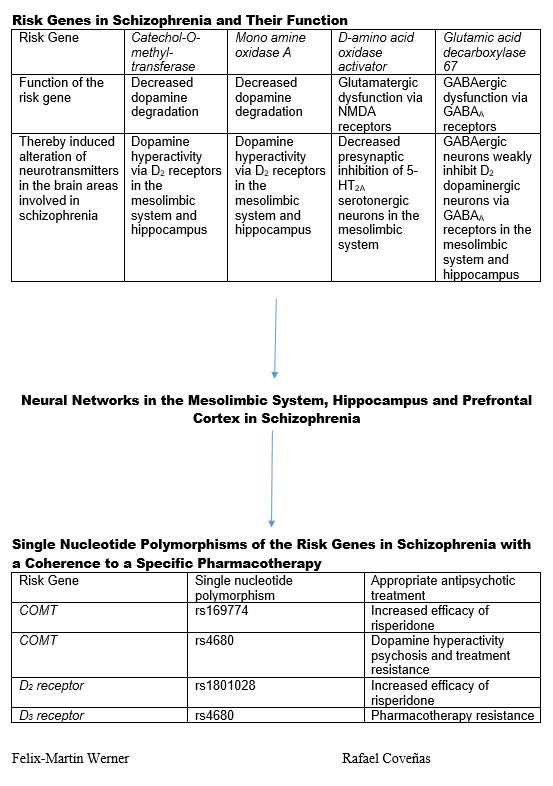
Dr. Felix-Martin Werner, working at the Euro Academy Pößneck in Germany and Prof. Rafael Coveñas, working at the Institute of Neurosciences of Castilla and León, Salamanca in Spain, have been working on neurological and psychiatric disease for over ten years. In their most recent review, published in Current Pharmaceutical Design (Bentham Science Publishers) Werner and Coveñas cover information about the risk genes in schizophrenia and explain the importance of examining their single nucleotide polymorphisms (SNP’s). In schizophrenia, 260 risk genes have been discovered, and an association between single SNPs and the clinical efficacy of a specific antipsychotic drug has been established. Among the risk genes in schizophrenia, the COMT, MAO A/B, GAD 67, DAOA, dysbindin-1 and neuregulin-1 genes are described, and their functions can be represented by an updated neural network model of the ventral tegmental area, hippocampus and prefrontal cortex. The COMT and MAO A/B genes encode a decreased dopamine degradation. As a consequence, dopamine hyperactivity via D2 receptors occurs in the hippocampus and ventral tegemental area. The GAD 67 gene encodes a GABA dysfunction. Consequently, GABAergic neurons weakly inhibit D2 dopaminergic neurons in the hippocampus and ventral tegmental area via GABAA receptors. The DAOA gene encodes a glutamatergic dysfunction. This leads to a weak presynaptic inhibition of 5-HT2A serotonergic neurons in the hippocampus and ventral tegmental area via NMDA receptors. Dysbindin-1 and neuregulin-1 genes encode as well a glutamatergic dysfunction. The most important SNPs, which show an association with a specific pharmacotherapy, are mentioned. The SNP rs169774 of the COMT gene and the SNP rs1801028 of the D2 receptor gene are linked with an increased efficacy of the antipsychotic drug risperidone. The SNP of the COMT and D2 receptor genes are related with a dopamine hyperactivity psychosis and treatment resistance. Patients suffering both hyperactivity and resistance could be treated with the antipsychotic drug clozapine in combination with the novel antipsychotic drug cariprazine. This drug combination improves the PANSS total score in treatment-resistant schizophrenic patients. “By examining in a cohort of schizophrenic patients the SNPs of the risk genes, it will be possible to differentiate patients with a good response to a specific antipsychotic drug from those with treatment resistance,” notes Dr. Werner.

###

For more information please visit: https://www.eurekaselect.com/191424/article

Media Contact
Faizan ul Haq
[email protected]

Related Journal Article

http://dx.doi.org/10.2174/1381612827666210215151333

Tags: BiotechnologyCell BiologyGenesGeneticsMedicine/HealthneurobiologyNeurochemistryPharmaceutical SciencePharmaceutical Sciences
Share13Tweet8Share2ShareShareShare2

Related Posts

Tracking Lanthanide-Labeled Microplastics in Plants

June 25, 2026

POSTECH Researchers Slash Cost of Reconstituted Cell-Free Systems by 95%

June 25, 2026

AI and Physics Collaborate to Design Advanced Hydrogen Storage Materials

June 25, 2026

Natural Hallucinogens: Evolution’s Ecological Tools, Not Mere Chemical Byproducts

June 25, 2026
Please login to join discussion

POPULAR NEWS

  • Saying Goodbye to PGY-6: Pediatric Fellowship Realities

    103 shares
    Share 41 Tweet 26
  • Multi-Hospital Study Reveals Long Covid Burden Is Twice as High as Current Estimates

    92 shares
    Share 36 Tweet 23
  • Detection of EDCs in Breast Milk and Infant Urine Up to Six Months Highlights Early Exposure Risks

    77 shares
    Share 31 Tweet 19
  • New Drug Candidate Developed at McMaster Shows Potential for Treating Brain Cancer

    58 shares
    Share 23 Tweet 15

About

We bring you the latest biotechnology news from best research centers and universities around the world. Check our website.

Follow us

Recent News

Tracking Lanthanide-Labeled Microplastics in Plants

POSTECH Researchers Slash Cost of Reconstituted Cell-Free Systems by 95%

AI and Physics Collaborate to Design Advanced Hydrogen Storage Materials

Subscribe to Blog via Email

Success! An email was just sent to confirm your subscription. Please find the email now and click 'Confirm' to start subscribing.

Join 82 other subscribers
  • Contact Us

Bioengineer.org © Copyright 2023 All Rights Reserved.

Welcome Back!

Login to your account below

Forgotten Password?

Retrieve your password

Please enter your username or email address to reset your password.

Log In
No Result
View All Result
  • Homepages
    • Home Page 1
    • Home Page 2
  • News
  • National
  • Business
  • Health
  • Lifestyle
  • Science

Bioengineer.org © Copyright 2023 All Rights Reserved.