Antibiotic contamination in natural water sources has emerged as a pressing environmental crisis, posing significant risks to both ecosystems and public health worldwide. Conventional water treatment methodologies often fall short of efficiently eliminating persistent antibiotic residues, which frequently enter water bodies through human and animal excretion. These residual contaminants, such as levofloxacin and other widely used antibiotics, resist degradation and can perpetuate antimicrobial resistance, thereby escalating the urgent need for innovative and sustainable remediation technologies.
In a groundbreaking development, a team of researchers led by Dr. Jiafang Xie at the Institute of Urban Environment, Chinese Academy of Sciences, has engineered a novel biochar-based catalyst derived from rice husks — an abundant agricultural byproduct — that demonstrates unprecedented efficacy in the rapid degradation of antibiotics under environmentally benign conditions. Their study, published in Biochar, reveals that the cobalt oxide-loaded biochar catalyst can instantaneously activate peroxymonosulfate to achieve complete breakdown of levofloxacin in merely four minutes at neutral pH, marking a transformative leap in wastewater treatment science.
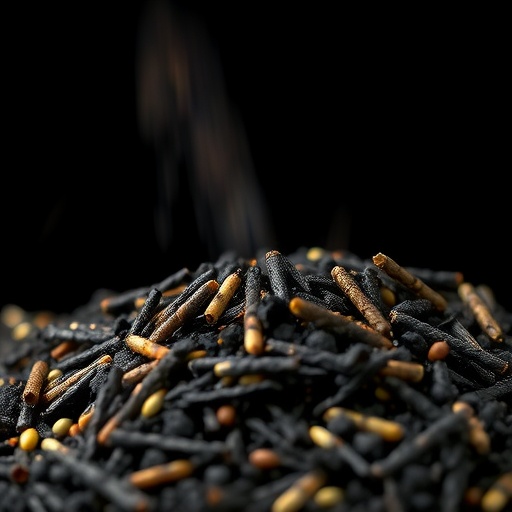
The synthesis of this biochar catalyst, designated as RHBA800@25Co3O4, involved the meticulous preparation of oxygen-rich activated biochar from rice husk biomass followed by the strategic dispersion of cobalt oxide (Co3O4) nanoparticles across its porous matrix. This synergistic structural design produces a highly reactive and accessible catalytic surface, effectively combining the high surface area and functional group abundance of biochar with the potent oxidative capabilities of cobalt oxide nanostructures. This optimization paves the way for superior interaction with peroxymonosulfate, an oxidant known for its potential in advanced oxidation processes.
Performance assessments extended beyond controlled laboratory conditions to real-world aqueous environments, where the catalyst maintained remarkably high degradation efficiencies. Trials conducted in various water samples—ranging from lake and tap water to secondary effluent discharged from municipal sewage treatment plants—confirmed its robust activity and versatility. Furthermore, in a custom-designed fixed-bed reactor, the catalyst demonstrated sustained functionality over 72 consecutive hours, highlighting its stability and practicality for continuous flow water purification systems.
A central scientific breakthrough of this research lies in elucidating the elusive catalytic mechanism underpinning Co3O4-mediated peroxymonosulfate activation, a topic previously clouded in uncertainty. Employing a combination of sophisticated in situ Raman spectroscopy, Fourier-transform infrared spectroscopy (FTIR), X-ray photoelectron spectroscopy (XPS), electron paramagnetic resonance (EPR), and density functional theory (DFT) calculations, the investigators identified lattice oxygen within Co3O4 as a pivotal contributor to the generation of reactive intermediates. Notably, under reaction conditions, lattice oxygen induces formation of a novel surface species, Co3O4−α–OH, which exhibits stronger affinity for peroxymonosulfate molecules and facilitates accelerated electron transfer essential for rapid oxidative reactions.
This discovery not only unravels the crucial role of lattice oxygen chemistry in cobalt oxide catalysts but also resonates with the catalyst’s observed ultrafast kinetics. The biochar support enhances cobalt oxide dispersion and prevents nanoparticle aggregation, optimizing active site availability. Meanwhile, the transformation of lattice oxygen into hydroxylated intermediates intensifies catalytic efficiency by promoting quicker and more effective peroxymonosulfate activation through both radical and non-radical pathways, including the generation of sulfate radicals, hydroxyl radicals, and singlet oxygen species.
Importantly, the degradation process exhibited comprehensive antibiotic elimination with reduced toxicity in the resulting solution. Analytical examination of transformation products revealed that the byproducts formed possess significantly lower antimicrobial activity. Correspondingly, bacteriological tests employing Escherichia coli demonstrated that treated levofloxacin solutions lacked antibacterial inhibition zones compared to untreated samples. This validates the catalyst’s dual role in not only cleaving antibiotic molecules but also mitigating potential ecological hazards associated with harmful metabolites.
The implications of this research extend beyond immediate water purification applications, underscoring a sustainable and circular approach to environmental remediation. By valorizing agricultural residues like rice husk into high-performance catalytic materials, the study exemplifies the integration of waste management with advanced chemical technology. This aligns with global efforts to address pollution while fostering resource efficiency and environmental stewardship through biochar innovation.
Dr. Xie emphasizes that the fusion of agriculture-derived biochar and transitional metal oxides represents a promising frontier in catalysis, where material design and mechanistic insights coalesce to solve practical challenges. The precise identification of Co3O4−α–OH intermediates from lattice oxygen transformation not only advances fundamental knowledge but also guides future catalyst development for broader environmental and industrial applications requiring efficient oxidation chemistry.
Looking ahead, the research team envisions deploying this cobalt oxide biochar catalyst in larger-scale water treatment infrastructures to tackle widespread antibiotic contamination issues. The demonstrated durability and performance in mixed and complex water matrices suggest high feasibility for real-world implementation. This technological innovation paves the way for rapid, cost-effective, and environmentally friendly solutions to safeguard water quality and public health on a global scale.
Ultimately, this study heralds a new era where interdisciplinary research marries the principles of materials science, environmental engineering, and catalysis to combat the persistent pollutant load burdening aquatic systems. The remarkable speed and efficacy of the RHBA800@25Co3O4 catalyst in simultaneously activating peroxymonosulfate and degrading antibiotics redefines potential benchmarks for next-generation water treatment technologies, inviting further exploration and adaptation in the fight against pollution and antimicrobial resistance.
Subject of Research: Experimental study on the development and mechanistic analysis of cobalt oxide-loaded rice husk biochar catalyst for rapid antibiotic degradation in water.
Article Title: In situ observation of Co3O4−α–OH formation on optimized biochar for peroxymonosulfate activation and ultrafast antibiotics degradation
News Publication Date: 16 June 2026
Web References:
Journal Biochar: https://link.springer.com/journal/42773
DOI: http://dx.doi.org/10.1007/s42773-026-00634-8
References:
Zhang, J., Xie, J., Zhu, S. et al. In situ observation of Co3O4−α–OH formation on optimized biochar for peroxymonosulfate activation and ultrafast antibiotics degradation. Biochar 8, 113 (2026). https://doi.org/10.1007/s42773-026-00634-8
Image Credits: Jian Zhang, Jiafang Xie, Shuhui Zhu, Jiacheng E. Yang, Bo Weng & Yuming Zheng
Keywords
Biochar, cobalt oxide, Co3O4−α–OH, antibiotic degradation, peroxymonosulfate activation, wastewater treatment, advanced oxidation processes, levofloxacin, rice husk catalyst, environmental remediation, antimicrobial resistance, catalytic mechanism
Tags: agricultural waste biocharantibiotic pollutant degradationantimicrobial resistance mitigationcobalt oxide nanoparticlesenvironmental pollution cleanuplevofloxacin decompositionneutral pH water treatmentperoxymonosulfate activationrapid antibiotic removalrice husk biochar catalystsustainable water remediationwastewater treatment innovation