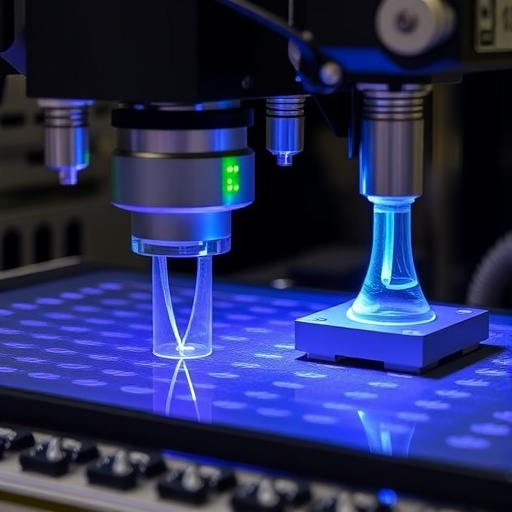
A new study is putting a high-tech “watchdog” inside one of additive manufacturing’s most promising processes. Researchers B.T. Weston, M.E. Zelinski, H.Z. Ammar and colleagues have reported work on scalable on-machine inspection for direct ink write additive manufacturing, a technique that builds objects by depositing functional materials through a nozzle. The research, published in npj Advanced Manufacturing, addresses a problem that could determine whether direct ink writing remains a laboratory tool or becomes a reliable method for producing complex parts at industrial scale.
Direct ink write, commonly abbreviated DIW, works much like a highly sophisticated three-dimensional printer. Instead of melting plastic filament, a printer forces a paste, gel, polymer, ceramic suspension, metal-containing ink or biological material through a small nozzle. As the nozzle moves, it lays down a continuous filament according to a programmed path. Layer by layer, these filaments form the intended structure. The process can create geometries that conventional manufacturing struggles to produce, including lattices, channels, lightweight frameworks and components made from materials that cannot easily be shaped by heat.
That flexibility also creates a demanding quality-control challenge. The deposited material can spread, sag, break, clog the nozzle or fail to bond correctly with the layer beneath it. Small variations in pressure, temperature, ink viscosity, nozzle height or printing speed can change the width and shape of a filament. A defect that appears minor in one layer may accumulate across dozens or hundreds of layers, eventually distorting the entire part. Traditional inspection methods often examine a component after printing, when correcting the underlying process may be impossible and wasted material, time and energy have already been consumed.
The Weston-led study focuses on inspection that happens directly on the machine while printing is underway. This approach can allow manufacturing systems to observe the deposited material as it is formed rather than relying exclusively on a final inspection. In practical terms, an on-machine system may monitor the printed track, compare its actual geometry with the intended toolpath and identify deviations early. The central engineering challenge is to make that monitoring fast, robust and adaptable enough to work across different print sizes, materials, speeds and production environments.
Inspection is particularly important in DIW because the process depends on the behavior of complex fluids. Many printable inks are non-Newtonian: their apparent viscosity changes with the force applied to them. Under pressure, an ink may flow through the nozzle, yet rapidly stiffen after deposition so that it retains its shape. This balance is essential. If the material flows too easily, walls can collapse and features can blur. If it resists flow too strongly, the extruded line may become discontinuous or the nozzle may experience unstable pressure. Real-time observation could help reveal how these material properties translate into visible manufacturing outcomes.
The word “scalable” in the study’s title points to a hurdle that has affected many advanced manufacturing inspection systems. A method that works for one small research specimen may not work for a large component, a faster printer or a production line containing multiple machines. Cameras and sensors must capture useful information without slowing the process, while software must interpret large streams of data quickly. The inspection system also needs to tolerate changes in lighting, surface texture, print orientation and material appearance. A scalable architecture therefore has to be more than a single camera taking snapshots; it must support repeatable measurement across changing conditions.
The research is significant because it connects manufacturing with machine perception. Rather than treating a printer as a device that simply follows instructions, on-machine inspection treats it as a system that can observe its own output. That distinction opens the door to closed-loop manufacturing, in which measurements are used to adjust printing conditions during production. Depending on the type of defect detected, a future system could potentially alter deposition speed, extrusion pressure, nozzle position or toolpath decisions before an error grows. The result would be a process that is not merely automated, but capable of responding to the physical reality it is creating.
Such capabilities could have consequences far beyond conventional prototyping. Direct ink writing is being explored for advanced ceramics, electronic structures, energy devices, soft robotics, biomedical materials and architected components. In these applications, internal geometry and material placement can determine electrical performance, mechanical strength, fluid transport or biological behavior. A hidden discontinuity or misplaced filament may therefore affect more than appearance. Reliable inspection could provide manufacturers with evidence that a printed structure matches its digital design, an essential requirement for industries where performance and traceability matter as much as speed.
The study arrives as additive manufacturing moves toward a new phase in which printing itself is no longer the only technical bottleneck. Producing a shape is increasingly possible; proving that the shape was produced correctly is the harder question. By targeting scalable inspection directly on the machine, Weston, Zelinski, Ammar and their collaborators are addressing the gap between experimental fabrication and dependable manufacturing. The broader message is compelling: the next generation of 3D printers may not simply deposit material layer by layer. They may continuously watch, measure and evaluate every line they create, turning real-time quality control into a core part of the printing process.
Subject of Research: Scalable on-machine inspection for direct ink write additive manufacturing
Article Title: Scalable on-machine inspection of direct ink write additive manufacturing
Article References: Weston, B.T., Zelinski, M.E., Ammar, H.Z. et al. “Scalable on-machine inspection of direct ink write additive manufacturing.” npj Advanced Manufacturing (2026). https://doi.org/10.1038/s44334-026-00107-7
Image Credits: AI Generated
DOI: 10.1038/s44334-026-00107-7
Keywords: direct ink writing, additive manufacturing, on-machine inspection, in-process monitoring, 3D printing, quality control, scalable manufacturing, machine vision
Tags: Additive manufacturing quality controlbiological material 3D printingcomplex part fabricationdirect ink write 3D printingfunctional material depositionhigh-tech manufacturing monitoringindustrial-scale additive manufacturinglayer bonding inspectionmaterial deposition accuracynozzle clog detectionreal-time defect detectionscalable in-process inspection