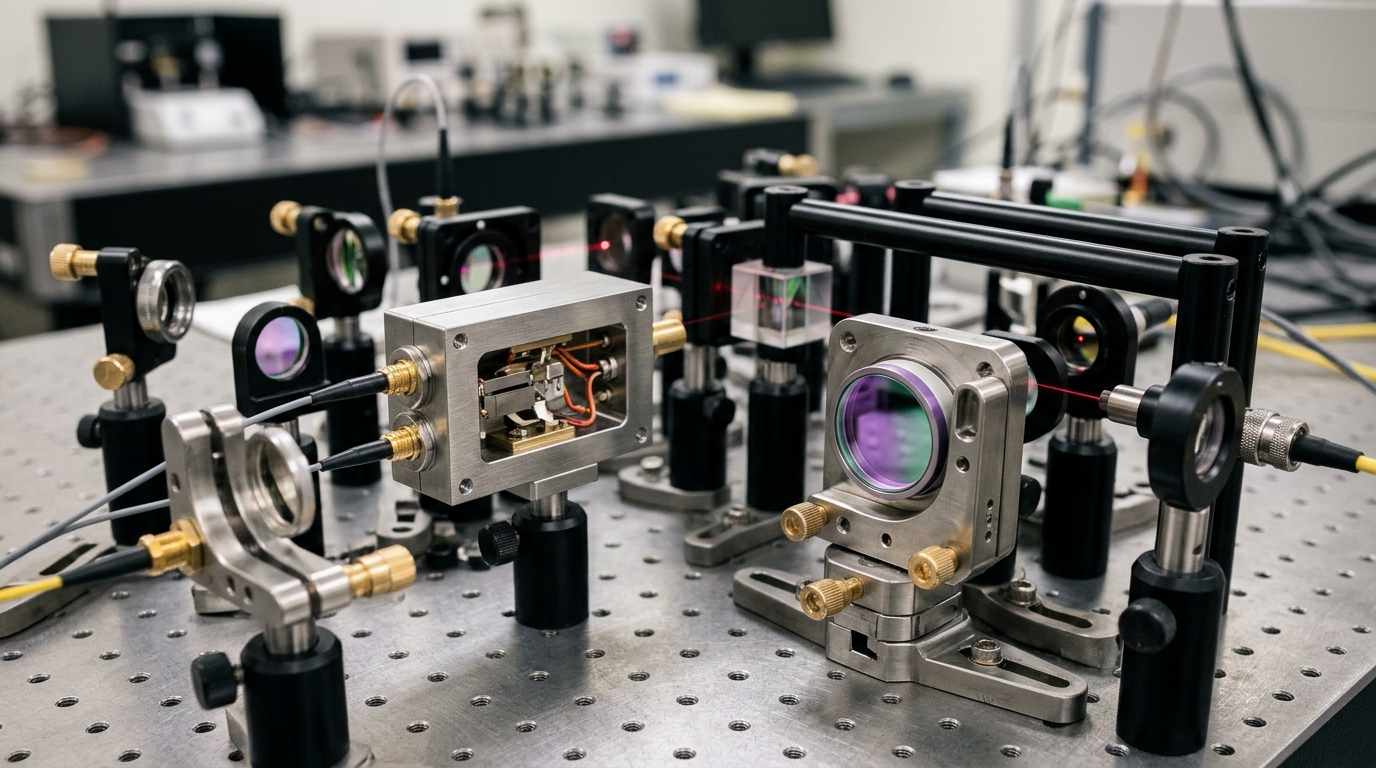
In an experimental study on coherent photonic frequency conversion, researchers have demonstrated that integrating an active semiconductor optical amplifier Mach–Zehnder interferometer with a Pound–Drever–Hall locking loop achieves ultra-narrow linewidth electro-optical mixing up to 78.5 gigahertz. The hybrid-integrated photonic architecture up-converts an intermediate-frequency electrical data signal into the millimeter-wave domain by sampling the signal with an optical pulse clock, simultaneously providing substantial optical output power and high conversion gain. Without active stabilization, semiconductor carrier dynamics and harmonic phase noise yield free-running signal linewidths of 220 to 280 kilohertz under single-arm standard modulation, and 120 to 180 kilohertz under dual-arm differential modulation. By applying closed-loop Pound–Drever–Hall feedback directly to the up-mixed optical carrier via a high-finesse reference cavity, the researchers compressed these spectral widths down to 5 to 10 kilohertz in standard mode and 1 to 3 kilohertz in differential mode. This performance validates active cavity-based servo locking on semiconductor optical amplifier mixers for generating spectrally pure millimeter-wave signals.
Growing demand for high-capacity wireless communication has intensified research into millimeter-wave and terahertz bands to enable advanced cellular networks, satellite communication, and radio-over-fiber infrastructure. Efficient frequency up-conversion within these spectral regions is critical for translating intermediate-frequency signals into radio-frequency carriers without sacrificing spectral purity. While conventional techniques employ electro-optic modulators, electro-absorption modulators, or nonlinear photodetection, semiconductor optical amplifier Mach–Zehnder interferometers provide distinct advantages due to their compact footprint, strong nonlinearities, and high internal optical gain. These structures support efficient mixing through cross-phase modulation and cross-gain modulation driven by a high-frequency sampling clock. Prior investigations into semiconductor optical amplifier mixers characterized conversion gain, optical signal-to-noise ratio, and error vector magnitude, but never addressed active linewidth stabilization. The current work fills this void by introducing closed-loop Pound–Drever–Hall locking to an active mixer output, quantitatively evaluating how drive configuration and feedback jointly suppress phase noise across high-frequency operational bands.
The experimental apparatus uses a hybrid-integrated optical module comprising two planar silica Mach–Zehnder interferometers embedding active semiconductor optical amplifier elements. Operating temperature is stabilized at 25 degrees Celsius via Peltier coolers and thermistors, while thermo-optic phase shifters adjust interferometer phase. The optical sampling signal, emitted by an optical pulse clock at 1550 nanometers, has a repetition rate of 19.5 gigahertz and a 1-picosecond pulse width. An optical attenuator reduces this sampling power to negative 1 dBm before middle-port injection, where it splits equally between both interferometer arms. Concurrently, an optical data signal at 1545 nanometers with negative 10 dBm power is modulated through a Mach–Zehnder modulator driven by a 0.5 gigahertz electrical signal from a radio-frequency generator at 13 dBm power.
The study rigorously examined two distinct modulation architectures: standard modulation and differential modulation. In standard modulation, the intermediate-frequency drive is routed exclusively to the electrode of the first semiconductor amplifier, leaving the second amplifier to propagate the unperturbed sampling signal. Carrier density modulation and optical gain fluctuations occur solely in the first arm before recombining with the second arm. In differential modulation, the intermediate-frequency drive is split equally and applied simultaneously to both semiconductor amplifiers with equal amplitude and zero relative phase difference. Because both arms undergo coherent, in-phase modulation, the up-mixed optical fields combine constructively at the output port, effectively doubling the modulation depth. Furthermore, balanced operation enforces common-mode rejection against symmetrical noise, including thermal drift, pump gain fluctuations, and carrier density perturbations. This common-mode suppression yields consistently lower phase noise, reduced spontaneous emission contributions, and superior mixing efficiency across the entire operational frequency range compared to single-arm standard modulation.
Operating stability was established by setting the interferometer to a destructive-interference null before applying the sampling clock. The first amplifier received a direct bias current of 600 milliamperes. Without optical clock input, phase shifters and the second amplifier’s bias current were jointly tuned around nominal levels to minimize output optical power, maximizing the extinction ratio at 600 milliamperes. Biasing at this transmission null provides intrinsic immunity against environmental phase drift because output transmission varies quadratically rather than linearly near an interference extremum, causing first-order sensitivity to arm-to-arm phase fluctuations to vanish. Small mechanical or thermal perturbations produce only second-order intensity variations, avoiding the need for an active interferometer phase tracking loop. Device dynamics were governed by a linewidth-enhancement factor of 4, internal gains of 38 dB in the first amplifier and 36 dB in the second amplifier, a carrier lifetime of 40 picoseconds, and a stimulated recombination time of 22 picoseconds, producing an effective carrier lifetime of 14.2 picoseconds.
Optical characterization confirmed that the up-conversion system generates elevated output power without requiring secondary optical amplifiers such as erbium-doped fiber devices. Over a continuous one-hour monitoring period, root-mean-square power fluctuations remained below 0.4 percent in standard mode and 0.2 percent in differential mode. Comparing output power against the negative 10 dBm input data signal revealed optical conversion gains of 39.5 dB for standard modulation and 45.5 dB for differential modulation, establishing an approximate 6 dB performance advantage for coherent two-arm recombination. Beam profiling confirmed high spatial beam quality, displaying clean near-Gaussian intensity profiles with circularity values of 94 percent under standard modulation and 98 percent under differential modulation.
Electrical performance was evaluated across four discrete harmonic mixing products generated by nonlinear interactions between the 19.5 gigahertz optical pulse comb and the 0.5 gigahertz intermediate-frequency drive. Optical comb tones beat with intermediate-frequency sidebands on a 300 gigahertz uni-traveling carrier photodiode with 0.85 amperes per watt responsivity, followed by a 33 dB low-noise amplifier and electrical spectrum analyzer. Output frequencies were examined at 20 gigahertz, 39.5 gigahertz, 59 gigahertz, and 78.5 gigahertz, representing harmonic orders one through four. Under standard modulation, electrical conversion gain degraded by 14 dB across this range, while signal-to-noise ratio declined from 70 dB to 45 dB, and spurious-free dynamic range dropped from 62 dBc to 43 dBc. Differential modulation exhibited a more resilient 8 dB gain roll-off, delivering 21 dB gain at 20 gigahertz and 13 dB at 78.5 gigahertz. The differential topology achieved 6 to 11 dBc higher spurious-free dynamic range, 2 to 7 dBm lower noise floors, and up to 14 dB signal-to-noise ratio enhancement at 78.5 gigahertz.
Free-running linewidth characterization of the up-mixed signals utilized an asymmetrical dual-arm interferometer designed to isolate frequency fluctuations without adding external modulation noise. The filtered optical beam entered an interferometer equipped with a reference arm and a delay arm containing up to 100 kilometers of optical fiber, which translated instantaneous frequency fluctuations into intensity variations through phase-sensitive interference before photodetection. Because modulation was already embedded within the mixer architecture, secondary phase modulators were excluded to prevent crosstalk. Measured free-running linewidths broadened monotonically with frequency, increasing from 220 kilohertz at 20 gigahertz to 280 kilohertz at 78.5 gigahertz in standard mode, and from 120 kilohertz to 180 kilohertz in differential mode. This spectral broadening was governed by three physical mechanisms: limited carrier recovery bandwidth and amplitude-to-phase noise conversion driven by Henry’s alpha factor of 4, cross-gain modulation coupling sampling amplitude fluctuations into phase, and harmonic phase-noise scaling proportional to the square of harmonic rank.
To suppress phase noise, researchers implemented a closed-loop Pound–Drever–Hall stabilization loop locking the up-mixed carrier to a high-finesse optical linear cavity. The 1550-nanometer optical beam traversed an optical isolator and an electro-optic phase modulator driven by a radio-frequency synthesizer, imposing phase modulation with an index of approximately 0.5 radians to create symmetric optical sidebands. This beam passed through a polarizing beam splitter and quarter-wave plate before entering a Fabry–Pérot cavity constructed from high-reflectivity dielectric mirrors. Acting as a sharp frequency discriminator, the cavity transmitted resonant carrier components while reflecting non-resonant sidebands and carrier errors. The reflected beam reached a photodiode, was electronically mixed with the radio-frequency local oscillator, and was filtered by a low-pass filter to generate a bipolar error signal reflecting frequency deviations. A proportional-integral-derivative controller converted this error into a real-time correction voltage applied to the second amplifier’s electrical control terminal, continuously locking the optical carrier to cavity resonance.
Active locking compressed the mixed signal linewidth by factors of 28-fold to 120-fold, matching the theoretical suppression ratio determined by electronic servo gain, phase modulation depth, and cavity finesse. Stabilized linewidths narrowed to 5 kilohertz at 20 gigahertz and 10 kilohertz at 78.5 gigahertz in standard mode, and reached 1 kilohertz at 20 gigahertz and 3 kilohertz at 78.5 gigahertz in differential mode. Diminishing compression at higher frequencies stems from servo bandwidth constraints imposed by cavity ringdown time as free-running linewidth broadens, with absolute limits bounded by detection shot noise and thermal cavity fluctuations. The 78.5 gigahertz upper measurement ceiling was imposed entirely by spectrum analyzer bandwidth rather than mixer capability, as prior 19.5 gigahertz sampling demonstrated mixing up to 195.5 gigahertz. Extending direct photodetection beyond 300 gigahertz via optical heterodyning could establish this stabilized mixer as a high-coherence photonic local oscillator for millimeter-wave communications, precision metrology, and high-resolution spectroscopy.
Subject of Research: Linewidth stabilization of high-frequency electro-optical mixing using Pound-Drever-Hall locking in semiconductor optical amplifier Mach-Zehnder interferometers.
Article Title: Ultra-narrow linewidth electro-optical mixing via SOA-MZI using Pound-Drever-Hall locking
Article References: Termos, H. (2026). Ultra-narrow linewidth electro-optical mixing via SOA-MZI using Pound-Drever-Hall locking. Journal of Materials Science: Materials in Energy, 2(1), Article 35. https://doi.org/10.1007/s44308-026-00045-y
Image Credits: AI Generated
DOI: 10.1007/s44308-026-00045-y
Keywords: Semiconductor Optical Amplifier, Mach-Zehnder Interferometer, Pound-Drever-Hall Locking, Electro-Optical Mixing, Frequency Up-Conversion, Optical Pulse Clock, Differential Modulation, Millimeter-Wave Photonics, Phase Noise Suppression, Optical Linear Cavity, Radio-Over-Fiber, Uni-Traveling Carrier Photodiode, Carrier Lifetime Dynamics, Spurious-Free Dynamic Range, Cross-Phase Modulation, Spectral Purity, Optical Conversion Gain, PID Controller
News Source: Denise Maddox. (November 17, 2026). Pound-Drever-Hall Stabilization Yields Kilohertz Linewidth in Electro-Optical Mixer. Scienmag.