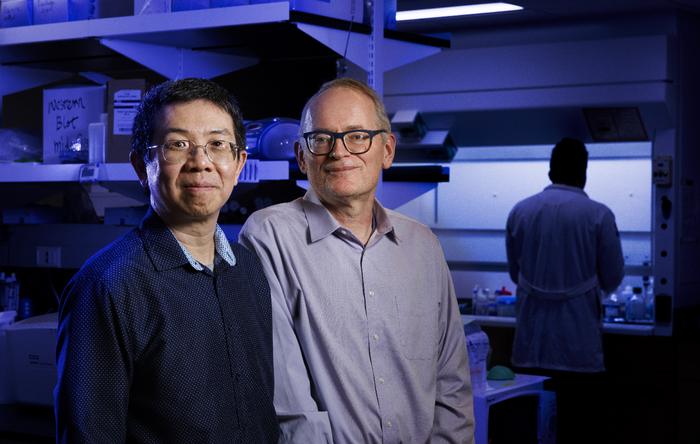

In a groundbreaking development hailing from the University of Nebraska–Lincoln, two prominent researchers have embarked on a transformative journey to redefine therapeutic delivery mechanisms. Jiantao Guo, a distinguished professor of chemistry, and Janos Zempleni, a revered Willa Cather Professor of nutrition and health sciences, have recently unveiled their startup, Minovacca. This innovative enterprise aims to leverage the natural properties of universal milk exosomes—tiny, biodegradable nanoparticles found in milk—to create an advanced system for delivering therapeutics directly to human cells.
Minovacca’s approach rests on the foundation of bioorthogonal chemistry, a field that enables scientists to perform chemical reactions in living systems without interfering with natural biological processes. By engineering milk exosomes to carry specific therapeutic cargo, including gene editing tools and plasmids, the researchers seek to offer target-specific delivery. This pivotal feature promises to enhance existing methods that often suffer from systemic delivery issues, where drugs inadvertently affect healthy cells alongside the targeted ones.
The methodology behind this innovative delivery system is impressive. The researchers utilize advanced genetic engineering and bioorthogonal techniques to modify the exosomes, ensuring they can bind to specific cell types. With the support of NUtech Ventures, the university’s commercialization affiliate, Zempleni and Guo have successfully filed a patent for this cutting-edge technology, underlining the significant commercial potential of their findings.
One of the standout features of Minovacca’s technology is its versatility. This adaptability allows the same platform to be modified to address a myriad of diseases, particularly rare conditions that frequently lack adequate funding and treatment options due to their limited patient populations. Zempleni emphasized that the company’s solution is not confined to just one type of rare disease, highlighting its flexibility in targeting diverse medical challenges.
The transition from laboratory research to commercial application has been a lengthy but rewarding journey for Zempleni and Guo. Their dedicated work over the years has not only validated the safety of using milk exosomes as a transport mechanism but has also established effective genetic protocols to enhance their functionality. With backing from significant funding sources, such as the U.S. Department of Agriculture and the National Institutes of Health, the team has reached a pivotal moment in their mission—the establishment of Minovacca.
Minovacca is poised to revolutionize the landscape of pharmaceutical development, particularly the realm of drug delivery. The company’s founders have located office space at the Nebraska Innovation Campus, reflecting their commitment to fostering connections with local talent, including students from the University of Nebraska. The startup envisions creating a dynamic workforce that will play a critical role in advancing their goal of submitting an Investigational New Drug (IND) Application to the FDA, a significant milestone for any therapeutic endeavor seeking regulatory approval.
The engineering behind their programmable milk exosomes represents a leap forward in specificity and efficacy, enabling the focused delivery of therapeutic agents with unprecedented potency. Zempleni’s initial studies demonstrated the fundamental safety and scalability of milk exosomes, laying the groundwork for Guo to develop a strategic framework targeting exosome distribution based on the specifics of various diseases.
To achieve this targeted cellular delivery, the researchers employ an ingenious design of peptide anchors on the exosome’s membrane. This nuanced strategy incorporates three distinct peptides, each with a unique role: a homing peptide guides the exosome to its intended destination; a “do not eat me” peptide helps the exosome evade destruction by the immune system; and a retrofusion peptide significantly enhances the exosome’s ability to survive once it enters the target cells.
What sets their approach apart is the novel methodology for anchoring these peptides to the exosome membrane. By creating docking sites within the exosome’s membrane protein, CD81, the researchers ensure that the peptide attachments remain stable and don’t detach in the presence of lipophilic compounds—an issue that has hampered previous attempts at exosome engineering. This innovation enhances the uniformity and reliability of exosome production, essential criteria for meeting regulatory scrutiny.
Minovacca’s targeted delivery system addresses one of the most pressing challenges in current drug delivery paradigms: the unintended dissemination of therapeutics across non-targeted cells. Side effects from traditional treatments, such as chemotherapy, often arise because these medications indiscriminately affect rapidly dividing cells, leading to a variety of adverse reactions. By providing a means to ensure that therapeutics reach only their intended targets, Minovacca’s technology holds the promise of minimizing such serious side effects.
In launching Minovacca, Zempleni acknowledges the steep learning curve and growth experienced in navigating the world of entrepreneurship. The name itself reflects a blend of classical influences, drawing from Greek and Roman mythology while fashioning it into a term that symbolizes the benefits of milk—an essential resource for life. This metaphorical connection encapsulates the mission of the startup: to harness nature for the betterment of human health.
Throughout this journey, Zempleni has remained steadfast in his commitment to prioritizing the welfare of others over financial gain. His vision transcends commercial success; it is rooted in an intrinsic desire to advance science in ways that can save lives. His dedication underscores the ethical responsibility that accompanies scientific innovation, reminding us that at the heart of research lies the potential to profoundly impact human health and well-being.
With its innovative foundation, Minovacca represents a promising leap toward reshaping how therapeutics are delivered, potentially heralding a new era in medicine where targeted treatments can minimize side effects and enhance efficacy. As this startup progresses and operationalizes its technology, the duo of Guo and Zempleni stands at the vanguard of a new frontier in pharmaceutical sciences, reminding the world of the inherent potential waiting to be unlocked in everyday substances like milk.
Subject of Research: Milk Exosomes and Drug Delivery Systems
Article Title: Minovacca: Revolutionizing Therapeutics Delivery with Milk Exosomes
News Publication Date: January 16, 2025
Web References:
References:
Image Credits: Craig Chandler | University Communication and Marketing University of Nebraska-Lincoln
Keywords
Health and medicine, Pharmaceuticals, Drug delivery systems, Gene therapy, Biochemistry, Disease intervention, Drug targets