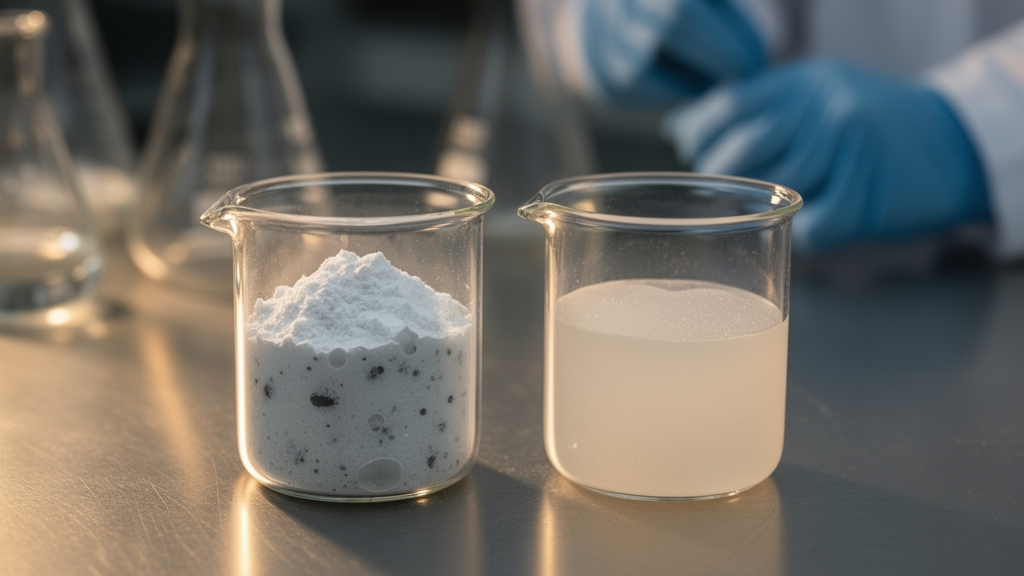
A review of high-purity silica synthesis concludes that ppb-level bulk purity alone does not establish service reliability because local defects, surface and interface contamination, hydroxyl and halogen residues, refractive-index heterogeneity, bubbles, and subsurface damage can still limit performance. The review compares hydrothermal growth, sol–gel processing, and chemical vapor deposition (CVD), treating them as routes with distinct defect histories rather than interchangeable products.
The review’s abstract identifies route-specific constraints. Hydrothermal growth is described as being mainly limited by mineralizer-derived contamination and interfacial impurity trapping. Sol–gel processing is associated with precursor purity, drying-induced cracking, and incomplete densification. For CVD, the central issues are soot-density control, co-management of hydroxyl and halogen species, and fictive-temperature relaxation. These are comparative assessments presented in the abstract, not results from a new experimental study or production trial.
The authors map each defect to the processing stage where it forms, the remaining opportunity for removal or relaxation, and the verification method used to assess residual risk. They also relate these defects to product forms and service conditions, including semiconductor quartzware, fiber preforms, photovoltaic crucibles, and laser optics. On that basis, route selection is evaluated by the defect most likely to cause product rejection rather than by a single measure of purity.
The work is a review, and the available source provides only its abstract, not the full body, figures, or underlying data. Accordingly, the specific evidence behind the comparisons and verification methods cannot be assessed from the supplied material. The abstract nevertheless presents a process-oriented framework for understanding why impurities and local defects enter, evolve, and are removed at different stages across hydrothermal, sol–gel, and CVD routes, and why the limiting defect changes with the intended application.
Subject of Research: A review of defect formation and verification across three high-purity silica synthesis routes
Article Title: Review: defect–process–application mapping for high-purity silica via hydrothermal, sol–gel, and CVD routes
Article References: Guo, F., Fan, J., Liu, Y., Guo, Z., Ma, Q., Yu, X., Lv, G., Jiang, Y., Fang, M., Zai, H., Min, X., Mi, R., Wu, X., Liu, Y., & Huang, Z. (2026). Review: defect–process–application mapping for high-purity silica via hydrothermal, sol–gel, and CVD routes. Journal of Materials Science, 61(42), 32463-32505. https://doi.org/10.1007/s10853-026-13703-x
Image Credits: AI Generated
DOI: 10.1007/s10853-026-13703-x
Keywords: high-purity silica, hydrothermal synthesis, sol–gel processing, chemical vapor deposition, defect engineering, semiconductor materials, fiber optics, photovoltaic manufacturing, laser optics, Review, defect, process
News Source: Denise Maddox. (October 20, 2026). Review maps defect risks across three high-purity silica production routes. Scienmag.