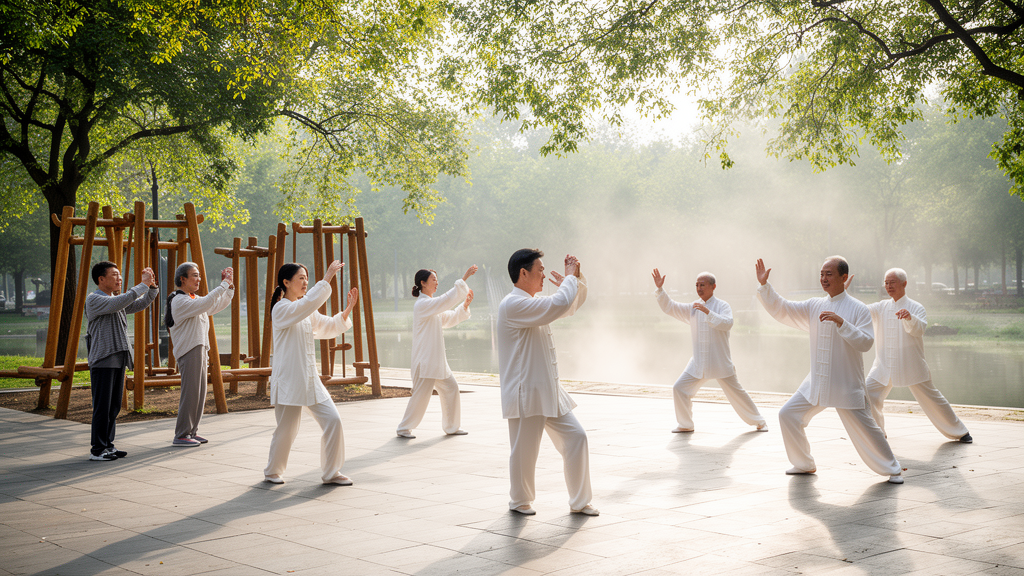
A systematic review and meta-analysis of 11 randomized controlled trials involving 750 college students found that soft Chinese martial arts interventions, including Tai Chi and Baduanjin, were associated with lower depressive symptom scores than control conditions. The pooled standardized mean difference was −0.71, with a 95% confidence interval of −1.23 to −0.18, a moderate-to-large effect by conventional benchmarks. The result suggests that these mind-body practices may have potential as a non-pharmacological intervention for university mental health programs, but it is not conclusive: the authors rated the certainty of the evidence as very low because of substantial heterogeneity, risk of bias and possible publication bias.
The researchers followed Preferred Reporting Items for Systematic Reviews and Meta-Analyses guidelines and registered the protocol with PROSPERO. They searched PubMed/MEDLINE, Embase, Web of Science, Scopus, the Cochrane Central Register of Controlled Trials, PsycINFO and China National Knowledge Infrastructure through July 31, 2025. The search used broad terms related to martial arts, college students and depressive mood, including terms for specific practices such as Tai Chi, Qigong and Baduanjin.
Two reviewers independently screened titles and abstracts, reviewed eligible full texts and extracted data, resolving disagreements through discussion or, when necessary, consultation with a third reviewer. Reference lists were also manually screened for additional records. Eligible studies enrolled undergraduate or postgraduate students aged 18 or older and compared a structured martial arts program with no intervention, usual care, a waiting list, educational activity or another form of exercise.
Randomized controlled trials were required to report quantitative depressive-symptom data using validated self-report questionnaires or clinician-rated scales. Eleven independent datasets met the inclusion criteria: eight came from peer-reviewed journal articles and three were formally reviewed master’s theses retrieved from CNKI. The trials included 375 participants in intervention groups and 375 in control groups.
Because studies used different measures, including the Self-Rating Depression Scale, Beck Depression Inventory and Symptom Checklist-90, the researchers expressed effects as standardized mean differences to combine outcomes across instruments. All included trials evaluated soft Chinese martial arts. Most used Tai Chi, while others examined Baduanjin or related slow-moving forms.
The programs ranged from 8 to 45 weeks, with scheduled frequencies of one to five sessions per week and session lengths of 45 to 90 minutes. No eligible study examined a hard martial art such as karate, taekwondo or mixed martial arts, so the analysis could not compare soft Chinese martial arts with other martial arts styles. They also conducted subgroup analyses by intervention duration, weekly frequency, session length and control type, while noting that these analyses were exploratory.
The main pooled analysis showed substantial heterogeneity, with I² of 82.6%, χ² of 57.56 on 10 degrees of freedom and p below 0.001. In practical terms, the estimated effect varied considerably among the trials, so the average result does not imply that every program produced the same response. Leave-one-out analysis showed that the pooled standardized mean difference ranged from −0.86 to −0.57 when individual studies were excluded, and all estimates remained statistically significant.
Heterogeneity remained high, with I² values from 75.5% to 84.4%. When the three master’s theses were removed, the pooled estimate remained significant at −0.68, with a 95% confidence interval of −1.25 to −0.11, although I² increased to 84.2%. The core result was therefore not driven by one dissertation or by the inclusion of the theses, but the variability among studies remained unresolved.
Exploratory subgroup results suggested possible differences according to program design, but the authors treated them as hypothesis-generating rather than confirmatory. Programs lasting one to eight weeks produced a standardized mean difference of −1.03, and programs lasting nine to 14 weeks produced an estimate of −1.35; both confidence intervals excluded zero, although the latter subgroup had an I² of 79.0%. Programs lasting at least 15 weeks showed no statistically significant pooled effect, with an estimate of −0.13 and a 95% confidence interval of −0.83 to 0.58.
Interventions delivered once or twice per week had an estimate of −1.13, whereas programs delivered three to five times per week had a non-significant estimate of −0.38. Heterogeneity was high in both frequency subgroups, so the apparent differences cannot establish an ideal schedule. Session length followed a similar pattern.
Programs with sessions lasting 20 to 60 minutes yielded a standardized mean difference of −0.69, with a 95% confidence interval of −1.36 to −0.03 and I² of 84.2%. Sessions longer than 60 minutes had an estimate of −0.75, but the 95% confidence interval extended from −1.79 to 0.28 and I² was 85.4%, so that subgroup was not statistically significant. Only one trial used an active comparator involving other physical education activities; the other 10 used passive controls such as no intervention or usual care.
The passive-control subgroup had a pooled estimate of −0.74. With only one active-control study, the review could not determine whether soft Chinese martial arts performed better or worse than comparable exercise or educational activities. The subgroup patterns also do not establish a critical dose or an optimal program design.
Methodological weaknesses limited confidence in the result. Allocation concealment was unclear in 10 of 11 trials, blinding of participants and personnel was unclear or at high risk in eight, and blinding of outcome assessment was unclear in nine. The reviewers therefore judged overall risk of bias as moderate to high.
The studies relied primarily on students’ self-reported symptoms rather than objective physiological or neurobiological indicators. All included studies reported immediate post-intervention outcomes, so the analysis did not establish whether any benefits persisted after the programs ended. Baseline depressive scores differed between intervention and control groups in a minority of trials, but incomplete reporting prevented consistent formal assessment of those imbalances.
Information about instructor qualifications, training environment, interpersonal climate, safeguarding and task progression was also insufficient, leaving possible contextual influences on participants’ experiences unexplored. Publication bias could not be ruled out. Egger’s regression test was not statistically significant, with t equal to −0.89, nine degrees of freedom and p equal to 0.397, but the test had limited power because only 11 studies were available.
The search also did not systematically cover grey literature, trial registries or forward citation tracking, which may have allowed unpublished or ongoing studies to be missed. Under the GRADE framework, certainty in the primary outcome was rated very low because of risk of bias, inconsistency and possible publication bias; no upgrading factors were applied because the subgroup differences were exploratory. The authors concluded that larger randomized trials with active comparators, longer follow-up and more consistent reporting are needed.
Until then, the evidence indicates a promising association with lower depressive symptom scores, rather than proof that Tai Chi or Baduanjin should be treated as established interventions for depression among college students.
Subject of Research: Soft Chinese martial arts and depressive symptoms among college students
Article Title: Effect of soft Chinese martial arts on depressive symptoms among college students: a systematic review and meta-analysis
Article References: Shi, L., Wang, Q., Li, W., & Xie, W. (2026). Effect of soft Chinese martial arts on depressive symptoms among college students: a systematic review and meta-analysis. Frontiers in Psychiatry, 17, Article 1850402. https://doi.org/10.3389/fpsyt.2026.1850402
Image Credits: AI Generated
DOI: 10.3389/fpsyt.2026.1850402
Keywords: soft Chinese martial arts, Tai Chi, Baduanjin, college students, depressive symptoms, randomized controlled trials, meta-analysis, mental health, evidence certainty, Effect, soft, Chinese
News Source: Glenn Wilkins. (October 20, 2026). Meta-analysis links soft Chinese martial arts with fewer depressive symptoms. Scienmag.