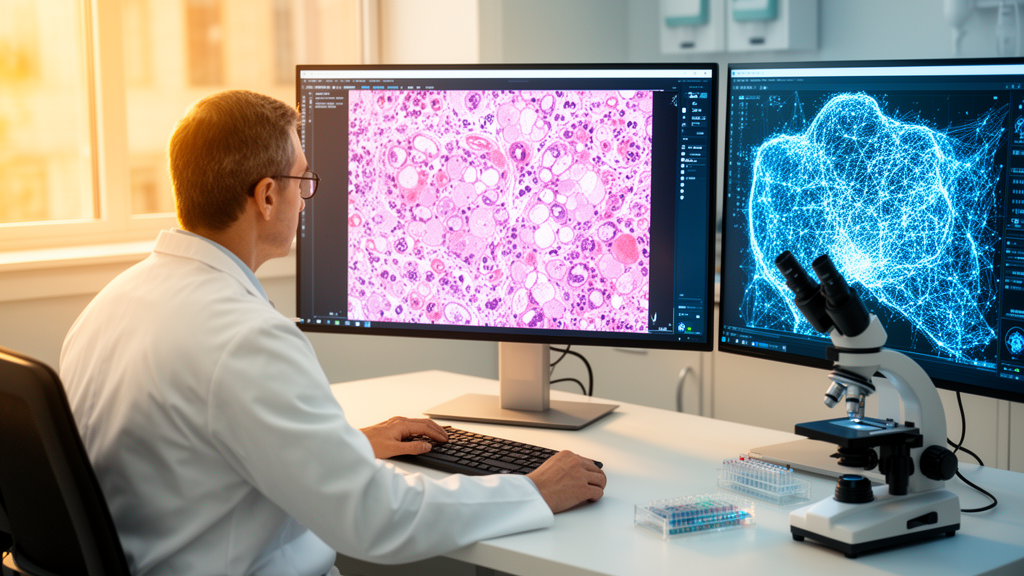
Pathology has long been considered the gold standard for disease diagnosis, but the field is in the middle of a profound transformation. The shift from traditional microscopy to digital pathology, powered by whole-slide imaging, has opened the door for artificial intelligence to reshape diagnostic and prognostic workflows. A new comprehensive review argues that a critical gap persists between the rapid advancement of AI algorithms and the practical demands of clinical practice, where pathologists need tools that are not only accurate but also interpretable, reliable, and seamlessly integrated into their daily work.
The review, led by Prof. Xing-hua Gao of The First Hospital of China Medical University and Prof. Xiao-yu Cui of Northeastern University, was made available online on July 22, 2026 and published in Chinese Medical Journal. It analyzes the field from 2020 to 2025 and introduces a novel framework for systematically connecting cutting-edge deep learning technologies with core clinical tasks in pathology.
“The challenge isn’t just about creating powerful algorithms; it’s about making them clinically relevant and actionable,” explains Prof. Gao. “We introduced a dual-perspective framework that maps specific deep learning architectures—like CNNs, Vision Transformers, and Graph Neural Networks—to essential clinical needs such as diagnostic classification, tissue segmentation, and prognostic prediction. This provides a much-needed roadmap for developing AI solutions that truly address the challenges pathologists face every day.”
That mapping is the review’s central contribution. Rather than cataloguing algorithms in isolation, the authors pair each major architecture with the clinical problem it is best suited to solve. Convolutional neural networks, Vision Transformers, and Graph Neural Networks are each matched against essential needs including diagnostic classification, tissue segmentation, and prognostic prediction, giving researchers a structured route from technical capability to bedside utility.
The review highlights how these advanced AI models are already making an impact. Vision Transformers can achieve over 94% accuracy in classifying oral epithelial dysplasia, while other models can predict cancer patient survival directly from standard H&E-stained slides, reducing the reliance on more expensive and time-consuming genetic tests. The paper also points to the landmark FDA approval of the Paige Prostate AI system as a sign that the digital era of pathology has truly arrived.
A significant hurdle for developing pathology AI is the need for vast amounts of expertly annotated data, which is both time-consuming and costly to produce. The review details emerging trends that tackle this bottleneck, including weakly supervised and self-supervised learning methods that minimize the reliance on costly annotations. These approaches allow AI models to learn from large, unlabeled datasets, accelerating development and deployment.
“Our goal is to foster the development of AI systems that enhance, rather than replace, the invaluable expertise of pathologists,” notes Prof. Cui. “This means focusing on critical challenges like model interpretability, ensuring regulatory approval, and validating performance across multiple medical centers. The future lies in creating integrated, trustworthy, and equitable AI that becomes an indispensable partner in clinical decision-making.”
By providing a systematic overview and a clear algorithm-to-task mapping, the review serves as a vital resource for both researchers developing the next generation of AI tools and clinicians looking to integrate them into practice. The authors conclude with a forward-looking vision for a future where computational pathology tools are seamlessly woven into the fabric of clinical care, ultimately improving diagnostic accuracy and patient outcomes.
The work was supported by the National Key R&D Program of China and the National Natural Science Foundation of China. As digital slides replace glass ones and algorithms mature from laboratory demonstrations toward regulated clinical instruments, the review’s central message is that the technology’s success will depend less on raw computational power than on how well it is aligned with the realities of diagnostic medicine.
Subject of Research: A review of deep learning-based computational pathology technologies and their clinical applications in diagnosis and prognosis.
Article Title: New review illuminates the future of AI in pathology
Article References: New review illuminates the future of AI in pathology. Original publication (Bibliographic details unavailable.)
Image Credits: AI Generated
DOI: Not provided
Keywords: artificial intelligence, pathology, deep learning, digital pathology, whole-slide imaging, Vision Transformers, computational pathology, diagnostic classification, prognostic prediction, self-supervised learning, Chinese Medical Journal, review
News Source: Blake Davidson. (October 29, 2026). Review maps deep learning tools to real clinical tasks in pathology. Scienmag.