Benzobactins are bacterial natural products that have special biological activity due to a compound consisting of two ring structures. The bacterial genes responsible for the formation of the compound were previously unclear. Now, scientists at the Max Planck Institute for Terrestrial Microbiology have been able to decipher its biosynthesis through extensive genomic research. Their research facilitates the discovery of numerous previously unknown natural compounds for medical drug therapy.
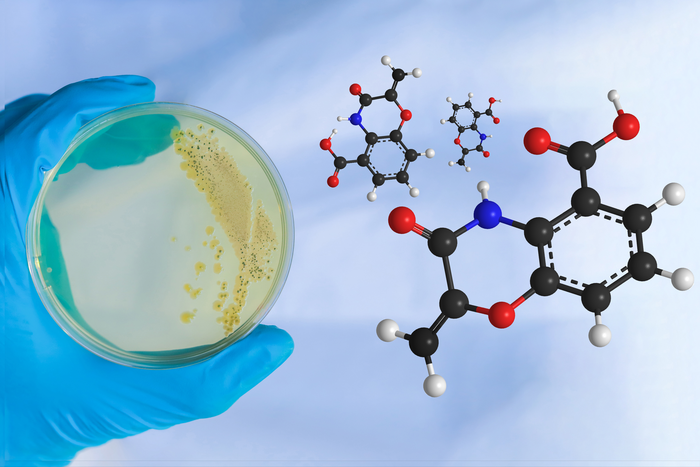
Credit: Max Planck Institute for Terrestrial Microbiology/Crames
Benzobactins are bacterial natural products that have special biological activity due to a compound consisting of two ring structures. The bacterial genes responsible for the formation of the compound were previously unclear. Now, scientists at the Max Planck Institute for Terrestrial Microbiology have been able to decipher its biosynthesis through extensive genomic research. Their research facilitates the discovery of numerous previously unknown natural compounds for medical drug therapy.
In their natural habitat, microorganisms are often exposed to changing environmental conditions that require numerous survival responses. The most efficient one is their capability to produce a wide array of natural products with diverse chemical structures and functions.
Benzobactines – powerful, but rare
Benzoxazolinate is a rare natural compound that confers extraordinary bioactivities on natural products. It is, for example, the essential part of lidamycin, an antitumor antibiotic that is one of the most cytotoxic compounds so far. The reason for this capacity is the fact that benzoxazolinate consists of two rings, a structure that allows it to interact with protein as well as with DNA. However, tracking down the producers of this rare substance in nature resembles the proverbial search for a needle in a haystack.
In order to exploit new pharmaceutically valuable natural compounds, like antibiotics, tumor suppressants or immunosuppressants, it is necessary to know the responsible genes, or more precisely, their biosynthetic gene clusters (BGCs). BGCs are locally clustered groups of two or more genes that together encode the production of a certain set of enzymes – and thus the corresponding natural products produced by these enzymes.
So far, the biosynthetic gene cassette of benzoxazolinate remained elusive, hindering to expand the repertoire of bioactive benzoxazolinate-containing compounds. More specifically, the last formation step of benzoxazolinate was unclear. Now a team of Max-Planck scientists led by Dr. Yi-Ming Shi and Prof. Dr. Helge Bode succeeded in the biosynthetic characterization of the benzoxazolinate pathway. During the biosynthesis, the pathway obviously “borrows” an intermediate from the so-called phenazine pathway, responsible for the production of another natural product. Most importantly, the researchers identified the enzyme that is responsible for the last step, the cyclization towards benzoxazolinate.
Using an enzyme as a probe for natural substances
PhD student Jan Crames, co-first author of the study that was also funded by the LOEWE Centre for Translational Biodiversity Genomics (LOEWE TBG) and the European Research Council, explains: “Knowing the enzyme`s identity, we used it as a probe. With genome-mining we were able to detect many closely related biosynthetic pathways for benzoxazolinate-containing natural products, so-called benzobactins.” According to the scientists, the most striking aspect was the wide distribution of these genes in other bacteria. “These pathways were found in taxonomically and ecologically remarkably diverse bacteria ranging from land to ocean, as well as plant pathogens and biocontrol microbes. Their wide distribution indicates that these molecules have a significant ecological function on the producers,” as Yi-Ming Shi, first author of the study indicates.
Prof. Helge Bode, leader of the department “Natural Products in Organismic Interactions“ at the Max-Planck Institute for Terrestrial Microbiology in Marburg, adds: “Our findings reveal the immense biosynthetic potential of a widespread biosynthetic gene cluster for benzobactin. Now, we have to find out their ecological function and if we can apply them as antibiotics or other drugs.”
Crystallization and structural analysis of a key enzyme was performed in cooperation with Dr. Laura Czech and Prof. Gert Bange from SYNMIKRO, Philipps-University Marburg. Enzyme kinetics was analyzed by Nicole Paczia and the team from our Core Facility for Metabolomics and Small Molecule Mass Spectrometry. Genome sequencing was carried out by Prof. Jörn Kalinowski and the team from Bielefeld University.
Journal
Angewandte Chemie
DOI
10.1002/anie.202206106
Method of Research
Meta-analysis
Subject of Research
Cells
Article Title
Genome Mining Enabled by Biosynthetic Characterization Uncovers a Class of Benzoxazolinate-Containing Natural Products in Diverse Bacteria
Article Publication Date
5-Oct-2022